
When most people think about doing AIP “successfully,” they imagine cooking consistently, making all their meals from scratch, and having the energy to follow their plan every day.
But that version of AIP only works on good days.
In reality, most people don’t struggle with AIP because they don’t care or don’t know what to eat. They struggle because their plan falls apart when energy drops, stress increases, symptoms flare, or life simply gets busy.
In Episode 58 of the Autoimmune Wellness Podcast, I introduce a practical framework designed specifically for real life: the AIP 3-Meal Safety Net. This post expands on that conversation and shows you how building meals for different capacity levels can make AIP more sustainable, flexible, and supportive over time.
.
Listen to the Episode
.
Kitchen Confidence Is About Strategy, Not Skill
When I talk about kitchen confidence, I’m not talking about loving to cook, following complicated recipes, or making elaborate meals every night.
Kitchen confidence means knowing how to feed yourself in a way that supports your body—even when capacity is low.
Living in an autoimmune body means energy, symptoms, appetite, and stress levels fluctuate. Life continues to happen alongside that reality. If your food plan requires motivation, creativity, perfect timing, or a lot of daily decisions, it’s eventually going to break down.
And when it does, people often turn that breakdown inward:
“I should be doing better.”
“I know what to eat—why can’t I just do it?”
The problem isn’t you.
The problem is complexity.
Simple meals reduce decision fatigue, lower stress, and make consistency possible. They’re not a failure of AIP—they’re often the reason AIP works in real life.
.
Why AIP Has to Be Built for Your Worst Days
A good AIP plan isn’t built for your best day.
It’s built for your worst one.
The days when:
- You’re exhausted
- You’re flaring
- Your schedule changes last minute
- Cooking feels overwhelming
If your plan only works when everything goes right, it won’t last.
That’s why I encourage people to stop thinking in terms of “perfect meals” and start thinking in terms of capacity.
.
The AIP 3-Meal Safety Net
The AIP 3-Meal Safety Net is not about eating three meals a day. It’s about having three types of meals available depending on how much energy, time, or support you have on a given day.
You don’t rotate through these in order.
You use the one that fits today.
The key is having all three available at the same time, so you’re prepared no matter what kind of day shows up.
.
Type 1 Meals: Low Capacity (When You’re Exhausted)
These meals are for the days when cooking feels impossible.
On low-capacity days, the goal is not cooking.
The goal is eating something nutrient-dense and supportive without adding stress.
Type 1 meals are:
- No-cook or almost no-cook
- Very few steps
- Very little decision-making
Examples include:
- Leftover protein with avocado, olive oil, and salt
- Tinned fish with vegetables and a fermented food
- Frozen vegetables heated and paired with precooked meat
- Soup pulled from the fridge or freezer and reheated
These meals are not “giving up.”
They’re how you stay fed, keep blood sugar stable, and support your body on hard days.
Eating something simple and supportive is always better than skipping a meal or abandoning your plan because you didn’t have the energy to cook what you thought you should eat.
.
Type 2 Meals: Medium Capacity (When Time or Bandwidth Is Tight)
These are your in-between days. You have some energy, but not enough for elaborate cooking.
Type 2 meals usually involve:
- Light cooking
- One pan or a blender
- About 30 minutes or less
Examples include:
- Baked or roasted fish over a simple salad
- Smoothies with protein and fat included
- Rotisserie chicken sautéed with quick-cooking vegetables
- Reheated leftovers paired with freshly cooked vegetables
- Simple skillet meals with ground meat and vegetables
For most people, these meals make up the majority of their week. They’re flexible, repeatable, and easy to adjust based on what you have on hand.
.
Type 3 Meals: Higher or Supported Capacity (When You Have Energy or Help)
Higher capacity doesn’t always mean you feel amazing. Sometimes it means:
- You have help
- Someone else is cooking
- You’ve planned cooking for a lower-demand day
Help counts as capacity.
Type 3 meals are about cooking once to support future you. This often looks like:
- Sheet-pan meals
- Big pots of soup or stew
- Slow cooker or Instant Pot meals
- Batch-cooked proteins (meatballs, patties, whole chicken)
- Roasted vegetables made in larger quantities
The real power of this category is the freezer.
Extra meals cooked on higher-capacity days become Type 1 or Type 2 meals later.
And sometimes—even when you plan for Type 3—you don’t have it in you. That’s okay. The framework still works because you have other options.
This system isn’t about getting it right every time. It’s about flexibility, honesty, and reducing pressure.
.
Building a System That Lasts
When you step back, the pattern becomes clear:
- Low-capacity meals keep you fed on hard days
- Medium-capacity meals carry most of your week
- Higher-capacity meals support the future you
These are skills, not rules.
As you practice them, kitchen confidence grows—not because you’re doing more, but because you’re doing less with more intention.
.
AIP Foundation Series: Support for Getting Started
If this episode helped you rethink how AIP fits into real life, you may find the AIP Foundation Series helpful as well.
The AIP Foundation Series is a free, beginner-friendly email course designed to help you:
- Understand the structure of AIP
- Learn what to eat in each phase
- Build simple, supportive meals
- Reduce overwhelm and confusion
It includes printable food lists, meal plans, and practical tools to support you whether you’re just getting started or refining your approach.
You can learn more and sign up here:
.
Episode Timeline
00:00 – Kitchen confidence & building AIP for real life
02:17 – Why AIP plans fail on “bad” days
04:51 – Introducing the AIP 3-Meal Safety Net
05:42 – Type 1 meals: low-capacity, no-cook options
09:03 – Type 2 meals: medium capacity, light cooking
12:17 – Type 3 meals: higher or supported capacity
16:08 – Recap & wrap-up
.
Episode Transcript
Below is the full transcript of Episode 58 of the Autoimmune Wellness Podcast.
This transcript is provided for accessibility and reference.
Title: Kitchen Confidence: The AIP 3-Meal Safety Net | Small Bite (Ep 058)
[00:00:00] Introduction: Kitchen Confidence
Mickey: If you’ve ever felt like you’re doing great on AIP, until you’re tired, stressed, flaring, or life throws you a curve ball, this episode is for you. Most people don’t struggle in the Elimination Phase because they don’t care or because they don’t know what to eat. They struggle because their plan only works on the “good” days.
And here’s the reframe I want you to start with. A good AIP plan is not built for your best day. It’s actually built for your worst. It’s built for the days when your energy drops, when your schedule changes last minute, when decision fatigue hits, and when cooking just feels like too much.
Kitchen confidence doesn’t come from being an expert cook. It comes from having options that you know will work when life gets real.
Welcome back to the Autoimmune Wellness Podcast. I’m your host, Mickey Trescott. If you’ve been listening to the recent deep dive and science-focused episodes, you know that we’ve spent a lot of time unpacking the structure of the Autoimmune Protocol, the “why” behind each of the phases, the research that supports it as a whole, and how all of these pieces fit together.
And now we’re going to shift gears a little bit. Alongside the upcoming research-driven conversations, I’m introducing a new series of shorter episodes called Small Bites. These episodes are designed to focus on the practical side of living with AIP. The skills, the strategies, and the mindset shifts that make it easier to apply what you’ve already learned in real life.
Today’s Small Bite is a Kitchen Confidence episode. I want you to know that the skills we’ll talk about today are meant to support you in every phase of AIP. That includes the Transition phase, the Elimination phase, and the Reintroduction phase, and beyond, as you build a way of eating that truly fits your life.
And before we get started, just a quick reminder that this podcast is for informational and educational purposes only and is not intended as medical advice. Please consult your qualified healthcare provider before making any changes to your diet or treatment plan. Alright, let’s get into it.
[00:02:17] Why AIP Has to Be Built for Real Life
Mickey: Today we’re talking about a framework I call the AIP 3-Meal Safety Net. But first I just want to talk a little bit about kitchen confidence and what I mean by that. It doesn’t mean that you love cooking, that you make elaborate meals, you’re an expert chef, or that you follow recipes every night. It means that you know how to feed yourself healthfully in a way that supports your body, even when capacity is low and life gets real.
We already know that having an autoimmune disease is stressful. Symptoms, energy, appetite all fluctuate and we know that life keeps happening. Things like work, kids appointments, emotions. If your food plan requires a high degree of motivation, lots of daily decisions, complex cooking, or needing to feel on top of things or in control, it’s eventually going to break down.
And often that breakdown turns to shame. “I should be doing better”. “I know what to eat. Why can’t I just do it?” But I’m here to tell you that the issue is definitely not you. The issue is that complexity creates more stress and stress is the last thing that somebody who’s already suffering with an autoimmune disease needs.
So I want to start with the message before we get into the framework. Simple is always good. Simple meals are easier to repeat, they require fewer decisions, and they’re what make consistency possible over time. I have worked with so many people over the years who come to AIP thinking that they need to spend hours a day cooking elaborate recipes, buying all kinds of kitchen gadgets, and turning every meal into a project in order to eat healthy, good tasting food, especially during the Elimination phase.
And if you genuinely love cooking, you have the time, the energy, the financial resources to do that, great. That can absolutely be a part of your approach. But if you don’t, and I will say many people don’t, that doesn’t mean that you’re doing AIP wrong.
In fact, sticking with simple is often the most supportive place to start. It might not look like your favorite influencer’s feed breakfast, lunch, and dinner, just looking camera- ready and perfect, but it will keep you fed and nourished and you can always add complexity later if and when it feels good.
But building your foundation on simple, repeatable meals is what helps AIP work in real life. It’s what I did when I originally went through AIP, and it is what I have coached many of my clients to start with.
[00:04:51] The AIP 3-Meal Safety Net
Mickey: The 3-Meal Safety Net is about having options for different capacity levels. So living in an autoimmune body, we have things like fatigue and fluctuating energy levels, which means we don’t always have the predictable ability to cook and feed ourselves like most healthy people.
When I talk about these three meals, I’m not talking about three meals you eat every day, like breakfast, lunch, and dinner. I’m talking about three types of meals that you can lean on depending on how you’re feeling and what kind of support you have that day.
I really believe in order to be prepared for anything as you embark on AIP or as you continue AIP, if you’re already in the elimination phase or in the reintroduction phase, you need all three in the works at the same time. And let me explain what they are.
[00:05:42] Type One: Low Capacity — When You’re Exhausted
Mickey: So first let’s talk about type one. This is for when you have the lowest capacity and you’re just exhausted. And when I talk about low capacity days, I’m talking about when you’re feeling tired, you’re in a flare, you’re overstimulated, or you’re just completely done. These are the days when cooking feels impossible, and that’s exactly when having a plan matters the most.
On these days, cooking is not the goal. Eating a nutrient-dense AIP meal is the goal. So these type one meals are no cook or almost no cook. Very few steps, very little thinking.
And let me be really concrete about what this can actually look like. It might be a leftover protein, think some roasted chicken, some ground meat, or a piece of salmon eaten, cold or reheated, paired with half an avocado, a drizzle of olive oil, and a good pinch of salt. That’s it. No recipe, no sides. That is a complete supportive meal. And uh, one that I have had many times.
It might be a can or a tin of fish, maybe sardines, salmon, tuna, opened straight from the can with some olive oil, whatever vegetable you have around, maybe a sliced cucumber, a handful of greens, some leftover roast vegetables or even frozen vegetables that you quickly steam in the microwave. A scoop of fermented cabbage or carrots. Again, really simple. You are just scooping things onto a plate and eating them.
It could be frozen vegetables combined with precooked meat. This is one that I use a lot. A bag of frozen broccoli or green beans, if we’re talking Modified AIP, heated up with leftover meat or a store-bought precooked protein, like a rotisserie chicken. Add salt. Add fat, you’re done.
Sometimes it’s just a soup. Soup pulled straight from the fridge or freezer, reheated and eaten exactly as is. I put out a little poll on Instagram asking you guys what your favorite type one meal is, and many of you said reheated soup was your go-to on days like this. I totally agree, and this is also my personal favorite type one meal. A big reason why when I’m going through periods of feeling good, I like to build my “soup bank” library in the freezer.
And actually the breakfast that I eat every day is a type one meal. Once a week I combine quick oats, pea protein, flax, hemp, a little coconut sugar, and walnuts, dry in jars. In the morning. I just add hot water and some fruit. While my recipe contains some reintroductions, if you are on Modified AIP, you can actually precook a buckwheat protein porridge on a good morning, takes about 15 minutes, jar it and have it in the refrigerator for the next four days of no cook breakfast. And if you’re looking for a recipe, I’ve actually got one coming up in my new cookbook.
None of these meals are fancy, none of them are complicated and none of them mean that you are giving up or doing AIP halfway. These meals are how you stay fed on hard days. They’re how you keep your blood sugar stable. They’re how you support your body without adding more stress when your capacity is already low and you’re not feeling great.
And the important thing to remember is eating something simple and supportive is always better than skipping a meal or going off your plan because you don’t have the energy to cook what you think you “should” be eating.
[00:09:03] Type Two: Medium Capacity — When Time or Bandwidth Is Tight
Mickey: Next, let’s talk about type two, and this is for those in-between days. You’ve got some energy, but not a lot. You can cook, but you don’t want an elaborate recipe. You don’t want to make a mess, and you definitely don’t want to spend hours in the kitchen.
This is where light cooking lives, usually 30 minutes or less, often with just one pan and very minimal cleanup. And for me, this category includes a lot of meals that are simple, flexible, and easy to repeat. One of my go-tos is that tinned fish or a quick piece of roasted fish like salmon, something that takes about 15 minutes to cook in the oven, served over a big salad.
The salad can be as simple as greens, olive oil, salt, and maybe a vegetable or two. Nothing fancy. It’s filling, nutrient-dense and doesn’t leave me with a pile of dishes. Smoothies also fit really well here and throwing ingredients into a blender can feel like cooking on days where standing at the stove and chopping is not appealing, but you still want something nourishing.
Add some AIP compliant protein, add a fat like coconut yogurt or sunflower butter, add some fruits and perhaps some greens, and you’re done. And I will say that smoothies have had a little bit of a controversial history in the AIP movement, but I think as long as you’re adding some protein and some fat, they absolutely can be a good meal.
Another favorite is rotisserie chicken, sauteed with quick cooking vegetables. Things like zucchini, mushroom, spinach, they just take a few minutes to cook, right? The chicken is already cooked, so you’re really just warming it up and cooking the vegetables all in one skillet. That’s a complete meal and under 20 minutes.
Sometimes it looks like thawing or reheating leftover meat. So we’re talking patties, meatballs, or ground meat, and then fresh cooking a vegetable alongside it. Maybe it’s winter squash roasted in the oven while you do something else, or a quick saute of spinach or greens in a pan. Very straightforward.
Skillet meals with ground meat are another great option here. Ground meat, cook it up and then remove it from the pan, add some vegetables, salt, fat, and then cook it all together at the end. You really don’t need a recipe. Very easy to customize based on what you have in hand, what’s in season, rotate some flavors.
And you’ll notice a pattern here. Type two meals often look like reheating something, plus cooking something fresh, or doing some very simple cooking from start to finish. There’s a little chopping, some stirring, maybe a pan or a blender, but that’s about it. And when I polled you guys on my Instagram channel, I got a lot of great responses for this meal.
Many votes for soup, frozen meat patties, baked fish, quick roasted skillet or steamed vegetables like sweet potatoes, zucchini, spinach, squash, and cabbage, tinned fish, all amazing ideas.
This category is incredibly important because it’s what carries most people through their week. And in fact, these days long past my stint on AIP Elimination, but still trying to fuel my body well, about one or two of my meals every day comes from this category, usually my breakfast or my lunch.
[00:12:17] Type Three: Higher or Supported Capacity — When You Have Energy or Help
Mickey: Now let’s move on to type three meals. These are for your higher capacity moments, but I want to be really clear about what that actually means. Higher capacity doesn’t always mean you feel great. Sometimes it can mean that somebody else is cooking, that you have support or help, and sometimes it just means that you have a little extra bandwidth that day.
And I want to say that help counts as capacity. Meal three isn’t about productivity. It’s not about meal prep culture, and it’s not about trying to be impressive or overdo it, but it’s about cooking once with intention and caring for that future you. And for a lot of people, including me, this kind of cooking works best when it’s planned for days with fewer commitments.
Now, when I was deep in my original AIP journey, I was working part-time, I was still very, fatigued from my Hashimoto’s, and I quickly realized that certain workdays just completely wiped me out. I would get off of work, come home, and there was no version of those days where I was going to cook a big meal, no matter how good my intentions were.
So I learned to plan this type of cooking for my days off, days when I had more energy to spend on cooking, more time, and a little more flexibility. That alone made a huge difference because I stopped setting myself up to fail.
And early on I also had to acknowledge something else. Because I was so ill I was not capable of doing this all on my own. And I have to note that my partner, Noah, stepped in and supported me and together we created a system that worked. We set aside time to prep, cook, and clean together. Sometimes I would cook and he would clean. Sometimes he would help me with the prep. And today that support still shows up just in a different form.
And I remember in those early days feeling awkward asking for help and thinking that because it was my protocol, I needed to do all of that cooking. And I would encourage any of you who might have a friend or a family member or someone who can help you, just ask for the help for this type three meal, especially in the very beginning when you’re at your lowest and you’re really not feeling well, it can help a lot.
Type three meal cooking often looks like sheet pan meals made in larger quantities, big pots of soup or stew, slow cooker or instant pot meals. Batch-cooked proteins like meatballs, patties, or whole chicken, roasted vegetables made in larger quantities. One of the biggest benefits of meal three is being able to bank food in the freezer. So those extra meatballs, patties, or broth can later become those type one meals on low capacity days or components of type two meals when you can do a little bit more.
So that freezer buffer is incredibly powerful and it turns those higher capacity days into support across multiple lower capacity days. And I also want to say this. Sometimes meal three is aspirational, and even now there are days when I’ve scheduled times to cook and when that time comes, I just don’t have it in me.
So I fall back on type one meals. I’m opening my freezer, grabbing a couple jars of AIP chili and thawing them for dinner. And the meat that I had planned on cooking goes into the freezer uncooked, or the vegetables get used up in a different or simpler way. And it definitely happens to me still, and I don’t force it. I try again on another day.
Because this framework isn’t about getting it right every time, it’s about having options, being flexible and responding to your day-to-day capacity honestly. This is how one good or supported day can carry you through several harder ones without the pressure, the guilt, or burning yourself out.
[00:16:08] Recap & Wrap-Up
Mickey: So let’s recap. AIP needs to be built for your real life, it needs to be built for your worst days, and given that, simple is always good. The AIP 3-Meal Safety Net gives you low capacity meals that you can just assemble on your worst or your flare days. Medium capacity meals with light cooking for most of your days, and higher or supported capacity meals that help the future you and feed into the material that makes those low capacity and medium capacity meals work.
These are skills, not rules, and I promise as you implement it, it will get easier. And I hope that I’ve given you guys tons of ideas to start building out your list of meals that you’re going to make when you’re are faced with these different capacity days.
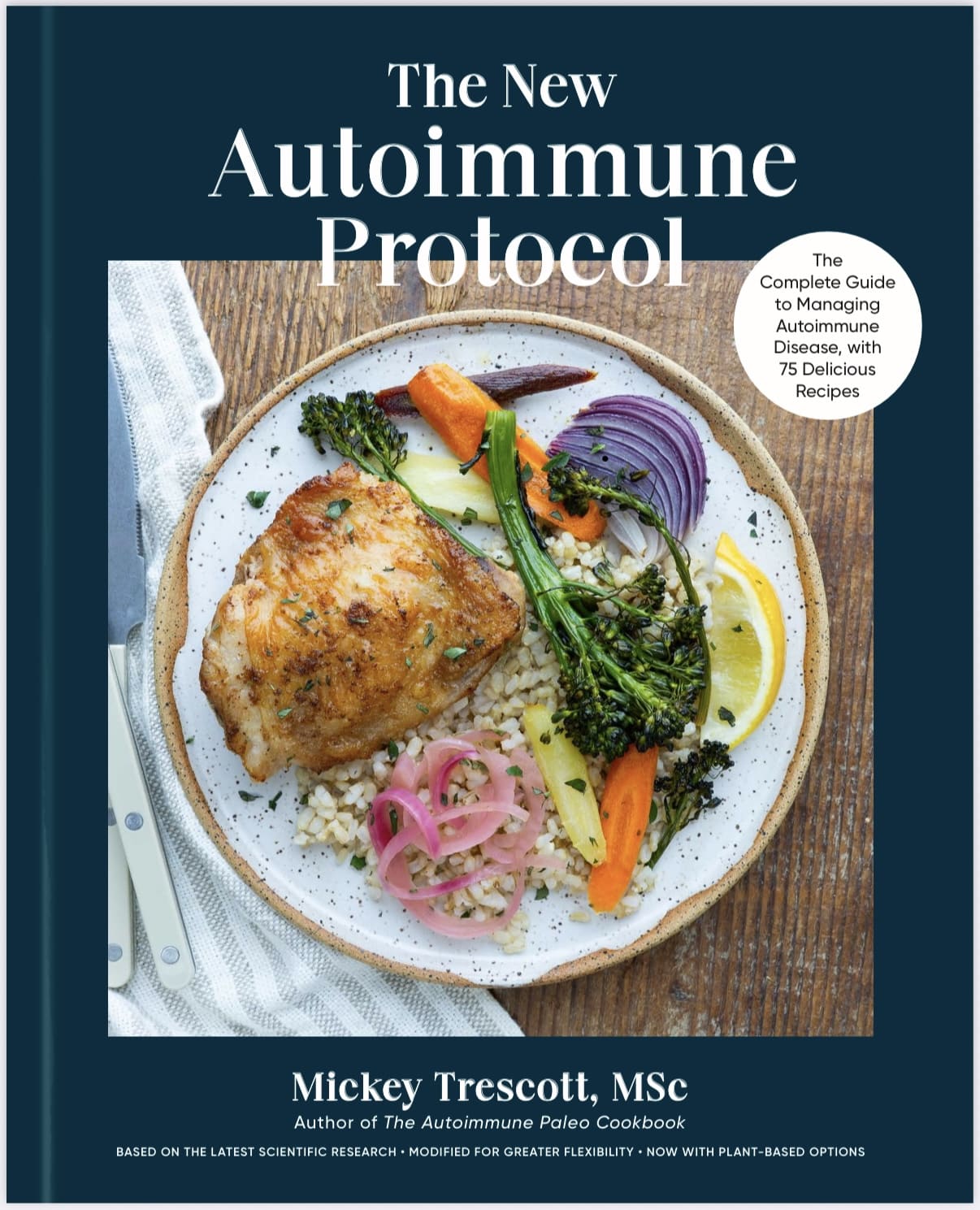
If these tips feel supportive, you’ll find a lot more of it in my upcoming book, the New Autoimmune Protocol, which is available for pre-order now. I recently announced the book and shared the cover on social media, and it has been really meaningful to finally share this next evolution of AIP with all of you.
The book brings together the updated research, but just as importantly, it focuses on how to actually apply that research in real life. So inside you’re going to find practical tools, recipes, and meal plans designed around real life capacity, not perfection.
The same themes we’ve been talking about here, nourishment over restriction, strategy over willpower, and building an approach that is sustainable long-term. And I also want to share that pre-orders are incredibly important for authors. They play a huge role in the success of a book launch and help make sure this work reaches the people who need it most.
So if this podcast or the way we’re talking about AIP here has been helpful to you, pre-ordering the book is one of the most impactful ways that you can support the work that I do.
Thank you so much for joining me, and I will see you in the next episode.
.





0 comments