
When you start the Autoimmune Protocol, it’s easy to focus on the details—what to eat, what to remove, and how to do it “right.” But there’s a deeper question that often gets overlooked: what are you actually working toward?
Without that clarity, it’s easy to feel stuck or disconnected from the process.
In this episode of the Autoimmune Wellness Podcast, I’m joined by Jaime Hartman, National Board Certified Health & Wellness Coach and co-teacher of the AIP Certified Coach Program, to explore how developing a personal health vision can bring more direction, motivation, and sustainability to your healing journey.
.
Watch the Episode
.
Why a Personal Health Vision Matters
A personal health vision goes beyond short-term goals. It’s about defining what health means to you—and what feeling better allows you to do in your life.
This clarity can help you:
- Stay grounded when AIP feels challenging
- Make decisions about priorities and trade-offs
- Communicate your needs to others
- Move forward with more intention
.
Rethinking What “Health” Means
Jaime introduces three ways to think about health:
- Medical — focused on symptoms and disease
- Holistic — including mental, emotional, and physical health
- Wellness — focused on resilience and adapting over time
For those with autoimmune disease, this broader view can help create a more realistic and supportive path forward.
.
Putting Your Vision Into Practice
Your personal health vision becomes a guide for real-life decisions—whether that’s how you approach reintroductions, manage your time and energy, or choose the type of support you need.
There’s no one “right” way to do AIP. What matters is aligning your approach with your life and your values.
.
How to Get Started
If you’re not sure where to begin, start with a few simple questions:
- What does health look like for me?
- What would I do if I felt better?
- What matters most in my life right now?
Even small reflections like these can help you move from focusing on restrictions to focusing on what you’re building.
.
Resources
Jaime Hartman
- Instagram: https://www.instagram.com/jaimehartman22/
- Website: https://gutsybynature.com
- AIP Summit: https://aipsummit.com
AIP Certified Coach Program & Practitioner Directory: https://aipcertified.com
.
Prefer to Listen Instead?
.
Episode Timeline
00:00 – Why AIP needs a bigger “why”
01:57 – Introducing Jaime Hartman
03:10 – What a personal health vision is
05:57 – Models of health: medical, holistic, wellness
09:45 – Why vision matters
12:09 – Using your vision in real life
17:11 – Journaling prompts
22:59 – Getting started when you feel stuck
25:00 – Wrap-up
.
Transcript
Below is the full transcript of Episode 85 of the Autoimmune Wellness Podcast. This transcript is provided for accessibility and reference.
Title: Developing Your Personal Health Vision with Jaime Hartman (Ep 085)
Mickey: Something I see all the time with AIP is people getting really focused on the details, like what to eat, what not to eat, or how to do it right. But sometimes there’s a bigger question that doesn’t get asked, which is, what are you actually trying to get back to?
Or maybe even, what are you trying to build with this experience? Because if you don’t have a vision or some clarity, it’s really easy to feel stuck in the process or like you’re just going through the motions.
Mickey: Welcome back to the Autoimmune Wellness Podcast. I’m your host, Mickey Trescott, and today we’re talking about something that I think is really foundational, especially if you are in those very early stages of AIP, which is developing your personal health vision.
And before we get started, just a quick reminder that this podcast is for informational and educational purposes only, and not intended as medical advice.
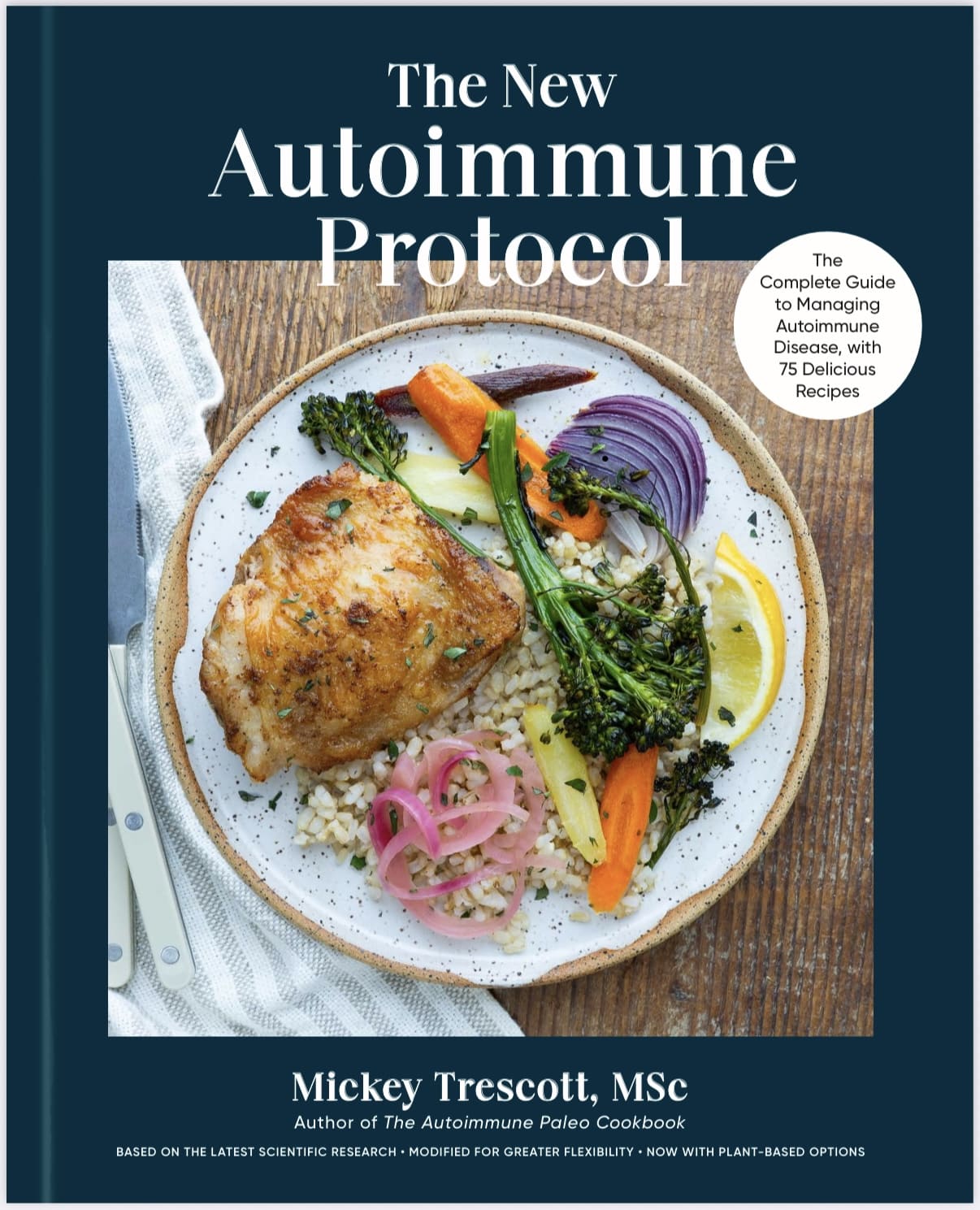
Now, developing your personal health vision is actually something we’re working on right now inside the New Autoimmune Protocol community. So if you pre-ordered the book and you’re going through the transition phase with us, this is a part of what we are focusing on right now in our second week.
So not just what’s changing with the food and the diet, but taking a step back and getting clear on what health actually looks like for you. And today’s guest, Jamie Hartman, is my partner and co-teacher in the AIP Certified Coach program. She’s the one who originally introduced me to this idea of a personal health vision in the first place.
It’s something that she has been using for a very long time in her coaching work, and it’s really shaped how we help people move through AIP in a way that actually feels personal and sustainable. So it felt really natural to bring her in for this conversation today. Before we dive in, I’m going to share a little bit more about Jamie and her background.
[00:01:57] Introducing Jaime Hartman, MEd., NBC-HWC
Mickey: Jamie Hartman is a national Board certified health and wellness coach trained through Duke Health, and she also has a Master’s degree in educational psychology from the University of Wisconsin. She brings over 25 years of experience in education and instructional design to her work.
She originally found the Autoimmune Protocol as a way to manage her own post-surgical Crohn’s disease, and back in 2013, in the way back of AIP, she started a blog called Gutsy by Nature to document her journey and stay motivated. Through that work, she connected with Sarah, Angie, and me, which eventually led her to make a full career shift. She was a part of that very first cohort of AIP Certified Coach practitioners in 2017, and became my partner and co-teacher in 2023.
She’s also the organizer and host of the AIP Summit Series, and in her private coaching practice, she helps clients identify and prioritize the changes that will actually move them forward in their personal health vision. So Jamie, I know that you are not new to a lot of our listeners, thank you so much for being here today and talking about this with us.
Jaime: It’s my pleasure. Thank you for having me.
[00:03:10] What A Health Vision Is (And How it Compares with Goal Setting)
Mickey: So let’s just jump right in and talk about what a personal health vision actually is and how it’s different from a health goal, which I think a lot of us have had at some point.
Jaime: Yeah. Well, there are a lot of ways that it can be different, and there are also some overlaps. But when I just think about a health goal, a health goal could just stand alone. It could be something that’s just, you know, one and done. Like maybe I have some kind of an injury or a setback, and I want to return to function.
That can be a health goal. I want to complete all my physical therapy so I can get back to being able to take care of myself or whatever that might be. Maybe you have a lab value that your doctor set as a goal for you that you’re targeting. So it could be, you know, something we’re shooting for, and you have some things you’re trying to do to get to that point. That could come externally. It could be something that you are doing as part of just improvement, maybe with your family or trying to get to bed earlier.
You know, goals can be kinda… They can be meaningful, but they can also be somewhat scattershot and just, you know, what is it that you’re working on right now without any real idea of why you’re doing it. Whereas a personal health vision something focused on what you see for yourself in the future and where you want to get to, what it is that’s important to you in your life that propels you forward in all of the things that you’re trying to do to improve your overall health.
And it’s personal. That’s also, I think, a key differentiator sometimes for goals. Sometimes goals are personal, but a lot of times goals kinda have some kind of an external impetus to them, whereas a personal health vision is always personal. It’s always about what it is that matters to you and what your wellness will do for you.
Mickey: Love that. Yeah, and I really like that a personal health vision can actually inform a lot of goals, right? Like it’s kind of like a theme that you can apply to a lot of different areas in your life. When I think of my personal health vision, like this morning I had an appointment with my rheumatologist and I was sitting with that before that appointment because it really affects not only what I’m doing every day, but then how I interact with my healthcare providers and making sure that I’m kind of staying true to that.
So I really appreciate that differentiation because I think a lot of us, especially with social media, you see like a health tip and then you’re like, I’m going to make a goal to do X, Y, or Z. But the visioning is really the important piece that I think I learned from you really helps people see through the actions, because it really is like that powerful well of inspiration for the why.
[00:05:57] A Few Different Lenses of Health: Medical, Holistic, and Wellness
Mickey: So one of the things that I love about this concept and what I learned from you is that people can view health through a few different models. So there’s more of like a medical lens. There’s more like a holistic lens or a wellness lens. Can you talk about these different lenses and kind of why that matters and how it relates to a personal health vision?
Jaime: Yeah. And this is really what drives the idea of a personal health vision, is that understanding that there is more than one way to define health. And so when you talk about the different models or the different lenses that you just listed, there is that medical model, which is really mostly what your doctor is looking at, and it is the absence or the reduction of disease and symptoms of disease. So it’s focused on the physical, primarily. Focused on how do we improve functioning in the body, how do we improve quality of life in terms of like, you know, pain control, pain management, ability to engage in activities, but very much focused on the things that a medical system, the medical community can do, and focused primarily on the physical body. That’s the medical lens of health.
Technically, health in that model is the absence of disease. And when we have a chronic disease and we say, “Well, that isn’t something that’s going to ever be a state,” then it becomes about managing that disease. That’s what the health is and managing the impact that it has.
If you are looking at health through a holistic lens though, you’re taking into consideration the fact that physical health, the medical model of health is only one piece. We also have mental health, we also have emotional health, also have spiritual health, and all of those domains can interact with each other, and they can be impacted by you know, problems in one area can spill over to others. Improvements in one area can improve in others, and they all matter. That’s that holistic lens.
As well as the medical model, the holistic lens says that, you know, we have physical, and we have emotional, and we have things that you can’t even pin down, areas and ways that we can measure and impact our health.
Then third, there’s a wellness model. And the wellness model takes all that really into consideration and acknowledges that as we progress through life, our bodies are always changing. You know, our state of wellbeing is dynamic. As we move through life stages, as we encounter different things that happen, different challenges in our life.
And so when you look at your health and you think about a personal health vision, if you take into consideration that wellness model, you’re going to focus more on how do you adapt to those challenges and the resiliency that you can build so that when those challenges inevitably come up, you’re in a better position in order to weather that, whatever it might be, and to still enjoy your life and still have a high quality of life, even as some of those challenges that we can’t avoid come across.
Mickey: Yeah, and actually hearing you say that, Jamie, I think where I’m at right now entering perimenopause. As you know, perimenopause is not a disease, it is not a condition, but it is a state of life that women go through. And so thinking about, I love thinking about that wellness model. How can we stay resilient and kind of move through.
People with autoimmune disease, you know, that might really be a way in to thinking about health throughout your lifespan, just because our bodies change so much. And then also with autoimmune disease, we have that extra layer.
[00:09:45] How A Personal Health Vision Can Serve An Autoimmune Journey
Mickey: So can you talk a little bit about, for people with autoimmune disease or chronic illness, why it is so important to get clear on each person’s own personal vision of health before they jump right into AIP or make a ton of changes?
Jaime: Mm-hmm. One really good reason for why it would help to get clear about that is just acknowledging that those big changes that are involved in doing AIP are not easy. They are big changes. And so if you embark on them, if you get started on them, and you really have no clear vision as to what you’re hoping this will do for you, where it will take you, what you will achieve, it’s a lot harder, one, for you to be motivated to do it, but it also is harder to explain to the people in your life who might be good support for you. If they don’t understand, you know, why you suddenly told them, “We’re changing the way we eat. I’m now going to bed at, you know, whatever time. I’m cutting out all these stressful things in my life.”
Like, these are huge changes that are going to impact those other people in your lives. And, you know, it’s, it’s understandable that they might not respond with, like, full-throated support if they don’t understand why you’re doing it. So it can help you have clarity, but it also can help your support network have clarity. And so if you do that early on in the process, you’re going to have an easier road.
We talk a lot with our students who are becoming AIP Certified Coaches about how do we help people through transition and how do we help them in the later troubleshooting stages. And it often comes back to what is the client’s health vision? You know, what is it that they want to achieve when they have started out that helps them to navigate the difficulties that come up and to make choices about priorities?
‘Cause you honestly usually can’t do everything that you know would be great for you to do for your health all at once. But if you have a good health vision that’s clear in the sense of being good, you have a clear personal health vision that you fully understand, that can help you. It can serve as a compass. It can serve as a way for you to figure out which direction you need to go in and how to make those choices so that you’re managing the things that you need to as they come up.
Mickey: I love thinking of it as kind of like a map of where you want to go. Right?
[00:12:09] How To Use Your Personal Health Vision
Mickey: So Jamie, once somebody has this clear personal health vision, how do they actually use it? Talk to me about how it helps guide those decisions or keep them grounded. Like, do you have any specific examples?
Jaime: Yeah, I mean, so the personal health vision is again, that idea of like what matters to you about feeling better because a lot of times that’s where we start out. I don’t feel good, I want to feel better, but then that personal health vision is about what are you going to do with that feeling better?
So when you have that clearly in mind, you can begin to make the choices that you need to and implement the changes that you need to, to help you get there. And as I was alluding to before, sometimes you can’t do everything. I’m thinking particularly about people I work with, like particularly women who are like in our age range who might be, might be parents, and there are several seasons of life when you’re raising children where, you know, your priority often is what the child needs to some degree.
You have to take care of yourself, but, you know, there might be like sleepless nights or maybe later when they’re teenagers, they’ve got evening activities. They’ve got, you know… They want to go out and, and socialize, and they have a curfew. And so the, the parent who, you know, I might look at them as their health coach, as their AIP coach and say, “You know, we, we really should prioritize sleep for you right now.” But for them, their health vision includes being present for their kids. And so that might mean that we need to work on setting some parameters for them, so they can still get, like in this example, the sleep that they need, but recognizing that there’s some instances where that’s not going to always happen.
So where do we build resiliency? Where do they make choices to build resiliency in other areas so that they can do that? They can, you know go off in the evening to see their kids’ activity and still get up early the next morning, and they can stay up late, wait for them to come home, whatever that might be. That allows them to make those decisions about what they’re going to do and what is the most important for them at the time.
Mickey: Yeah. I love that. I think that’s such a perfect, and like a real life example because, you know, we talk about AIP as this abstract thing. You know, you do it for this amount of time. There are all these rules, but then that goes through the filter of each person’s unique life circumstances and what their household is like and kind of the things that they are managing.
And so I think that’s a really powerful factor. Is there another one that you want to share?
Jaime: Get– Yeah, can I give you another example?
Mickey: Yeah. Oh yeah. I think these are great.
Jaime: Another one might be if somebody’s personal health vision includes wanting to travel, wanting to really, like, go off and see the world. And when they’re traveling, they really– like, they want to participate fully. They want to be able to eat the cultural foods that are there.
For that person, their personal health vision is that they want that flexibility. They want that freedom of movement. And so the priorities for them, when we think just simply about going through elimination and reintroduction in AIP, we’re going to really focus on reintroduction because that’s what they want to understand. They want to know how is each food impacting me so that when I go off and travel, I know what do I specifically need to be extra super careful about, and where can I, kinda let loose and enjoy things a little bit more that I may be eating foods that I wouldn’t necessarily have at home, that I wouldn’t necessarily be choosing, but are going to be part of that traveling experience.
So for that person, if that is part of their health vision, what’s really important, that reintroduction process has a new sort of importance ’cause they need that information, so they can go off and do those things.
Mickey: That’s a great example and I would also add a lot of times personal health vision comes through when people are considering how to combine the different types of healthcare. So, you know, conventional medicine, alternative medicine, you know, plus like all the DIY stuff, the dietary side. I know you and I have had a lot of experience as coaches just seeing this go through because we have our own personal beliefs as patients and kind of how we interface with healthcare in our own journeys.
But I have been delighted in some situations just to see clients identify that and then stick true to that when it comes to making decisions about their health and know this does not mean I’m never going to use conventional medicine. Actually, a lot of people really lean into all of the tools in the toolbox because their vision is so much bigger than I want to heal naturally.
You know, for some people like that’s their jam. But just seeing them really choose the tool that is like very well researched and very appropriate for their condition. And then also do all the things in their own power, like the diet, the lifestyle of the habits, and then just be able to experience life in the way that they intend, which is really cool to see.
[00:17:11] Journaling Questions For Creating Your Personal Health Vision
Mickey: So when somebody sits down, let’s talk about the process of actually creating your personal health vision. So when somebody sits down and they’re going to create that personal health vision, what kinds of questions would you have them ask or you know, to move beyond the, I just want to feel better framework into something that is specific and meaningful. And do you have any recommendations like how to set the mood?
Jaime: Yeah. And you used the right words there. It needs to be meaningful, and it really does need to be as specific as they can because that’s again, if you’re going to use this as a way to communicate with external people, you want to be able to tell them quickly, like why it is that you’re doing this, what is your personal health vision.
So if you can be specific and concise, that helps, but it also is a feeling. So the first thing that I will often ask people to do is to answer for themselves that question about what is health, how do they define health? And that can be really eye-opening for some people because their you know, analysis of what health has been may be different now that they’ve had an autoimmune diagnosis, but they’ve never really taken the time to kinda that out for themselves.
So it can help to just journal, like actually start writing like, “How did I define health when I was younger? How do I define it now? What do I think of, you know, i-if I were to think of it through that holistic or that wellness model, does that change things for me?” That can really start to get those thoughts rolling about what is health?
Then there’s the part of it that is your vision. So thinking about what’s important to you. What are the activities that you like to do? Who are the people that are important to you, and what do you want to do for them? How do you want to be there for them? What gives you a sense of meaning, a sense of purpose, sense of fulfillment? Those are all things that can be part of that personal health vision of what it is that really matters to you and why you want to improve your ability to function in the world through all of the different tools in your toolbox to better manage your autoimmune disease.
Those are all things that, that can help get started. And then you can do even a little bit of a visualization where you might actually, like, write down, you know, what it is that– how you would spend a really great day. You know, if you felt really good, what would that be like? You could use, you know, all the different tools that you have to envision that. A health vision can also be a somatic experience, like how does it feel? It can also be tapping into the, you know, what you hear, you smell, you know, all of those things can help really articulate for yourself what it is that you want from a better sense of wellbeing.
Mickey: I think when people have this experience, I know I had this experience when I was super sick. It was actually a new concept to me to imagine being well, I actually was working with a provider who had me do this exercise and you know, would ask questions like, well, you know, when you feel better, what are you going to do?
And I remember just being like, I can’t even imagine feeling better. So part of that exercise I think is really powerful in, you know, looking forward and imagining it and feeling it. You know, there’s definitely science behind that, but then clarifying kind of that motivation. You know her going back to when things get hard and you haven’t done your meal prep for the week, and you’re just like, I kind of want to give up. When you have that to fall back on, it just feels more real, right?
Jaime: Mm-hmm. And I want to acknowledge what you said. It can also be really scary to start to fantasize when you’re in that place of being really, really debilitated, and I have been there. And I had kind of a feeling, I don’t know if I ever articulated this in, in words, but had this feeling that, like I didn’t dare to hope for too much, like it might be jinxing me or something, that if I really started to, to kinda go off into my brain and to my visualization of what it could be like, that I would just end up getting disappointed when it didn’t work out. And so that, that can be really scary.
And so for people who are maybe holding back on that for that reason and you sometimes you don’t know that’s why you’re holding back till you really examine your thoughts and your feelings about it. But if you realize that is why this feels funny to you and you don’t dare imagine feeling better because you’ve been disappointed.
Maybe you’ve been struggling for a long time. You’ve been feeling depleted for a long, long time. It, it can feel really, like, you know, scary to start to allow yourself to dream of something better. So if that is a burden that you have for yourself, you can try a little bit of a thought experiment where you could say, “Okay, so, so that’s fair. It’s understandable to be afraid of that. But what if I wasn’t? What if it didn’t scare me? might that life be like?”
Kinda step outside of it and allow yourself to come back in and think about it from that position of it’s just a “what if,” like it’s okay, I’m not going to be hurt by this. Just going to do the thought experiment to see what it would be like if I did actually achieve all of this, and that might just be an entryway in.
Mickey: I love that. Yeah. And I, I think you’re really smart to acknowledge the fear that I think as people who have suffered with our own pretty deep chronic illnesses at pretty young ages, you start to wonder. Can I ever get better and live in that really emotional and sad place? But I think that’s a really smart tip to really step outside of it and continue the thought experiment without having to like, put your whole heart into it.
[00:22:59] Advice For Anyone Feeling Discouraged And Wanting To Begin
Mickey: So for the person listening who feels disconnected from their body, maybe discouraged or unsure what is even possible anymore, how can they begin this process gently and realistically?
Jaime: Mm-hmm. Well, for that person, if they’re listening and, you know, maybe even they’re in a place where they could even close their eyes right now, if you’re not driving or needing to pay attention to your surroundings, you could try doing that. And take a couple breaths, just get that sense of, “I’m okay. I’m safe right now. It’s safe for me to imagine a situation where I feel really good.”
Then if it– if that’s all you can do is just say, like, imagine what it would be like if you did, “feel better”. You know, we all have our own symptoms and situations. And if that’s really happening, if you really, like, allow yourself to experience what that is like. And then imagine you’re having just a really great day on one of those days what you feel better.
That great day might be a day you’re spending with people you care about. you’re doing activities that you really enjoy doing. And if it helps to imagine that activity, if you are a person who can actually visualize it or visualize the faces of the other people that you’re with and the look on their face as they’re enjoying being with you and what your face is doing as you’re feeling good and enjoying being with them.
You could also tap into your senses of what you might be hearing on this great day, even what you’re tasting and smelling. Just be in that. What can you do when you’re feeling better? And then that is really where you start with what your vision is.
And you can then maybe start to put that into words, and your health vision becomes something about being able to do X, Y, and Z because you fill in the reason.
Mickey: I love that. Thank you so much, Jamie, for being here and for sharing this, especially at the starting point. I think it’s really important for people to have these conversations that can shift how they approach this process because a vision is going to move somebody out of just focusing on what they’re removing and changing and instead think about what they’re moving towards, right?
So many of us just get caught up in the details and what we’re doing instead of like having that roadmap. And I think with AIP there are just so many moving parts and having a personal healing vision is something that we can return to again and again. Like I said, today, I had a very important rheumatology appointment where I was going to be making some decisions with my doctor about my long-term care.
And so I sat with that vision before that appointment and that really helped me clarify that conversation that I had, and keep me grounded even when things feel like unclear.
If this resonated, I encourage you to take some time with this. Even just sitting down and journaling through a few of the questions that Jamie highlighted can give you a lot of clarity.
Jamie, where can everybody find you? Can you let us know if they want to follow you and keep up with your work? Where can you be found?
Jaime: You can find me in a lot of different places, but probably if you just went to Gutsy By Nature, my legacy blog, it’s still like kind of my legacy website, and it links to everything else that I do. So that’s the easiest place to find me.
Mickey: And why don’t you also tell everybody about the AIP Summit because it’s such a great resource and I’m not letting you get away without telling everyone about that.
Jaime: Well, the AIP Summit is something I organize, but the real credit goes to our community of AIP Certified Coaches. They’re the ones that, that put in all of the great content and the, the expertise that makes it happen. But it’s something that the flagship event is annually. We do it early in January each year, and we do it live.
We record all these presentations. It’s a full five days worth of content. And then we have seasonal encores throughout the year where we bring that all back so that anybody at any time of the year, and they find us, they can get caught up and learn from each other. And then everything is in an archive because we’ve been doing it now for seven years.
So we’ve got quite a lot of, of, of archived material, and there’s opportunities for people to get into the archives. We have a free tier of a membership, but also a paid membership that gives you full access to it. So it’s a way to meet, like in quotes, you know, virtually meet some AIP Certified Coaches, and also to learn a lot about not just the core of the protocol, like the actual AIP protocol, but all the other things that these great healthcare and wellness professionals who’ve trained as AIP Certified Coaches have to offer.
Mickey: Yeah, there’s just such a diverse group of people who are teaching in that community, and I love that you’re just giving everybody or some organization to share what they do, which is like so much more than just what we, as the core of the AIP community really knows and does. So thanks for that.
We will link all of that in the show notes, and for anyone listening who is looking for more structure around AIP, this is also something that we are actively working through right now inside the New Autoimmune Protocol community.
You guys have heard me talk about it, but I’m just giving you a last chance for anybody who pre-orders the book. Which is coming out in a couple weeks. We are starting a full AIP group experience together on June 1st. So if you’ve been wanting to go through this with support, it’s a really great way to do it.
And Jamie, thanks again for having this conversation with me and for bringing your work to the AIP space. It has made such a difference in how we guide people through this process. Thanks for being here.
.



0 comments