
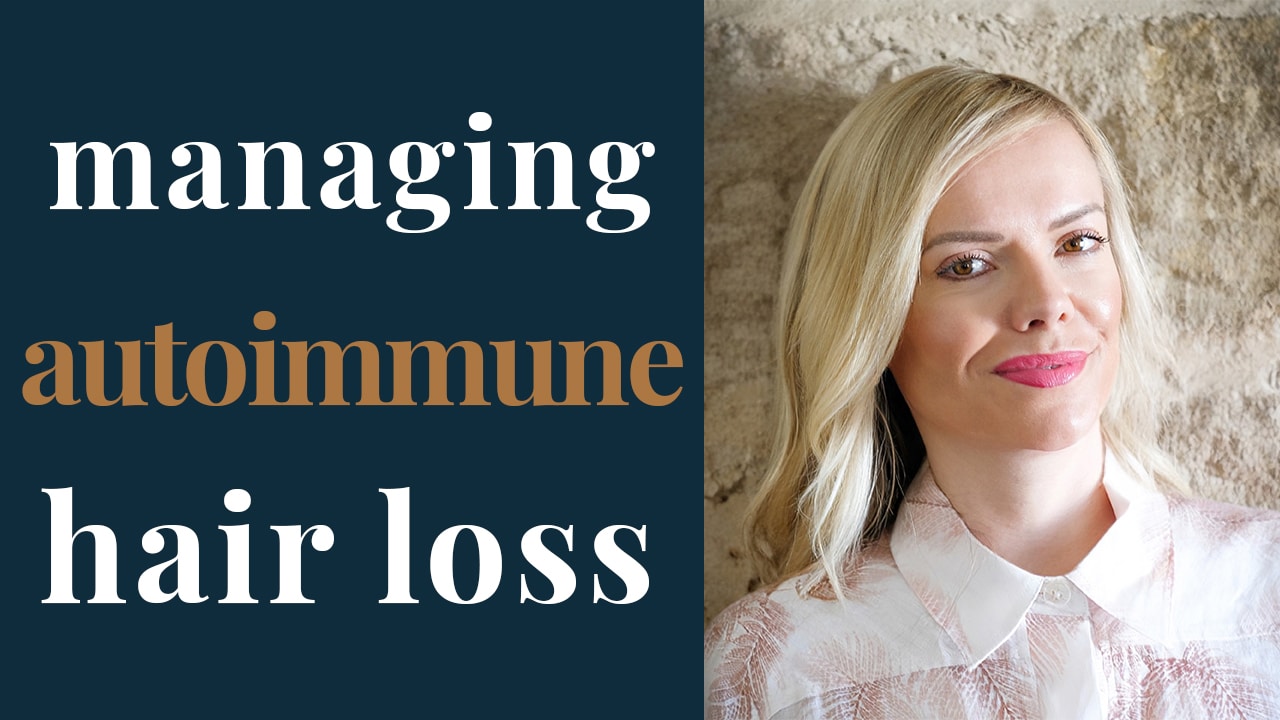
Hair loss is one of the most common symptoms people experience with autoimmune disease—but it’s also one of the most misunderstood.
While many people assume hair loss is simply part of having an autoimmune condition, there are actually many potential contributors, including nutrient deficiencies, hormone changes, chronic stress, gut health, scalp inflammation, and autoimmune processes themselves. Understanding the underlying cause is the first step toward supporting healthy regrowth.
In this episode of the Autoimmune Wellness Podcast, I’m joined by registered nutritionist, AIP Certified Coach, and founder of the Autoimmunity Nutrition Clinic, VJ Hamilton. Drawing from both her professional expertise and her own experience with alopecia areata, psoriasis, and post-viral chronic fatigue syndrome, VJ explains why hair loss should always be viewed as a symptom—not a diagnosis.
.
Watch the Episode
.
Understanding the Different Types of Hair Loss
Not all hair loss is the same.
VJ explains the key differences between autoimmune hair loss, stress-related shedding, hormone-related thinning, and nutrient deficiency-related hair loss—and why identifying the pattern can help point toward the underlying cause.
We also discuss why hair is often one of the last tissues in the body to recover once healing begins.
.
Looking Beyond the Hair
One of the biggest takeaways from this conversation is that healthy hair starts with overall health.
Together, we explore:
- Common nutrient deficiencies linked to hair loss
- The role of protein, iron, zinc, selenium, vitamin D, and B vitamins
- How gut health and nutrient absorption affect hair growth
- Why chronic stress can trigger hair shedding months after the stressful event
Rather than searching for a single supplement or miracle product, VJ encourages a root-cause approach.
.
Supporting Healthy Hair Growth
We also discuss realistic expectations for regrowth and the importance of patience.
Hair grows slowly, and meaningful improvements often take months—not weeks. VJ shares practical strategies for supporting scalp health, choosing supplements thoughtfully, and understanding when topical therapies may be helpful alongside addressing the underlying cause.
.
Resources
VJ Hamilton
- Website: https://autoimmunenutritionclinic.com
- Podcast: The Autoimmune Reset
- Instagram: https://www.instagram.com/theautoimmunitynutritionist/
.
Prefer to Listen Instead?
.
Episode Timeline
00:00 – Why hair loss is so common in autoimmune disease
01:52 – Introducing VJ Hamilton
03:13 – VJ’s journey with alopecia, psoriasis, and chronic fatigue
06:40 – Different types of hair loss in autoimmune disease
13:30 – Nutrient deficiencies and hair health
23:46 – Common root causes and what to investigate first
27:26 – Why stress-related hair shedding is delayed
30:34 – Helpful supplements (and common misconceptions)
35:15 – Topical treatments and scalp care
41:23 – Setting realistic expectations for hair regrowth
47:14 – Wrap-up and where to learn more
.
Transcript
Below is the full transcript of Episode 91 of the Autoimmune Wellness Podcast. This transcript is provided for accessibility and reference.
Title: Understanding Hair Loss and Autoimmune Disease with VJ Hamilton (Ep 091)
Mickey: Hair loss is one of the most common symptoms people experience with autoimmune disease, but it’s also one of the least talked about. For many of us, our hair can feel like a reflection of our health, so when it starts thinning, shedding, breaking, maybe falling out in patches, it can be incredibly distressing.
And what makes it even more confusing is there’s not just one cause of all of those symptoms. And over the years, I have personally experienced several different types of hair loss. I have dealt with hormonal hair loss related to my Hashimoto’s, hair loss from iron deficiency and other nutrient imbalances, and even hair loss associated with my scalp psoriasis.
Each of these experiences was different, and each of them taught me something new about how closely my hair reflects what’s happening inside my body. And that is why I am so excited for this conversation today. We’re talking about the many factors that influence hair health in people with autoimmune disease, from immune function and inflammation to nutrient status, stress, hormones, and more.
And joining me is somebody who has both professional expertise and personal experience in navigating these challenges.
Mickey: Welcome back to the Autoimmune Wellness Podcast. I’m your host, Mickey Trescott. Here on the podcast, we explore the intersection of autoimmune disease, nutrition, lifestyle, and healing. Our goal is to provide information, inspiration, and practical tools to help you advocate for your health and make informed decisions on your wellness journey.
Before we get started, a quick reminder that this podcast is intended for educational and informational purposes only, and is definitely not a substitute for medical advice, so always consult your healthcare team before making changes to your diet, your supplements, medications, or your treatment plan.
[00:01:52] Introducing VJ Hamilton, Registered Nutritionist and AIP Certified Coach
Mickey: Today, I’m joined by VJ Hamilton, founder of the Autoimmunity Nutrition Clinic and a leading expert in autoimmune disease. She specializes in skin disorders, chronic fatigue, joint health, and digestive issues. VJ is a registered nutritionist with a background in biochemistry and immunology, and is also a certified functional medicine practitioner and an AIP Certified Coach.
Her passion for this work is deeply personal. VJ’s own autoimmune journey began at just seven years old when she developed alopecia areata. Later, she would also experience psoriasis and post-viral chronic fatigue syndrome, inspiring her to pursue studies in immunology and nutrition to better understand the root causes behind her symptoms. Through nutrition and lifestyle changes, she was able to transform her own health, and today she helps other people navigate autoimmune conditions through her clinical work, educational programs, and podcast, The Autoimmune Reset.
Today, we’re diving into the topic of hair health, exploring the different causes of hair loss and autoimmune disease, the role of nutrient deficiencies, hormones, stress, inflammation, and what you can realistically expect when you’re working to support hair regrowth.
VJ, thank you so much for being here, and welcome to the podcast!
VJ Hamilton: Thanks so much, Mickey. I’m delighted to be here!
[00:03:13] VJ’s Story of Alopecia and Chronic Fatigue
Mickey: So I would love to dive in and just talk about your personal experience. You first experienced alopecia when you’re just seven, which is a really incredible age to be diagnosed with this type of condition. Can you take us back into that experience and how it shaped your interest in autoimmunity and eventually your career?
VJ Hamilton: Yeah. So I was seven years old and my parents discovered a circular patch of hair loss, and they were quite concerned when they found it. I went to the dermatologist, and then I was diagnosed with alopecia areata. And I was asked about whether I was stressed, and at the time my parents were separating. I had had a milk allergy when I was first born, but I’d introduced milk again, and I didn’t really like to eat proper food.
I was quite a picky eater even though my parents did try and make me eat certain foods. but at the time it was what… it was seen as one of those things. I was sent away with a steroid cream, and I was lucky in the fact that that patch did grow back. But then I would continue to experience hair loss. And as with many autoimmune diseases, I went on to develop another autoimmune disease, which was psoriasis, as a teenager. And then I had issues with fatigue as well.
As I was about 16 years old, I noticed that I wasn’t able to do as much as my friends. And I wasn’t diagnosed with post-viral chronic fatigue syndrome until I was in my early 30s, but that’s what I had. And I always thought to myself, “This isn’t just one of those things. There is a reason for this.” And I was thinking that even when I was young, and that’s why I went on to study biochemistry and immunology, ’cause I wanted to study autoimmune disease more in depth and find more answers. And that did give me an understanding of the mechanism, but it wasn’t until I became a nutritionist in my 30s and discovered functional medicine and discovered AIP and all these different resources and information to understand the underlying root cause that I realized there is a why to hair loss.
It’s not just about hair. It’s actually about the immune system. And that’s why I do what I do today. But, you know, there’s been a lot more going on throughout that journey, and I did experience hair loss for 25 years. So it did grow back, but then I would discover another patch of hair. I noticed it was seasonal, during the seasons there’s a lot of burden on the immune system from allergies and pollens, so I’m sure that was part of it as well. But yeah, the hair would just keep coming out, and I just got to the point of almost accepting it. But with the chronic fatigue that I was in such a bad state with that in my early 30s that I needed to do something, and that’s when I started digging deep and realizing that there was more to it than just hair loss
Mickey: Yeah, as somebody who was sick in my 20s, I know, exactly how that feels to be a young person and chronically tired. Your peers don’t have any way to relate to that, and I cannot imagine starting with autoimmunity at seven, but going back to your story of your parents separating, I mean, what we know now about the stress really triggering the immune system, it makes a lot of sense, but it’s really unfortunate how it had to happen that way.
Thanks for being here and compiling all of this knowledge for us because I know 25 years is a long time to have spent troubleshooting this in your own body, and so I know you have a lot of wisdom to share.
[00:06:40] Different Types of Hair Loss Affecting Autoimmune Patients
Mickey: So many people in our audience, they’re here because they have experienced hair loss, maybe at some point in their autoimmune journey. Can you explain some of the different types of hair loss that are common in people with autoimmune disease?
VJ Hamilton: Yeah. So with alopecia areata, that is an autoimmune disease that is attacking the hair follicles. So we know the immune system is driving that hair loss because the immune system is attacking the hair follicle, so it not only isn’t able to grow the hair, but it’s damaged. So sometimes the hair will grow, but it will break off.
Whereas there are different types of hair loss, and I think this is where we need to think about the hair growth cycle. So our hair grows in these cycles, so we have this growth phase that at least 70% or 80% of our hair you’d expect to be in the growth phase. But when we have different types of hair loss, like we can have a hair loss called telogen effluvium, which happens after a period of chronic stress. What happens is when we are chronically stressed or in that fight or flight, the hair growth isn’t prioritized.
So with the hair growth cycle, there are different stages. We have the growth phase, we’d expect our 70, 80% of our hair to be in. We then have a, almost a transitional phase where the hair moves into the telogen phase, so the catagen phase moves into the telogen phase, which is where the hair is resting in the follicle, but it eventually will come out, so that’s why it’s called telogen effluvium because all of the hair on your head, well, it’s not always all of it, but more than you’d expect is pushed into that resting phase.
So that’s telogen effluvium, and ordinarily, that’s caused by an acute stressful event, so something that is very stressful, that can happen. But they have shown in the research now that it is happening more with chronic stress as well. But it can also be an injury or a shock or a life event that can cause that.
We also have hair loss that’s related to our hormones. So as you mentioned, it can relate to our thyroid hormones ’cause the hair follicle is extremely metabolically active. And if your thyroid isn’t producing sufficient hormones, then that can affect how well your hair is being produced. So a lot of this is looking at do you have the building blocks to grow the hair, when we’re looking at at hair loss related to thyroid issues.
You can also have hair loss related to other autoimmune conditions. It’s almost a symptom of certain autoimmune conditions, and that can happen due to inflammation, but it’s not quite the same mechanism as alopecia areata. then lastly, we have hair loss like female pattern hair loss or male pattern hair loss, which is to do with the hair follicle shrinking, and that is to do with testosterone and the way that testosterone is converted and detoxed in the body.
So there are lots of different types of hair loss, and that’s why I encourage anybody who is experiencing hair loss or shedding to go and speak to your doctor or dermatologist to get that diagnosis because the way that you treat it medically is very different. And when it comes to how I work with clients and understanding the underlying root cause, it’s good to know what that diagnosis is before we start doing anything, with foods or nutrition to help with that.
Mickey: Yeah, that was a very clear and specific list, and something that stood out to me is that you can have an autoimmune disease that affects the hair follicle like alopecia, and you can also have an autoimmune disease like psoriasis that affects the skin on the scalp that can cause hair loss as a symptom in a different way.
So a lot of these things are very intertwined, and thank you for describing all of that because, yeah, there, there’s so much there, so many reasons, and I think if you chase down the wrong reason, the wrong root cause, you might not see any progress. So that is really important. Can you talk about just what is specific about autoimmune hair loss, and how might it different from these other types of hair loss like the stress, nutrient deficiencies, or hormones?
VJ Hamilton: With alopecia areata, the immune system, for various reasons, has decided that your hair follicle is a target. And the hair follicle is amazing when you start looking into it. It has this immune-privileged site, so the immune system shouldn’t be able to target anything within that follicle. It’s almost like the hair follicle becomes leaky, and certain aspects of it are then shown to the immune system, so the immune system starts to target it ’cause it’s not familiar with the inside of the follicle. So that’s why it’s not always about just keeping the immune system balanced. It’s actually the health of the follicle’s important as well.
So alopecia areata is driven by that immune response, whereas other types of hair loss can be driven by nutrient deficiencies, so you don’t have the building blocks to grow hair. You might be protein deficient, or you might not have adequate amounts of certain B vitamins like biotin or folate or B12 or even other nutrients like zinc, selenium, vitamin A, all these nutrients which are so vital for hair growth. So that can be a factor as well.
It can also be to do with our hormones and our hormone balance, and if we have high amounts of certain hormones, that can cause hair loss. And that works in the sense, as I said earlier, about it, it causes the hair follicle to become smaller and smaller, and actually you might notice your hair becoming thinner and thinner. And that can be a reason for hair loss if it’s to do with that, the sex hormones and the testosterone.
And, and I would just say with the nutrient deficiencies as well, which is quite interesting, one of the things that you might see is that your hair will only grow to a certain length. And people always think that their hair is snapping at the ends, but it’s just that the hair is coming out at a certain length, so it will only grow that length because it’s moving straight into that resting phase where the hair comes out.
And then with the stress piece, it’s more about the hair being pushed into the resting phase so that your body can prioritize other things, rather than it being an immune response. However, just to say, the truth is there’s probably an element of various different things going on when we lose our hair, and I often will find that clients will have alopecia areata, but they also have some type of diffuse thinning, and it’s understanding why that is happening at the same time. And one of the reasons for that could be nutrient deficiencies, which would affect both types of hair loss as well.
Mickey: Yeah, let’s dig in a little deeper. I know you mentioned some of the nutrients, but let’s talk about the nutrition part because I know a lot of our listeners, that’s going to be the first places people look for answers.
[00:13:30] Nutrient Deficiencies and Hair Loss
Mickey: Which specific nutrient deficiencies are most commonly associated with hair loss? And if you can even break down the type, like the type of symptoms people might notice and how they’d figure that out, that would be amazing.
VJ Hamilton: Yeah, I think the main one is iron and how we store iron as well. But iron is not one thing. We can get iron from vegetables, which is much harder for our body to digest, absorb, and utilize, whereas we can also get iron from animal products, and that type of iron is a lot easier for our bodies to utilize.
So sometimes somebody might be eating plenty of iron-rich foods, but they’re not digesting and absorbing it and able to use that type of iron. So I often will see a deficiency in iron just from diet alone. However, there can be issues with actually storing iron at the cellular level, which can be blocked by inflammation. And the reason that your ferritin is so important is because, as I said, there’s such a high turnover of cells in the hair follicle. You need to continuously be your dividing your cells and multiplying those cells to grow hair, that you need a high iron store because we have iron stores in different areas of the body.
So you might actually have sufficient amounts of iron to keep everything else working, but you need a higher amount to ensure that your hair follicles constantly have that supply of iron. So that’s why we need higher ferritin levels, which is your iron store rather than your iron that you have in your red blood cells. But that’s one that I will look for straight away.
And some of the symptoms of low iron would be fatigue, tiredness, achy legs, sometimes restless legs. And you can have lots of different symptoms with iron deficiency because it can affect lots of different functions within the body, and I think that’s the thing with a lot of these nutrients. Sometimes it’s not as obvious, but I would say fatigue is one of the symptoms that you would see regularly with iron deficiency. And hair shedding, you would see a lot with low ferritin.
Another, deficiency would be, well, the baseline of what the hair is made of is the building blocks of hair, which is protein. So just making sure that you’re getting sufficient amounts of protein.
But on top of that, making sure that you’re getting B vitamins because B vitamins can help with protein synthesis. And just to remember that protein isn’t one thing, it’s made up of amino acids, and these amino acids all have a different role when it comes to the different functions that they play in our body. And some amino acids are more essential than others. And even going back to when I was vegetarian, I would eat quinoa quite often because it’s got some of the key amino acids in them. It’s quite a good plant-based protein because of that. And when I was vegetarian, I did manage to get my hair to grow back by eating a lot of quinoa, but I ended up reacting to it, I went way too far. This was before I was a nutritionist.
So the B vitamins are really important as well, and I would say B12 and biotin. But I would say with biotin. Biotin is important for protein synthesis, so if you taking a high amount of biotin, that’s not going to be helpful if you’re protein deficient. And with any of these vitamins, it’s when they’re deficient that there’s an issue. Taking high strength probably isn’t going to help you that much.
But there are different versions of some of these vitamins that can be helpful. In my own health, one thing that came up on my full blood count with my doctors was that I had enlarged red blood cells, which is the MCV value. And because of that, they were willing to investigate a few other things for me, like my thyroid and I was able to get more testing just through my local doctor. Because a lot of people will have test results and everything will be fine, but that can be a sign of a functional B12 deficiency. So that really helped me to dig in a bit and understand what’s going on with my B12.
And then there are minerals like zinc, which is so important for the immune system, and then the selenium, which is an antioxidant and can help with the health of the hair follicle. So I’d be looking at deficiencies in those minerals as well. And they’re really some of the key ones, that I’m generally looking for when I’m working with clients.
And just making sure that they have optimal amounts of those as well. We want to be getting to kind of the higher end of the reference range. And then for any autoimmune condition, I’m looking at vitamin D because if your vitamin D is low, then your immune system is less likely to be tolerant to things like the hair follicle, and that’s the beauty of vitamin D.
It really helps with these things called T regulatory cells that keep the immune system in check, and when they are low, your body is far more likely to react to self-tissue like the hair follicle. Whereas when vitamin D is at optimal amounts or even, like slightly higher amounts, especially if you have any, variations in your vitamin D genes. But yeah, you want to be having optimal amounts of vitamin D in order for your immune system to be a bit more tolerant to things. so that, that’s really what I’m looking at when I’m working with clients, like the basic like full blood count, information that you would generally get.
Mickey: Awesome. That was so comprehensive. And I just want to hone in on iron for a minute, just because it, I think even though people know about iron and hair loss, I want to talk a little bit about the functional range for ferritin, because I think if a lot of us, I know here in the US, you go to the doctor, you have your ferritin tested.
If it comes back at 20, your conventional doctor is going to be like, “You’re fine.” They’re not going to think of that as something that needs treatment until it’s maybe below 10 or, or something, which is absolutely not right. You really need to be treating a ferritin that is under 50 aggressively by functional standards.
And, I personally believe that it needs to be over 100, especially if you are symptomatic. I have had ferritin down to six. And you know, I have celiac, I have Hashimoto’s. These are both conditions for which low ferritin is associated, so that is another mechanism. We’ve already discussed some of how that happens, but I just want to flag that for people to be really aggressive about that ferritin.
And I know you guys, if you’ve been following me for a while, I love heme iron in terms of supplements, and the one that I like is called Simply Heme by Three Arrows Nutra. You guys can use a code AUTOIMMUNE for 10% off. That’s actually what I’ve used to get my ferritin close to 100. I’m still working on that triple digits.
But I really notice a big difference when I got over 50 in terms of the shedding that I was getting when I was taking a shower. So I wanted to flag that because, a lot of people really, they eat a lot of meat. Maybe they’re even eating liver. Maybe they’re even taking an iron supplement, which, you know, can be kinda hard on your digestive system if it’s not like a heme iron.
But if you’re not aggressive about it and your level is still low, you gotta keep going.
VJ Hamilton: I completely agree. And I was quite surprised when I last got my ferritin done and it was, like, 130. I was like, “Oh, it’s maybe getting a bit
Mickey: Yeah!
VJ Hamilton: I was like, “Wow, this is maybe why I feel, feel so much warmer.” I used to feel so cold all the time. And I’m sure that was, like, ’cause my thyroid, I never got diagnosed with Hashimoto’s, but it was always all over the place at one point. But I really do believe it’s from me not eating gluten, ’cause I’ve again, not been diagnosed with celiac, but I do think there was some absorption issues going on. But eating red meat regularly, and I, I think people are quite put off of eating too much. And I’m not saying eat loads, but getting the organ meat, the nutrient-dense meats in makes such a big difference.
But also, your menstrual cycle is very heavy, you’ve
Mickey: Yep
VJ Hamilton: to weigh that up because you are losing so much blood every month, and you need to be you need to be taking that back in. And I think when I explain that to clients, they’re like, “Yeah, I’m only eating red meat once a week or maybe, like, once every two weeks.”
It’s like, that’s not going to be enough. And there are ways that you can supplement as well if you’re not wanting to eat that much red meat. But I have to be a bit more conscious about it. I love red meat, even though I was used to be a vegetarian. I love the taste of it. But even, you know, when you get into a cycle at home, sometimes I forget about it, and then get my Instant Pot out and just make, like, a big lamb tagine, or, like, a nice slow-cooked meat. And I just feel brilliant after having it. I can feel myself lifting after eating that type of food. But yeah, I was really pleased when I saw those results, and I was like, obviously, you know, it has paid off in the long run.
Mickey: And this is why we test, right? Like, ’cause iron overload is also a thing, so I always say a caveat, if you’re low in iron, I think far more people, especially with an autoimmune background, tend to be on the low end. But there are some people, especially certain genetic backgrounds, hemochromatosis, iron overload is real.
So this is why it’s important that you don’t just listen to us talk about iron or vitamin D and go buy a supplement and take it. You really do need to work with someone, get your level tested, see where you’re starting at, and then thoughtfully supplement based on your specific issue, right?
VJ Hamilton: I completely agree. I was, I think I was down at 25 when I first started working on my health, like 12 years ago. So I think it does take time as well, but there were other things that I’ve had to correct as well to for various different reasons. Like the gut, like the menstrual cycle.
Mickey: Digestion. When you wake that up, a lot of these nutrients we talked about, like you’re talking about all the B vitamins and the minerals, the zinc and everything, that’s just going to be like a synergistic effect that’s just going to help your digestion. And then when we’re talking about eating whole foods, nutrient-dense foods, most people are going to be getting these nutrients from their diet.
They’re not going to need to supplement if their digestion is good. So cue for everybody listening, if you’ve got some digestive dysfunction, it’s a great sign to maybe work with someone to improve that if you’re looking for a natural way to boost what you’re already doing, which is eating good food.
So I love that.
[00:23:46] The Most Common Areas to Explore for Hair Loss Root Causes
Mickey: So I would love to talk about what are the most common areas that you might do some testing or exploring for root causes to kind of put them in the different buckets of types of hair loss or even interview questions?
VJ Hamilton: First I’m looking at the gut based on what you just said, to be honest, because if they’re not digesting their food and absorbing it, then they could be nutrient deficient. But also, if there’s any inflammation going on in the gut, then there could be that inflammatory response happening, and that could be giving me an idea of alopecia areata. I would say with alopecia areata because it comes out in, normally in patches to start with, I know it can go on to, like, full hair loss, you often will know if it’s alopecia areata, so it’s more thinking about some of the other types of hair loss. So I will be looking at their timeline to start with before thinking about any testing.
So understanding what’s happened in your life in the last year, sometimes clients will come to me and they might say, “I had shedding five years ago, and then it was absolutely fine, and I forgot about it, and now it’s come back again.” We’ll explore what happened five years ago as well. But what I’m looking for is has there been a stressful event? Have they had a virus? Have they had an injury? Has there been any gut issues or or stomach bugs or trips away? And that helps me build a picture, and then I will start thinking about the gut. But often, I know it’s probably what everybody says, but often I am thinking about the gut, even if somebody doesn’t have symptoms, because I didn’t really think that I had that many symptoms.
I look back and I realize I did have a lot of digestive symptoms, but I didn’t realize that at the time, and I would’ve just said, “No, my gut’s fine.” But there was so much going on in my gut that I didn’t realize. So for most people, I am looking at that, especially if they have any symptoms like constipation or bloating or heartburn or urgency to go to the toilet or anything going on with the digestion, we’re looking there first. And then understanding their family history as well, ’cause that might give you some insight, especially when we’re looking at female pattern hair loss or if they have any hormonal issues like, it’s PMOS, isn’t it, now?
Mickey: Mm-hmm.
VJ Hamilton: and anything, anything going on hormonally, I might be thinking, actually we need to explore that area. If they’ve had a very stressful event, then we might be considering their nervous system and telogen effluvium. So just understanding whats happening in their life and what’s been happening in their life for the last six months, I would say, because hair will shift into that resting phase, it can sit in the hair follicle for up to three months. So you’re not just thinking about now, you really are thinking about what’s been happening recently.
And by building that picture, that gives you a lot more insight into what the underlying root cause is. And even if somebody has alopecia areata, and we know it’s alopecia areata, we still don’t know the root cause. And I’ve worked with hundreds of clients now with alopecia areata, and everybody’s got a different root cause. I mean, some of them are the same, but everybody has their own fact pattern that’s got them to that point. And it can be several things. They’re just putting a big burden on the immune system and they’ve got that genetic susceptibility and it’s just one thing’s tipped them over, they experience hair loss.
And we need to get everything back into balance and understanding what’s driving that, which can be a virus, it can be mold toxicity, it can be the gut, it can be chronic stress. So there can be lots of different elements to it.
[00:27:26] Stress and Hair Shedding – A Delayed Timeline
Mickey: I would love for you to speak more just about the timeline of how stress impacts shedding, because I know a lot of people are really surprised to hear that the hair doesn’t shed when you’re going through the stressful event.
Can you describe that again? I know you alluded to it a couple times, but I think it bears repeating that timeline of how the hair goes into that resting phase and then when they will notice the symptom.
VJ Hamilton: Yeah. So even with alopecia areata, this can happen as well, and telogen effluvium is certainly when it happens. So I remember when I had alopecia, if I had a stressful event or something happened in my life, grief, stress, major life change, I would almost count the months, because what happens is the hair is growing and then this event happens, and your hair is pushed into this telogen resting phase, but it just sits in the hair follicle.
So the hair doesn’t actually come out for about two to three months. So it’s almost like I knew that the, that things had happened, and I could feel the level of stress in my body that I knew that was going to lead to hair loss. I’d be like, “Oh, I know. I just know in two months time it’s going to come out.” And that would often be when it would come out. And the good thing about that is that was… then it was like, okay, right, I just need to get on it and be proactive. The reason it’s good to know about that is that you can then have a better understanding of what might have contributed to it because stress isn’t the reason that I was experiencing alopecia areata for that long. It was just the trigger.
So everything else was unstable already, and then I’d have the stressful event, and the hair came out. And then I’d rest, I’d look after myself, the hair would grow back, and then because I was still… everything was unstable, I was still eating gluten, I still had gut issues, I still, you know, had nutrient deficiencies, all these other things going on, then I’d have another stressful event, and it would come out, and it would just keep doing that in cycles.
So I just did not have stable foundations at all. And that’s where, when I’m working with clients, I would like them to get to, to the point that they have those stable foundations so they can go through these life events that we’re all going to go through, but not experience the hair loss. because you know, that is when you are a bit more vulnerable to any type of autoimmune disease, when you go through these stressful periods.
Mickey: Yeah, I think you just perfectly described also my experience with my scalp psoriasis is really I feel like when my resilience is built up and high, those stressful events are less of a trigger. And I think this is really common in general with people who have skin, and now I’ll add to my list hair, because you’ve educated me so much on this topic.
But really just knowing that you are the type of person who is responsive to stress in your life doesn’t mean that you are going to eliminate stress from your life. Nobody can do that realistically. But we can increase our resilience by the nutrient density, by balancing our hormones, by all the things that we’ve talked about here, and, I’ve definitely experienced that myself.
So thank you for making that point. That’s great.
[00:30:34] Supplements Helpful or Over-Hyped for Hair Loss
Mickey: So one thing I do want to circle back on supplements. I know we talked about nutrients and a little bit we talked about iron and vitamin D supplementation. But do you feel like there’s any supplements that, A, are helpful for hair loss, or B, may be over-hyped, or C, that people should be cautious about taking without proper testing?
I know we touched on this a little bit with iron and vitamin D, but I would love your take on supplements in general.
VJ Hamilton: Supplements are brilliant when they are addressing a nutrient need, and I think that goes for all of the nutrients that I mentioned. So if you are deficient in those nutrients, then it’s important for you to get your levels up, whether it’s through supplements or it’s through eating a more nutrient-rich diet. Biotin is one that you see time and time again in the media and in every hair product, there will be biotin. There is a reason for that, because it helps with protein synthesis, and it helps to produce hair. And it can help with lots of other factors as well. So if it’s low, it’s a problem. But generally, people don’t have low biotin. So that would just be one that I would be cautious of and it can also affect your thyroid results. It can affect other markers if you’re taking high amounts of biotin. So it’s just to have an awareness that, that it can affect some blood test results as well.
I would say because hair loss, especially alopecia areata, but I’d say a lot of different types of hair loss, there is usually this underlying inflammation, and actually inflammation can cause you to not be able to store as much iron. Anything that is anti-inflammatory is going to be helpful, and a lot of people who I work with don’t particularly like eating fish, so they are more likely to be low on their omega-3s, and omega-3s have this amazing anti-inflammatory response in the body, and if you don’t have sufficient amounts, it can almost swing your body into a more pro-inflammatory state.
And it’s not that we don’t want inflammation because we obviously do when we are defending our bodies from a virus or bacteria or when we get injured. the truth is we need to make sure that that’s balanced with omega-3s. So that would be one, again, that I’d be more mindful of. You can get quite inexpensive tests now to test your omega-3 ratio because it’s about the ratio between your omega-3 and omega-6s.
But I would just say for your cellular health, you need an assortment of different fatty acids, so different healthy fats, so from your olive oil. You also need saturated fats from your coconut oil, from your ghee. So it’s just a mixture because we need to make sure those cell membranes are really healthy as well, and they are made up of these fatty acids.
So that’s just one to bear in mind. And one of the favorite that I’m seeing really good results with at the moment is phosphatidylcholine, which is really important for the cell membranes. And when we think about hair, it is about cells dividing. there are so many other reasons why cell membranes are so important for our health and our immune system and energy production.
As I said, the hair follicle needs lots of energy. So I like phosphatidylcholine, I wouldn’t say there is a lot of evidence to show that that’s really important for hair growth, and that’s why I always go down to that underlying root cause and what that client needs. I’m seeing omega-3s are pretty important for people because of that anti-inflammatory response that it has in the body. And then making sure that you’re getting those polyphenols and antioxidants from food. But there are some really good antioxidants that you can take alongside that if oxidative stress is an issue in causing that inflammatory response.
Mickey: Yeah. Awesome. Thank you for that. That’s really insightful. And omega-3 is also going to help the microbiome, the gut, our skin so there’s a theme here. Things that are good for our overall system are generally going to be good for building hair, so I hope everyone’s taking that away.
VJ Hamilton: Yeah, and just going back to your point on scalp psoriasis, I mean, that is to do with our skin barrier and when we have issues with our skin barrier, that becomes an issue. That’s another reason why fats are so important, and we hear more and more about healthy fats now. I think the AIP, the Autoimmune Protocols help so much with that. But that’s another reason because if you have dry skin, it just causes that barrier to break down and that’s when we’re going to be more exposed to certain autoimmune conditions. That’s another reason why they’re so vital. But I know these things can happen as we move through life, there can be changes and extra need for certain nutrients as
Mickey: Yeah. Yeah.
[00:35:15] Topical Treatments for Hair Loss
Mickey: Let’s talk a little bit about topical. I know really the first line is going to be to take a root cause, internal, produce the hair, keep the hair on our head approach that we’ve covered extensively. But let’s talk about if there’s any topical treatments or things that you recommend.
I know I have a couple that I can mention that I use for my psoriasis, that I found helpful, but I’m curious if you have any recommendations?
VJ Hamilton: In the UK, I’m a registered nutritionist, so I don’t work with any prescription medications or anything. And I know some clients will use minoxidil or I’ve had some clients in the US now been using some peptides. So that’s all interesting, and I’d be happy to talk about that. But as a nutritionist, really looking at things that are going to improve the health of the follicles, whilst we’re working on anything going on underneath.
So just using really natural products like rosemary oil, because it’s an antioxidant. I like black seed oil because something that we haven’t really talked about, but I’m seeing more and more clients who have issues with their histamine response and MCAS, and it’s also an antihistamine, so that can be nice to use on the hair follicle. And something that I did which people are, like, sometimes quite shocked by is I used onion juice because it’s a really powerful antioxidant, and just grate it and you can put it on the scalp on a night, leave it overnight and wash it off. There is a smell to it because it’s onion.
Mickey: Not before a date!
VJ Hamilton: Yeah, exactly. But I just do it on a night, and it’s not greasy either, and I just… The greasy hair. And when you’ve got patches that you’re trying to hide, when you put the oils on it’s fine ’cause you’re probably going to wash it off in the morning anyway. But , it would sometimes split your hair in different ways.
So I preferred the onion juice. And I honestly got my patches growing pretty quickly when I was using onion juice. And then red light therapy is something that I know it’s more of an investment, but it has been shown to really help with the cellular health in the scalp. So I haven’t been using one, and I used to go and pay a fortune at a clinic in London for an hour of using this comb. But I am thinking even for myself I’m maintaining some healthy hair growth as I, as I get older as well.
Mickey: Yeah, and I mean, the devices are getting a lot more affordable. That’s not something that I’ve done, but I know the price is dropping pretty quick, so accessible red light therapy might be in the future. So I’m going to share a little bit about, for my psoriasis, what I noticed.
I used to be afraid to wash my hair because I would lose so much hair in the shower, and I’ve actually learned that washing my hair more with the right shampoo, which for psoriasis I use a salicylic acid, which is a very, I think mine’s 3%, it’s a really mild, topical exfoliant. Washing more often, actually keeping my scalp clear of those plaques and letting the skin turn over more quickly, my hair’s actually happier and stays on my head more, and I was just so afraid for so long.
So I’m just sharing, like of course everybody has to figure out what works for them. But I was down to one or two washes a week, just because I would shed so much in the shower, and I’m kinda taking the reverse approach now, where I’m washing gently, but with a exfoliating shampoo. I’m finding that that works really well.
And I’m also, because those products can be drying, sometimes I will put oil, like coconut oil or jojoba oil on the ends of my hair before I shampoo to manage that dryness that you get from using that kind of product. I’m a psoriasis girly. I don’t know, for other types of hair losses that’s helpful.
But I know that for many years I was more of the crunchy, natural, I found the shampoos that were very natural just really didn’t clean my hair very well, and then the conditioners didn’t really create enough slip. So it’s not like I’ve gone full silicone or anything, but finding that magic balance between exfoliating and then hydrating has been really good for like keeping the hair on my head where I want it to stay, right?
‘Cause especially when you’re worried about it coming out, it is very real to feel like you need to baby your hair to just keep it attached, right?
VJ Hamilton: It’s so difficult, and I would say even when you’re washing your hair more often, you’re going to see less shedding. So it, I think it’s when you have that experience of seeing a lot of shedding that it, it can be quite scary. I just work with where my clients are at when I’m advising them on this, but I agree.
I think if you clear the hair follicles, they’re going to grow more healthy hair anyway, and that’s, that can be an issue with some of the, oils as well. I did a trichology course a while ago. I’m, I’m not a trichologist, but I just was dabbling into that as well as being a nutritionist, they talked a lot about how even some of the oils can clog up the the follicles, and it just means that the hair’s not able to grow as well.
And I think that’s the same thing, isn’t it, actually, when you, when you’re washing your hair, it’s going to help more with the hair growth and taking any impurities off the scalp. But I’ve found it quite hard to find a shampoo that is washing my hair, but it’s completely chemical-free.
But I would use like the Yuka app or the Environmental Working Group and finding a shampoo on there that has less chemicals in it. That’s what I would be looking for. Because a shampoo isn’t going to help you with hair growth to a certain extent, but if you start putting chemicals on your scalp, then it’s more likely that it’s going to be inflamed.
So it’s just looking at a pure version that’s going to wash your hair. I’m, again, like you, just put oils on the end of your hair to moisturize it. That is
Mickey: Yeah.
VJ Hamilton: the best way to do it.
Mickey: Yeah, it’s a tricky balance ’cause the chemicals, they affect our skin, but then also if you don’t actually get your scalp clean, which a lot of the crunchy products do that, it doesn’t help. So I’ve been through this whole cycle where I’ve landed at the medical, not prescription grade, but fragrance-free, paraben, sulfate-free, but it is a shampoo and it cleans well.
So if you guys want to know what I do, DM me on Instagram. I’m happy to give you all the deets.
[00:41:23] Setting Realisic Expectations for Regrowing Hair
Mickey: So let’s finish up just by talking about just how slow hair growth is, and if for anybody who’s on this journey who is going to be working nutritionally on a root cause approach, how do you help your clients set realistic expectations when they’re trying to recover from hair loss?
And what signs suggest that they might be moving in the right direction even before they see obvious regrowth?
VJ Hamilton: Yeah. It’s one of the most frustrating things, I think, when you are experiencing hair loss, ’cause you are looking for that as your results, that you’re getting better. If your hair’s growing back, you’re recovering and you’re doing really well, and if your hair isn’t growing back, then nothing’s working, and it is hard to stay focused and patient, to be honest.
I was exactly the same. And to be honest, I think for a part of my life when I was dealing with this on my own in my 20s, I just was in a bit of denial about it, but maybe that was best ’cause I just kind of forgot about it and I was like, “I’m not allowed to keep checking the mirror. I’m allowed to do this once, and then I’m leaving it two weeks.”
And that’s the thing. It takes a long time for some people for the hair to grow back. I mean, it can take years, if I’m honest. For most of my clients, I’m working with them at a minimum three months. But I wouldn’t be expecting to see any hair growth in that three months. I might start seeing it at the three-month mark. And then if things are going well, by six months… It depends on the severity of the hair loss, but that’s where you may see some really good regrowth, at six months. But everybody is different, and I’ve worked with clients for two years, especially some children where they’ve had a lot of complex issues going on, now their hair’s growing back, and I’m getting pictures of, like, a full head of hair of a little girl that I was working with for two years.
Whereas some people are quicker than that, and the thing to bear in mind is that the hair follicle is so sensitive that it’s the last thing that is going to improve, and that’s the frustrating thing. And that’s why I’m so proactive with my health because it’s like with anything. It’s like if you have arthritis or psoriasis. It’s so much harder to get rid of it once it’s there rather than be proactive. But sometimes different things happen in our life and, and we will have a flare. That’s just often what will happen.
So I’m working with clients, and we’re working on their gut, and we’re seeing improvements in their digestion, or they have energy issues to begin with and we see improvements in their energy,
Mickey: or
VJ Hamilton: they have other skin issues going on and those skin issues improve. We need other metrics to be monitoring whilst we’re working together so we can be
Mickey: confident
VJ Hamilton: that there is some progress happening. And some clients will do functional testing with me, and they might retest as we’re working together. Some clients haven’t had a menstrual cycle in years, and then suddenly that comes back, and all these things are showing us that the body’s switching on again and the body is changing.
But the hair growth often comes when the body is in that optimal state and it feels safe enough to grow the hair. And I would say that underlying all that is working on the nervous system because if your body doesn’t feel safe, then for some people the hair won’t grow. Your body needs to be in that safe, calm, assured state and then it feels like, “Okay, we can switch on this system in the body now. We’ve got enough resources for that.”
But the amazing thing is that your body is set to grow hair. It’s like breathing, it’s like your vision, it’s like all these things that we do. Your body knows to grow hair, but it it, at the minute for whatever reason when it comes to hair loss, the types of hair loss that we’ve discussed anyway, not the scarring type, but every other type, its just waiting to grow that hair and once everything is in check that will happen.
But it could take three months and as I said I’m working with a little girl and it’s taken two years, but she’s had her hair grow back. And I’ll be honest, some clients leave me and they haven’t had their hair grow back and they’ve just decided that they’re fine with it. We might have done some tests and seen some things and they’ve decided, “No, I’m okay.” And then other people will maybe leave at six months, seen some good visible signs, carry on doing it, six months later all their hair’s grown back. So it’s very different for each person. But I thoroughly believe that if you keep going with it you will see results in the end.
That, you know, that, that’s what I truly believe with this
Mickey: Yeah. Thank you so much for sharing that realistic perspective, and I totally agree with you. I think skin falls under the same category, where it really is a low-priority thing for the body to do. The conditions have to be perfect, which is really frustrating when it’s the thing you want.
And I just want to normalize for anybody listening. So before I got sick, I had hair down to my hips, and when I was in the middle of my hair loss crisis, I chopped it off thinking, “I’m just going to chop it off. I’m going to do all the things.” I did all the things. My hair doubled in volume. It came back.
Guess what? I still like my hair short. So,
VJ Hamilton: You did great
Mickey: yeah. And so, you know, short hair, a wig, whatever you need to do to get through, somebody has done it. Your family, your friends, everybody is going to love you for the person you are. It doesn’t matter how much hair you have on your head. So I just want to say that, ’cause I just remember being a young person in my 20s, so much of my identity was just in this luscious long hair that I had, and having to chop it off.
Now, I think part of the perimenopause, going into my 40s, just being like, I don’t really care so much anymore. But I just want to give everyone license to it’s okay to cut it. Sometimes it makes that shedding and that loss just feel a little bit less stressful when it’s not so long.
VJ Hamilton: Yeah. I hope it makes you feel better. I completely agree
[00:47:14] Closing and Wrap-Up
Mickey: Yeah. Well, VJ, thank you so much for joining me today. This has been an incredible interview. I love that you have been able to share both your own story and your expertise as a clinician. I know this conversation is going to bring so much clarity to everybody listening and anybody struggling with hair loss.
One of my biggest takeaways is that hair loss isn’t a diagnosis in itself. It is a symptom. And so I hope that everybody listening is thinking about how that could be driven by autoimmune activity, nutrient deficiency, hormone changes, stress, medications, other underlying factor, or a mixture of all of them, unfortunately.
Our hair is often reflecting what is happening inside our bodies, and while it can be so frustrating that hair is the last thing to recover, understanding those root causes give us a much better chance at supporting healthy regrowth over time. So before we wrap up, VJ, can you let everybody know where they can learn more about you and your work and your programs?
VJ Hamilton: Yeah. The best place to find out more about what I do is on my website, which is www.autoimmunenutritionclinic.com. And I am sharing lots of articles over there. You can also download my free guide, which is the Autoimmunity Recovery Plan. It’s just a really simple guide giving you some recommendations of lifestyle activities that you can bring into your life, but also some dietary recommendations and things to just get started when you are dealing with an autoimmune disease or hair loss. So if you head over there, you’ll find a lot of information. But as Mickey said at the beginning, I also have a podcast, The Autoimmune Reset, and which you can find on all the podcast channels. I’ve done lots of episodes over there on hair loss and alopecia, so have a listen over there. And I am on Instagram @theautoimmunitynutritionist as well.
So yeah, a couple of ways that people can get in touch!
Mickey: Awesome. Well, thank you everybody for listening. If you enjoyed this episode, I’d love it if you’d subscribe, leave a rating or review, and share it with somebody who could benefit from this conversation. They really help people discover the podcast. And until next time, take care of yourselves, and I will see you on the next episode of the Autoimmune Wellness Podcast!
.







0 comments