
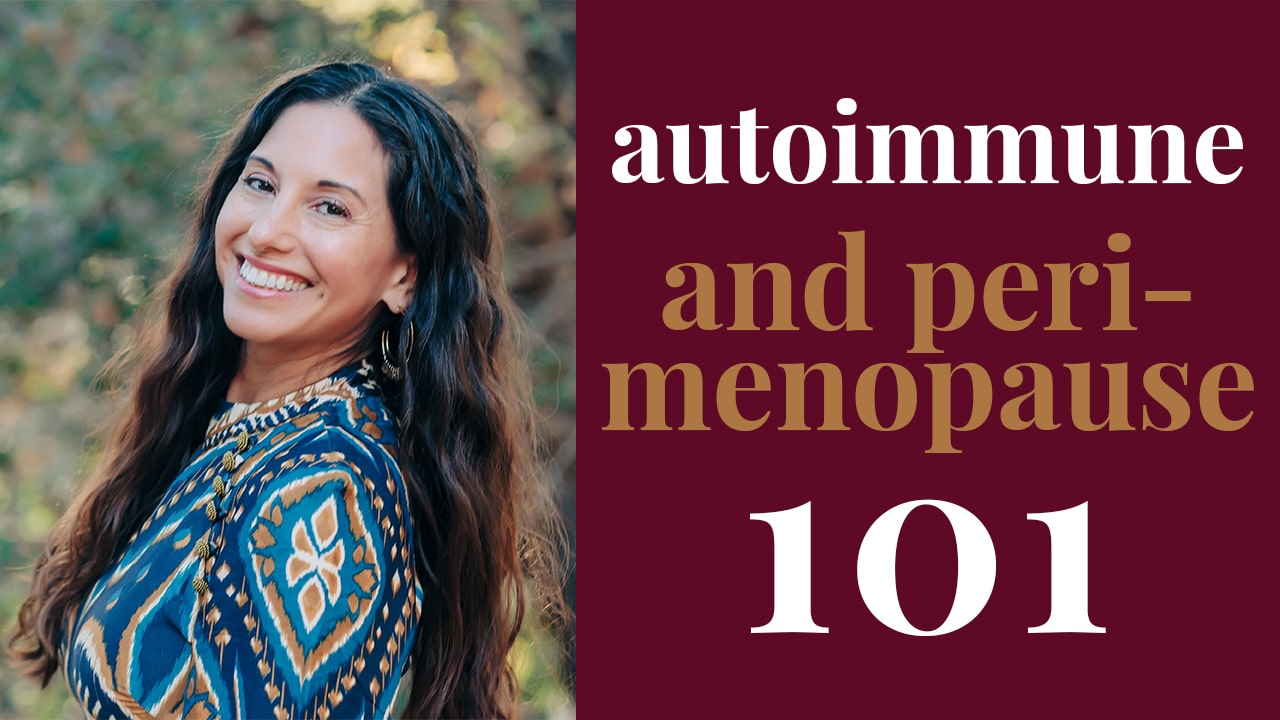
Perimenopause can be confusing on its own. When you’re also living with autoimmune disease, it can be even harder to tell what’s behind changes in sleep, mood, energy, inflammation, or brain fog.
In this episode of the Autoimmune Wellness Podcast, I’m joined by functional medicine practitioner, bestselling author, and women’s hormone health expert Dr. Mariza Snyder. Together, we break down what happens during perimenopause, why symptoms can begin before obvious cycle changes, and what women with autoimmune disease should know about navigating this transition.
.
Watch the Episode
.
Is It Perimenopause, Autoimmunity, or Both?
Many common perimenopause symptoms overlap with autoimmune symptoms, including fatigue, brain fog, sleep disruption, mood changes, and changes in resilience.
Dr. Mariza explains how fluctuating estrogen and progesterone can affect the brain, immune system, metabolism, and stress response, and why symptoms may begin as early as the late 30s.
We also discuss why tracking symptoms alongside your menstrual cycle can help reveal patterns that might otherwise be easy to miss.
.
Building a Strong Foundation for Perimenopause
While hormone shifts are unavoidable, there are many ways to support the body through this transition.
We discuss the importance of nutrition, blood sugar regulation, sleep, movement, strength training, and stress resilience. Dr. Mariza also shares her “landing the plane” approach to creating a more supportive nighttime routine.
The goal isn’t to do everything perfectly, but to recognize that your body’s needs may be changing and adjust your strategies accordingly.
.
When to Seek More Support
We also talk about advocating for yourself when symptoms are significantly affecting your quality of life.
Dr. Mariza shares when it may be helpful to dig deeper with a knowledgeable provider and where hormone replacement therapy may fit alongside foundational lifestyle strategies.
For those of us with autoimmune disease, this conversation is an important reminder that changing symptoms don’t necessarily mean everything that worked before has stopped working. Sometimes the body simply needs a different kind of support in this new phase.
.
Resources
.
Prefer to Listen Instead?
.
Episode Timeline
00:00 – Why perimenopause can be confusing with autoimmune disease
03:16 – Introducing Dr. Mariza Snyder
04:28 – Perimenopause 101: What are we dealing with?
10:28 – Common and surprising symptoms of perimenopause
17:14 – The perimenopause-autoimmune connection
23:22 – Why old strategies can stop working
28:27 – A foundational approach to perimenopause
35:28 – Knowing when to dig deeper and advocate for care
40:57 – Hormone replacement therapy in perimenopause
46:09 – Hope for autoimmune women navigating perimenopause
.
Transcript
Below is the full transcript of Episode 95 of the Autoimmune Wellness Podcast. This transcript is provided for accessibility and reference.
Title: Understanding Perimenopause: A Beginner’s Guide with Dr. Mariza Snyder (Ep 95)
Mickey Trescott: Perimenopause is certainly having a moment. Over the past few years, it’s gone from something that hardly anyone was talking about to one of the biggest conversations in women’s health. Social media is filled with women wondering why they suddenly can’t sleep, why we are anxious for apparently no reason, and why we’re gaining weight despite doing everything right, or maybe even why we just do not feel like ourselves anymore.
Recently, somebody left a comment on one of my Instagram posts saying, “Is it autoimmune disease or perimenopause? The world’s worst game show.” And I personally have never felt so seen.
For so many women living with autoimmune disease, that perfectly captures this stage of life. We are constantly asking ourselves, “Could this be an autoimmune flare, or is it my hormones changing, or is it both mixed together?” And most importantly, why do the strategies that have been helping for years suddenly seem to have completely stopped working?
The truth is we have very little research looking at perimenopause, and even less specifically at the combination with autoimmune disease, which leaves so many women trying to piece together answers on their own. And that’s why I wanted to dedicate an entire episode to Perimenopause 101.
Mickey Trescott: Welcome back to the Autoimmune Wellness Podcast. I’m your host, Mickey Trescott, and today’s episode is one that I have been looking forward to for a long time. Perimenopause has become one of the most requested topics from our community, and honestly, it is so easy to understand why. It’s a major hormonal transition that affects every woman, yet many of us arrive here with very little understanding of what is actually happening inside our bodies.
I also know from my own experience, you guys know that I’ve been talking about this on the podcast all year, and from talking with so many women in the autoimmune community, that this season of life can feel so confusing. Symptoms are overlapping, our hormones are fluctuating, and our autoimmune conditions might behave completely differently. And without much research to guide us, it can feel overwhelming trying to figure out what’s normal and what’s not.
So when I started thinking about who I wanted to bring on for our very first episode dedicated to perimenopause, Dr. Mariza Snyder was at the very top of my list. What I appreciate so much about her work is that she brings such a calm, grounded, and evidence-based approach to a topic that is often surrounded by confusion and fear. She’s got this remarkable ability to translate complex hormonal changes into language that is really easy for us to understand while helping women focus on the foundational habits that support them through this transition. So rather than offering quick fixes, she empowers women to understand what’s happening biologically so that they can navigate perimenopause with confidence.
So today, we’re covering Perimenopause 101, what it is, what’s happening hormonally, what symptoms to expect, and why this transition can feel so significant for women with autoimmune disease, and the foundational lifestyle strat- strategies that can help you feel your best. We’re also going to talk a little bit about where hormone replacement therapy fits into the picture, and why it works best as a complement to, not a replacement for, all of those healthy foundations.
[00:03:16] Introducing Dr. Mariza Snyder
Mickey Trescott: Dr. Mariza Snyder is a nationally recognized functional medicine practitioner, best-selling author, and one of the leading voices in women’s hormone health, metabolism, and longevity. With more than 17 years of clinical experience, she has helped redefine the conversation around perimenopause, helping women understand it’s not something to fear, but a critical neuroendocrine that shapes long-term health and resilience.
She’s the host of the top-ranked Energized with Dr. Mariza podcast, with more than 14 million downloads, the author of eight books, including her newest bestseller, I’ve got it right here, The Perimenopause Revolution. Through her books, podcast, and educational programs, she has empowered millions of women to feel better and understand their changing bodies.
Dr. Mariza, welcome to the Autoimmune Wellness Podcast.
Dr. Mariza: Thank you so much, Mickey. I am so happy to be here, and you are such a deep inspiration. I’m grateful that we get to have this conversation really around peri, but also that intersection of peri and autoimmunity, which I think both you and I have had an experience with.
Mickey: An experience is, uh, putting it lightly, for sure. Thank you so much. I’m delighted to have you.
[00:04:28] Perimenopause 101: What Are We Dealing With Here?
Mickey: So let’s start at the very beginning. For anybody who is new to this conversation, what exactly is perimenopause? When does it typically begin? Give us the basics of what’s happening hormonally, and why do you describe it as such a important neuroendocrine transition?
Dr. Mariza: Yeah. I love this question so much, and this is really kind of the, the 101 of the 101 of perimenopause. I want to just start, as I was listening to your intro as you were giving context, that I was one of those women. I was diagnosed with Hashimoto’s thyroiditis in my late 30s, spent a lot of time trying to get that into remission, got pregnant, had my son at 41, and then at 43, I am coming out of that postpartum haze.
And any momma kinda knows what that is. And I had a pretty decent runway. Like, I was feeling pretty good, and about six months in my energy tanked, my weight started piling on, I felt more inflamed, and immediately I thought it was my Hashimoto’s. I thought it was a Hashi’s flare. I mean, my antibodies were definitely up.
There were things going on. But as I was addressing the thyroid piece, and doing strategies that had worked for me for so long, there were other symptoms that I simply couldn’t explain, not, not well enough, and, and we’ll get into that. And what ultimately happened about six to eight months into this journey of figuring out, like, playing Whac-A-Mole with labs and, and trying to figure out what was going on, I started tracking my symptoms along with my cycle.
And like, on the dot, on day 21, day 22, like midway through my luteal cycle, I would experience this deep sense of dread, and I would have rage. When I was three months in a row of this, that’s what I knew it was perimenopause. So it was through my mood-related symptoms, those neuroendocrine-driven symptoms. Yes, the Hashi’s is there too, and, and it got flared up probably because of postpartum and perimenopause, and I also had these very classic perimenopausal symptoms.
And so I just wanted to share that because I’ve been in this journey. I understand questioning myself, wondering what was going on. And the reason for this, and this is why it’s so important for us to understand and why it gets so messy for women, is that perimenopause is actually a clinical diagnosis. It’s based primarily on cycle changes, your age, and more than 50 recognized physical, emotional, and cognitive symptoms that come along with it.
Now, it typically begins about four to 10 plus years leading into menopause. And if we were to reverse menopause for just a moment, I want to give some stats around menopause. We know that menopause on average, like the average age that we will go through it, is 51 years old. But natural menopause can be anywhere between 45 and 55.
And so if we reverse engineer perimenopause from there, and I have so many friends who go into menopause in their late 40s, not necessarily even in their 50s, that can put us in perimenopause as early as our mid to late 30s. Now, in my clinical experience of over 17 years, the majority of my patients really noticed that something was shifting and changing in their early 40s, between like 41 and 44 years old.
But it can really throw us off because a lot of clinicians aren’t educated or taught that early perimenopause can actually be happening in our late 30s and early 40s, and that’s where things get really messy. And I was sharing with you a study that was just done looking at more than 7,600 women.
I’ve got the research article up right now. Looking at 7,600 women in the US and found that 34% didn’t know what reproductive stage that they were in. Was it before perimenopause, so childbearing years, perimenopause, or post-menopause? And specifically for the women between 40 and 44, which is often early perimenopause, it was in that window that the number jumped to not understanding where they were in that journey up to 42%.
So nearly half of the women were confused about where they were in their reproductive journey. And I think that this part matters the most because the biggest challenge wasn’t experiencing the symptoms, it was connecting those symptoms to perimenopause. You know, women were noticing sleep issues, mood issues, cognition, maybe even some cycle changes.
They didn’t have the framework or the support to understand what those changes meant. And that’s why I’m so excited that we’re having this conversation because hopefully we tease out kind of that nuance of perimenopause early versus late and when we start to recognize and how to get support.
Mickey: I love that. It’s such a, a comprehensive answer, and I love that you’re honing in on kind of the beginning of perimenopause ’cause I think we are all conditioned what to expect in the late stage. We know what happens in menopause, but 10 years is such a big window, and I was shocked to find out that, yeah, at 37, that’s when I clocked my first symptoms, which were sleep loss and anxiety.
Even though I wasn’t having anything triggering with my cycle, normal cycles, I was shocked to find out that those were actually symptoms of early perimenopause. And as I got further and further down, they just got worse and worse and worse. And then my autoimmune body started behaving very differently based on my cycle, even though my cycle was still a normal 28 days. Wasn’t having anything weird going on, but it had to do with those hormonal shifts.
I love that you’re showing us that it really can be starting to happen younger, than we perceive that to be. And what’s so hard is I think some of those symptoms initially do not seem tied to hormones, and that’s really the next line of questioning that I have for you, is really normalizing this experience of just how wild it can be to have these symptoms that really don’t seem to be tied to hormones, but to be really hormonally affected.
[00:10:28] Common Symptoms in Perimenopause
Mickey: What are the most common symptoms that women experience during perimenopause, including the ones that are really surprising that they don’t realize that they’re hormone-related?
Dr. Mariza: Yeah. I, I love this question so much, ’cause this is, again, really based on that study that I gave you a moment ago, the confusion, right? And I think one of the underlying concerns around all of this is that we have really normalized women’s pain and women’s suffering. And so when you come into early perimenopause and you’re dealing with a little bit of You know, a little bit of mood changing, a little bit of anxiety, irritability, maybe your sleep is shifting, or you can’t remember where you put your keys, or even the word ‘keys’ when you’re asking to find them.
It’s easy to kinda just push that under the rug, you know? And maybe not get support for that. And as it’s gradually building, like you had mentioned, Mickey, that initially you were like, “Huh, this is interesting. Like, I don’t… There’s no kind of reason why I should be experiencing these symptoms. Let me keep an eye on this. Let me be aware of it.” And then they kept continuing to shift and change, and then also, your awareness around your autoimmunity as well, recognizing that that was shifting, too. And you’re like, “Huh, I need to connect the dots here.” And so agency’s a big part of that. Understanding your body’s going to be a big part of that.
But I want to dispel one of the biggest misconceptions that perimenopause is mostly hot flashes, night sweats, sleep disturbances, low libido, crime scene periods. And yes, these are symptoms that are very common for peri. Mostly common for late perimenopause heading into early menopause. And this is echoed across the research, right? That we know that those can be some of the bigger symptoms when hormones are now significantly dropping and we are having skipped periods at this point. Like, we’re really experiencing a lot of anovulatory cycles, cycles without ovulation.
Now, the symptoms that catch most women off-guard are going to be the symptoms that often happen in the early part of perimenopause and are, at least for my women, a big majority of my women have autoimmune conditions, and also they’re very high-performing, and it’s often the brain-related symptoms. The, the kind of the symptoms that are related to the neuroendocrine transition. Those are going to be, again, the brain fog, the lack of word recall, the inability to multitask the way that you used to, the sleep, whether you’re having a hard time getting to sleep, or the 2:00 or 3:00 in the morning wake-ups, the cravings that are hitting you at 10:00 at night.
The mood swings, the irritability. And I want to just put, like, a little mark on the irritability piece, that it is literally the most common perimenopause symptom. And I was having that moment yesterday. I was feeling so irritable yesterday. And so I went into my app that I track everything in, and I’m like, ” Where am I in the luteal phase right now?”
Because ooh, it’s feeling really… It’s feeling like I’m hitting my edge. Like, my stress buffer just packed its bags and walked out the door when I woke up yesterday. The other thing that I think is very common for many patients that are going through early perimenopause and are trying to, like, put a finger on what is going on is that things that used to feel effortless, things that you could do you didn’t really have to think about, are now requiring more effort. You’re having to really think about them.
So that load that you were carrying, all of a sudden it feels a lot heavier, so you feel a bit more overwhelmed. You feel more anxiety. I think other symptoms that catch women off guard is rage, a deep sense of dread, even depression, and these can all be cycle contingent as well. A lot of my patients initially will experience many of these types of symptoms in that luteal phase of their cycle after ovulation versus the follicular phase of their cycle, and we can get into a little bit of what’s going on there.
And I’m so grateful that the data is really backing this up. You know, research from the SWAN study, one of the largest long-term studies on the menopause transition, found that roughly six in 10 perimenopause women report memory complaints. Across multiple studies, 44 to 62% of women notice cognitive changes during this transition, and 40 to 66% of women notice sleep disruptions as well.
And two-thirds of women report some type of just mood shift and change during the perimenopause transition. And so when women start to tell me, “Gosh, I’m losing my confidence. I don’t have the same motivation. I can’t find my words, and my shoulder hurts, but my cycle hasn’t shifted. Like, I still am running normal cycles,” you know, those, those symptoms really speak to that, that shift.
That’s not just menstrual cycle dependent. It’s really the connection between what these powerful hormones are doing in the brain. You know, we know that estrogen is a major player, the CEO of the brain, and when it begins to erratically decline, not only does it impact how it’s regulating the immune system and blood glucose regulation, but it’s also impacting our neurotransmitters like dopamine, serotonin, and GABA.
So we know a lot of this is happening. It’s not only modulating neuroinflammation, but it’s modulating our mood. And so when we start to experience these fluctuations and change in, it’s the brain that often feels this transition before the ovaries begin to announce it, and we see it within our menstrual cycles.
Mickey: Wow. Yeah, that was just a knowledge bomb of information, but I hope really validating for everybody listening. I think as women, we are so conditioned to not talk about when our mental landscape has changed, right? Like, we are not rewarded for being like, “I am irritable. I’m being moody. I’m being depressed,” whatever. It’s just like bottle it up, right?
Dr. Mariza: Yeah, shove it, shove it down. Yeah, push through at all cost. And, I know that’s probably why part of my autoimmune presentation, is that pushing through at all cost and just shoving it down, right? So I agree.
Mickey: I mean, even like, you know, I’ve had this… perfected my sleep practice for 15 years. I protect it like almost nothing else in my life because I know it is the linchpin to feeling good and healthy and recovering. And when I first started having sleep problems, it was in a cyclical nature. Of course, I couldn’t track it to my period because what would happen is I would not be able to sleep for, like, three nights in a row.
I would be sleeping maybe three or four hours. I would get so exhausted that then I would override, and then I would start sleeping again, and then it would, like, a couple weeks later, it would start happening again. It took me a really long time to figure out that was only happening in the luteal phase, and it was also happening when I was feeling very autoimmune vulnerable.
[00:17:14] The Perimenopause Autoimmune Connection
Mickey: So that’s actually my next question is that autoimmune connection, and I have just been looking everywhere for more information about this connection between autoimmune disease and perimenopause, and it’s just not out there.
Dr. Mariza: No.
Mickey: Is already so, like, under-researched and under-understood. not even a word, but I’m making it up now.
Dr. Mariza: underfunded!
Mickey: Underfunded. I mean, from every angle, getting attention to the autoimmune experience is just really difficult, so I’m, I’m hoping that some researchers are curious and interested and ready to look into this. But really, I know women in my community are asking, “Is this an autoimmune flare? Is this perimenopause, or is it both?”
Can you talk about how this transition can feel just especially disruptive for women who are already managing autoimmune disease, and especially those of us who, we’ve been doing the diet, we’ve been doing the lifestyle, we’ve been taking care of our medical needs, and then all of a sudden, it’s just like potholes everywhere, you know?
Dr. Mariza: Yeah.
Mickey: Uh, what do we do?
Dr. Mariza: I love this question so much. And Mickey, thank you for asking, because I know that this is your women. This is you and me. This is so many of my patients where they’re like, “Oh my gosh, I have figured this out. I have stabilized.” And then perimenopause comes in, and just, it just wrecks shop, right?
And we feel like we’re starting all over again. So this is probably one of the biggest gaps in women’s health research because we genuinely don’t have enough studies on this exact intersection, just as you said. But clinically and increasingly in the emerging research, like talk to clinicians that are really looking at this, and they are seeing this all of the time. I am seeing this all of the time.
And it makes complete sense why women managing autoimmune disease feel this transition especially hard. And here’s really the mechanism. As I talked about estrogen a little minute ago, and I didn’t really give it enough due diligence, but estrogen is not just a reproductive hormone. It is one of the body’s primary immune modulators. It helps support regulatory T cells, the immune cells whose job is to keep the immune response in check and to prevent it from attacking our own tissue.
Progesterone has a similarly calming anti-inflammatory effect, and I think we all know that, especially if you’re noticing major shifts and changes in that luteal phase of your cycle. That’s often because progesterone isn’t as robust as we would love it to be. And we feel the effects of that. You know, that’s going to be one of the first hormones that begins to drop precipitously in our late 30s into our early 40s. And so usually we’re good in the follicular phase. We’re not so great in the luteal phase.
And, and that’s the other reason why I think it’s so hard to really kinda diagnose perimenopause, is that the symptoms can feel like a moving target. Some days you’re great. Other days you’re not so great. And when life is life-ing, and you are taking care of your family and your career, and you’ve got all these obligations, we haven’t necessarily been taught like, “Hey, track your symptoms along with your cycle.”
It can be easy to just miss and just be like, “Oh man, I had three bad days of sleep, but now everything’s okay.” And then, “Oh man, I’m having four bad days of sleep a month later, and then everything’s okay again.” That moving target can be really hard to nail. And so I just wanted to point the picture that these two hormones are playing a much bigger role than, oh, you know, you’re having irregular cycles or you’re skipping periods. It’s so much more than that.
These hormones are quietly buffering your immune system, your stress response, your inflammation levels, often without you ever really knowing it. And in perimenopause, that buffer doesn’t just decline. It fluctuates unpredictably. And when it does, several things happen at once. Sleep gets disrupted, and you nailed it. Sleep is the force multiplier. I think any of us who’ve had a bad night of sleep, like you wake up the next day and everything feels harder. Compound that into multiple days of disrupted, fragmented sleep, and now blood sugar is unstable, your energy is unstable, your mood, ooh, it, it’s just everything feels heightened and intense.
Cortisol regulation gets shakier. Inflammatory cytokines like interleukin 6 tend to rise. And if you’re already managing an autoimmune condition like so many women listening right now, including ourselves, you are often operating with less physiological reserve to begin with. I mean, I think all of us, we’re like, “Okay, let’s just get us to this place.”
And now this hormone buffer, what I call this hormone architecture and scaffolding that was kinda holding it all together for us, that was helping us to compensate, is being pulled out from underneath you. So it’s no coincidence that you and I both know that roughly, what, 78% of autoimmune disease occur in women. Estrogen’s relationship with autoimmune activation is a big part of why.
So when a woman asks, ” Is it my autoimmune flare, or is this perimenopause?” My answer is, it’s a yes and. It’s often a yes and. That perimenopause is kinda rocking that boat because our immune system is becoming just that conversation. It’s like trying to play telephone with a bunch of four-year-olds. Whatever that message was to start with, it’s going to get a little messy on the way, and the immune system is having to buffer as a result.
Mickey: Yeah, I just love how you described that as really not having the buffer for resilience, ’cause that is exactly how I’ve experienced this in my own body. Feeling like for over a decade, I had this buffer built up, and I knew when the buffer was getting small, I needed to focus on nutrient density, focus on my sleep. Just I knew how to reset myself. It would take two or three weeks, I’d be good to go.
Once perimenopause hit, I felt like I’m constantly on the line. Like, am I going to get a flare? I get psoriasis on my scalp, during my luteal phase I have a few days of not sleeping. I feel like my rash is coming back. I feel like my eye inflammation is starting. And then all of a sudden I get my period, and it’s like, okay, everything, I’m sleeping again. It’s like all kind of resets.
I really appreciate how you describe that, because it really resonates with my experience, just feeling like that buffer that I had spent so many years building up, now I’m riding the line.
[00:23:22] Why Our Old Strategies Stop Working in Perimenopause
Mickey: So the next thing I’d like to talk about is kind of why some of these old strategies or these foundational strategies are working not as well or as well as they were before. Why does this transition change the rules, and how should women think about adapting instead of feeling like this thing isn’t working anymore?
Dr. Mariza: Yeah. Oh my gosh, this might be one of my favorite questions because I, I want to dispel some, I wouldn’t call them myths, but the… I think often we blame ourselves, right? And I hear the story from almost every woman I get to work with, that she’s like, “Okay, I, I finally figured it out.”
You know, whether it’s in her 30s or maybe late 30s. And then perimenopause arrives and nothing works the same. And the first thing we feel, we feel like we failed. We feel like something is wrong with me. I know that that was even how I was feeling at first. And, and I think that this is a narrative that has been translated through society and even through our doctor’s offices.
I was interviewing an obesity medicine doctor just a few days ago, and we were talking about how when women start to gain weight and experience weight resistance and visceral belly fat in their 40s, and the prevailing narrative in medicine currently for a lot of people is that women are lazy, or they lack the willpower, or they’re not eating in a calorie deficit. And the rules have literally changed. Your physiology is shifting. Your body has entered a new operating system. And the old playbook where, whether it was pushing through at all costs, or significant intermittent fasting, or it was working out on the treadmill for 45 minutes a day, whatever you were doing to kinda maintain, it shifted.
And I think that I, I want women to just be able to breathe a sigh of relief. And I know that doesn’t alleviate, well, what do I do about it? But I just want you to know that it wasn’t you. Like I talked about earlier, these hormones are running the show. These are whole body, system-wide hormones. They are impacting your bone. They’re impacting your brain, your muscle, your digestion, your blood sugar regulation, your vascular regulation. They’re modulating blood pressure and lipids. I mean, we’re talking about these hormones were really holding it all together. And you have to understand that for decades, your body has been used to these hormones, estrogen and progesterone, rhythmically being released and as such, being massive regulators in a very rhythmic matter.
And now we’ve entered this 10-year transition because for most women, it’s going to be 10 years. And that is not a transition. I mean, that is a freaking career. We’re talking about a major time in your life where you are handling the most, right? I would say that this is a time where majority of us have just, just the load of what we are taking on and just because of the way that it all lands in terms of our lifetime, we’re taking on the most and our bodies are shifting really without permission.
And when that rhythmic hormone scaffolding begins to falter, it’s not just the stress buffer, right? It’s that we are now losing more muscle. We’re losing more bone. We see vascular changes. I mean, we are gaining weight for no apparent reason. Our immune system feels like it’s on the fritz. And so I just wanted to speak into that, that this isn’t a weakness.
This isn’t a personal failure. It’s really your body asking for a new level of support. Your body’s calling in, and this is where we get to take in this data. And I know we’re going to get into creating some agency and how we can get more clear in what our bodies are trying to tell us. But I, I just wanted to dispel that this is your fault, that this is really what is happening when these hormones are erratically declining over the course of 10 years.
Mickey: I love that you’re just giving us permission to feel what we’re feeling and being okay with that. One thing that I can say is, like, nobody prepared me for the reality of being hypothyroid, having Hashimoto’s, and being cold all the time. My whole life has revolved around being cold, right?
Electric blankets, and sweaters, and tea rituals, and whatever, to being warm. And I I’m just like, “Why is nobody talking about this?” I have not heard about going from just being chronically cold to just being chronically warm and sweating, and being in my house being like, “What?” And not, not even hot flash yet, just generally being warm.
Nobody prepared me.
Dr. Mariza: No.
Mickey: thank you so much for just explaining
Dr. Mariza: Right, thermal regulation.
Mickey: I’m…
Dr. Mariza: mean, that takes, you know, we all of a sudden
Mickey: were, you were describing the change in the vasculature, and I’m like, “Yeah, that’s happening.” You know? Like, it’s not even hot flash status yet, but I’m just like, “I am warm. Wow.” Like, this is really interesting. But really validating that this is really a time of transition and, our bodies are changing, and we need to be curious about it.
One of the things that I love about your book and kind of how you talk and write about this, is just really building this process of self-discovery to get through. One of the things that I want to talk about next is in your book, Perimenopause Revolution, really highly recommend anybody who is in this transition, about to start, going through, this is the place to start.
[00:28:27] A Foundational Approach to Perimenopause
Mickey: But one of the things that I just adore about this book is that you don’t start with hormones first. You start with foundations. You make the case that sleep, nutrition, strength training, stress resilience, metabolic health are all what really prepare us to navigate this transition well. Can you walk us through these foundations and why they matter so much?
Dr. Mariza: Yeah. Thank you so much for acknowledging that. Having the conversation around HRT is so important. I believe that women deserve all the tools in the toolbox. Like, we have been denied so many tools and the toolbox that I’m like, if it’s going to help move you forward, if it’s going to bring back your motivation or reduce your hot flashes, or help you get back in the gym or just feel more at home in your body, then every tool. Every woman deserves every tool. I believe that we all deserve the best of things and that you deserve a gold standard of care.
I also recognize that our ability to function, like you and I having this conversation, without messing up because our brains are massively recalibrating right now in perimenopause, that we have to have a good foundation. Hormones work best inside of a healthy ecosystem. But if your blood sugar is unstable, you’re chronically underslept, you’re inflamed, you’re sedentary, and your stress response is constantly in, like, nervous system activation mode or hypervigilance, adding hormones on top of that, slapping on a patch or taking oral micronized progesterone doesn’t necessarily address the foundational piece of cellular energy or cellular depletion. It’s like turning up the thermostat, no pun intended, we’re talking about thermoregulation today, in a house with the windows open. Like, that air is just going right out the window.
So the five pillars, and I did start with cellular energy as the epicenter. So I talked a lot about blood sugar regulation, because I believe that insulin resistance is something that we’re not acknowledging, that a lot of us are struggling with, particularly in midlife, and it can drive a lot of other issues. And if blood sugar is a proxy to stabilizing insulin resistance, let’s start there, and it’s one of the easier things that we can do. And what I talk about in that aspect of the book is really building your plate around blood sugar stability and building your plate around an anti-inflammatory nutrition foundation.
And it’s a lot of what your book connects with. It’s a lot of the way that women are already thinking about eating in terms of having an autoimmune condition. So I don’t think any of that is new. But one of the things I always love bringing to the table is probably what I call the, the simplest longevity hack that I know of, and that is movement after meals.
And it can be a 10-minute walk. It can be some exercise snacks. It could be sweeping your kitchen. But just movement after meals can really help to improve digestion, help to regulate that nervous system, and ultimately help to kinda keep that blood glucose in a more stable fashion. That postprandial glucose is what we want to keep stable.
The next one, you had mentioned it earlier. This is the force multiplier, and I think we can all relate that when sleep is garbage, when it’s disrupted, it’s fragmented, we’re waking up in the middle of the night, man, everything feels so much harder the next day, including your stress buffer. And I find that a big part of why our sleep is not super great in perimenopause, outside of the hormone shifting, is that we are dealing with a little bit of stress.
Whether it’s stress because of our hormones shifting or stress trying to figure out what’s going on with our bodies or stress because life is lifing in its own right, that stress can lead to fragmented sleep at night. And so I have what I call my sacred sleep reset, and there’s one little piece about this reset, if you’re okay with it, Mickey, I’d love to share.
Mickey: Yeah, go for it.
Dr. Mariza: So I call it landing the plane. I don’t know about you and your clinical practice, but this is what I’ve seen in mine. My women will do a morning routine all day. They’ll get up earlier, they’ll do a morning routine, but when it comes to a nighttime routine, I don’t know what it is. I think it’s because the day has been doing what it’s doing. They finally get the kids to sleep. Everything is kind of done with the day, and it’s finally their time. And this is where I feel like we can sabotage ourselves. But I want you to treat your sleep routine like it is a million-dollar meeting. Like, it is the most important medicine intervention that you can bring in.
So I have what I call the landing the plane into this kind of sacred reset, I break it up in that last final hour. So let’s say your bedtime is 10:00. I want you to start this routine at 9:00, and I want you to break up that hour into three 20 minute chunks, and this just kind of alleviates all the things that we want to get done by compartmentalizing.
So that first 20 minutes is you closing the loops on anything that you didn’t finish, like handle your business is what I call it. You got 20 minutes. Now, if you feel like you need 90 minutes to do this, then start at 8:30. So you, you have 20 minutes to 30 minutes to handle your business.
The next 20 to 30 minutes, this is your hygiene. I always love to set my future self up for success, so I get my clothes out, especially my workout clothes the night before. I fill up my emotional support water, so I’ve got that. Always a little bit of ice in case I get a little warm, especially in the summertimes. I wash my face, I brush my teeth, I do all the hygiene.
And then the final 30 to 20 minutes, depending on how you want to break this up, is all about you winding down. And what I love to recommend, especially if you still feel like you’re looping a little bit, like you’re still kind of closing down those loops mentally, is to start with the four, seven, eight breath.
And if that feels hard, you’re like, “Man, a seven-second hold,” do a four, five, six. I typically recommend 10 to 15 rounds of this, and then move into journaling or reading or meditation. Your phone has been put away. And it just gives you time to land that plane so that, you’re not closing those loops.
I find that cortisol, when it’s kind of popping at 2:00 or 3:00 in the morning, is when we’ll wake up. But this allows us to kind of wind it down, and it gives us permission to handle things we need to handle, but then also to kind of really create that sacred time for ourselves to get that deep, restful sleep.
Mickey: Yeah, that’s, it’s a perfect description of a wind-down routine. And personally, I do something very similar. I actually have an alarm on my phone that goes off to tell me when to start because I, I need that little help. But my thing that I do right before bed is actually stretching because I have psoriatic arthritis, and I can get pain in my sleep, which will inhibit my sleep if I’m not feeling kinda loosey-goosey when get under the covers.
So I just do a little mobility work and add that sometimes to a little breathwork, and that’s the best thing for a clutch night of sleep for me.
Dr. Mariza: I love that. I love that so much. And do you move Mickey in the morning too when you wake up to kind of loosen your body? Yeah, so
Mickey: Morning is the, is the worst, but actually just being still for a long time makes my tendons really, really stiff. And anybody with arthritis, you know, you know how it goes. Too much stretching can be a trigger, so I like to do five to 10 minutes first thing, five to 10 minutes before I go to bed. But it really, really helps. Thank you for being generous and sharing that, that landing the plane, I love that analogy.
[00:35:28] Knowing When to Dig Deeper
Mickey: So let’s talk about digging deeper. We’ve talked about the foundations. We’re pretty informed on exercise and sleep and nutrition and kind of those pillars and why they’re important. do women know what is a normal part of perimenopause and what they just need to kinda keep rolling with versus when it’s time to advocate for themselves and start looking deeper with a healthcare provider?
Dr. Mariza: Mm, this is such a great question, and the harder truth here, I’m sure you see this all the time, is that most women are told to wait. They’re told to wait until menopause is over. They’re told to wait until their labs get worse. They’re told to wait until their symptoms are unmanageable.
And I just want anyone listening to this to know that you are not imagining your symptoms, because the healthcare system wasn’t built to recognize this transition quickly. I cannot tell you how many times… I literally just had a patient tell me a few days ago that her primary doctor told her that she was too young. I had another patient tell me that he just doesn’t do hormone replacement therapy. He just doesn’t do it. I just, it’s mind-blowing to me. I’m just like, “What is going on?” And so I just want you to know that you’re not imagining your symptoms, and you are allowed to take up space.
Advocating for yourself is not being difficult when you’re in perimenopause and menopause. It’s how you get the answers that you deserve, and it’s unfair that we’re in a time where we’re still having to advocate so deeply for our care. But most doctors don’t know how to recognize it and they don’t have a specialty in it or any type of training in it.
And so I wanted to just talk about, you know, what does it look like to advocate for yourself? One, first thing I always tell my patients is call that doctor’s office, whether it’s a specialty or it’s your primary doctor, it’s your OBGYN, and ask, ” Does this doctor specialize or take care of women in perimenopause and menopause with that lens?”
And before you even pay the co-pay, right? But let’s say they do. So I want you to walk into that office, and I want you to have everything on paper, whether you write it or you’ve typed it out and you printed it, and have the top three things that you want to address that are your biggest health concerns or questions around your health.
Next, let, have a history of lived data for yourself. So what have your moods been like? What is your cycle looking like right now? Are symptoms cyclical? You know, all of that data’s going to help the conversation move forward so that they’re partnering with you and that you really can advocate for these things that are shifting and changing that maybe you haven’t been able to pick up.
Then I would say have clarity on labs, the labs that you want to run. You probably know the labs that you want to run for your autoimmunity, but what are labs that we want to be looking at specifically for perimenopause and for our overall metabolic health and our inflammation, all of those things we want to be looking at.
And in the book I talk about this, but I have a beautiful guide, a comprehensive lab list guide that you can take to your doctor that we can include. And then, if there’s imaging that needs to be done, like have that written down as well so that you are able to move that conversation forward.
If you have a practitioner that is just unwilling to work with you or, you know, is not willing to move the conversation forward or run the labs, just have them mark in their chart why they wouldn’t be willing to do it so you’ve got evidence about just not getting the support that you need, just so that it’s marked.
And then I would recommend getting a second opinion, and I know how hard it is to even make time to go to that doctor’s appointment and do all the things, but you deserve that gold standard of care. And if you’ve got a provider who will not work with you or who will not listen to you or who just has no idea what’s going on with you in just this transition, you deserve better than that.
Mickey: Absolutely, self-advocacy is so, so important, and navigating the healthcare system is just this huge part of life with autoimmune disease, and then now perimenopause it just, it shouldn’t have to take up that much brain space, and coordination, and organization, and scheduling, but it does. And it is so wild. Autoimmune patients are very familiar with being dismissed, so it’s a rough skill to have had to learn. Being diagnosed with an autoimmune disease, we often go many, many years seeing many, many providers, so that side, a lot of us are used to.
With perimenopause, it is really common for primary care, even, you know, OBGYNs to just be like, “It’s too soon. We don’t do hormones,” even though the standard has changed based on medical guidelines. So how do you feel about people, looking at, like, the Menopause Society website to find providers? That’s actually what I did to find my latest provider. But do you have any other recommendations for people who are looking for somebody to work with?
Dr. Mariza: Yeah. The Menopause Society is a great place, and then also locally, if you’re not finding somebody, I recommend calling your local compounding pharmacist. They know who’s prescribing hormone replacement therapy. Whether it’s compounded or not, they’re going to know who really has a great way of looking at hormones, they understand the nuance of what’s going on. Their protocols are diversified. That would be the second place I would look is your nearest compounding pharmacist.
Mickey: That’s a great recommendation, yeah, because they know who’s doing the special formulations. That’s actually something that I’ve done. As a thyroid patient, I take compounded thyroid medication, and I’ve had a couple clients who needed some different tweaking of dosages and fillers and things, and so I have long used that trick of having them call their local compounding pharmacy and be like, “Who do you know that’s prescribing, you know, interesting formulations?”
Because those are usually the providers that are much more open. So, hopefully you guys can find someone good to work with.
[00:40:57] Hormone Replacement Therapy in Perimenopause
Mickey: Let’s finish this conversation talking about hormone replacement therapy. I really appreciate that in your book you frame HRT as complementary to the foundations, not a replacement for them.
Like you said, you can’t just slap on a patch and have all the AC go out the windows. Can you explain where you see HRT fitting into the picture, who might benefit, and why building the healthy foundation first still matters so much?
Dr. Mariza: Yeah, I love, I love this question as well, and this is obviously the hot question or the hot topic right now, talking about hormone replacement therapy being safe, and I believe it is very, very safe. It’s like the cherry on top. The way that I think about hormone replacement therapy and kind of similar, you think about our thyroid medication, how it can really help to turn the lights on.
Because I think a lot of women, as they step into this time, not only do we see it as a preventative for supporting bone and supporting our cardiovascular system and, and kind of mitigating thermoregulation issues like hot flashes and night sweats, but it can really be used as a longevity tool as well in terms of long-term health outcomes.
And so one of the things I think about HRT is that the second that you’re starting to really struggle with some symptoms, that it’s disrupting your life, it is a worthwhile conversation to initiate. That’s number one. But I will say also that hormone replacement therapy isn’t going to lift the weights for you. It’s not going to build your plate at home. It’s not going to necessarily help you, like, really mitigate your stress response system or movement or even your sleep routine, but they can be supportive, right? I’ve had patients who had worked out their entire lives, but then just lost the motivation and come to find out their testosterone levels were significantly low.
You bring a little bit of that into their recommendation or into their protocol, and now they’re feeling confident. They’re feeling motivated. They’ve got the energy and capacity, and so I think of them as a tool to kinda help bridge the gap of building those foundations, and so if a little bit of testosterone therapy or estrogen therapy can help you get back in the gym or get to moving again, I am a full-body yes to that.
I think what I struggle with is when it’s overpromised as the fix-all or the panacea to all issues around perimenopause and menopause, and our bodies just don’t work that way. Yes, we know that the hormones are deeply interconnected. I’ve made that case today in this conversation, and they’re not going to fix everything, and the nothing that I know of is going to fix everything, right? Movement isn’t going to fix everything. Your sleep isn’t going to fix everything, although I think sleep will get you closer to that goal. It’s a multitude of things. It’s one more tool in the toolbox that we deserve to have, but isn’t going to necessarily be your ultimate, one-size fix-all fixer.
And I think that’s the other thing, too, is that when it comes to HRT, that it’s going to be nuanced. The one thing that I can promise you in perimenopause specifically is what you’re experiencing at 41 or 37 is going to be different at 46. It’ll be different at 49 and definitely different at 52. Also, your body is going to change throughout that process as well, and so not only what you’re mitigating in terms of symptom management is going to be different, but also in terms of protection of your body is going to change as well.
So all of that needs to be taken into consideration. It’s just a much more nuanced conversation about what your goals are, what you’re trying to mitigate in terms of symptom management, but also a deep understanding that those foundations that we talked about earlier are non-negotiable when it comes to building our health span and feeling amazing in our bodies, and so again, I just want to make that clear that it is a yes and here.
It’s not an either/or.
Mickey: Yeah. I really appreciate this balanced perspective, and honestly, it’s because of voices like yourself that have really encouraged me to start working with someone. And my listeners already know, because I give them my health updates, that a part of my journey in the last couple years with my autoimmune stuff resurfacing, I started working with a provider and supplementing a low dose of progesterone just in my luteal phase, and my sleep issues, my irritability disappeared. And I think part of that success story is just because in noticing exactly when the symptom was happening, being able to work with someone to attribute it to the low progesterone, and then trialing that.
And so many people try things, and it backfires or it doesn’t work, and it doesn’t mean you failed. It just means that that wasn’t a good match for your biology at the moment. So I just love how now I have this expectation that as I go through perimenopause, things are going to change. And when I notice them changing, I’m so happy that I have the foundations in place, that I have a provider that I can go to and do some lab testing and tweak things. But I’m expecting that that’s going to change. I’m not just expecting that this small dose of progesterone that I’m taking right now is just going to carry me all the way through, right? I know that things are going to change.
So if that is something that you guys are interested in learning more, I definitely recommend Dr. Mariza’s book, The Perimenopause Revolution. It taught me a lot about what I’m going through right now, and I’m so grateful for these ideas because honestly, I feel like I kind of got through something that could’ve been a lot worse in terms of my autoimmune flares in the last year. So thank you for that.
[00:46:09] Hope For Autoimmune Women Navigating Perimenopause
Mickey: Finally, for the women who are listening today, maybe feeling overwhelmed, wondering if they’ll ever feel like themselves again, what do you want them to know? What’s your closing message?
Dr. Mariza: Absolutely. You know, I know that perimenopause can feel destabilizing and equally transformative, right? It can become the catalyst that helps you build the healthiest, strongest, most resilient version of yourself that you have ever been. I believe that perimenopause is calling us forth in terms of invitation.
Invitation to honor our bodies, invitation to prioritize ourselves, an invitation into kind of reassessing what isn’t serving us anymore, that the future version of us will be so thankful that we stepped into, that we embraced as we are becoming her. So this is what I think about with perimenopause, that it’s a beautiful opportunity, a window of opportunity to step into our strongest chapter yet.
And this is what the perimenopause revolution literally is all about, that you get to thrive, not just survive this transition.
Mickey: Oh, I love that. Thank you so much for sharing in this way with us. You’re so generous and energized, and, like, you really obviously practice what you preach, and I’m just so grateful for you. I really appreciate the way that you approach this topic ’cause I think there can be a lot of noise, but you’ve given us such a grounded way to understand what is actually happening in our bodies and more importantly, what we can do to support ourselves through it.
So one of my biggest takeaways from this conversation is that we don’t need to wait until we’re struggling to start preparing for the transition. The foundations that we talked about today, nutrition, sleep, strength, metabolic health, stress resilience, they matter before, during, and long after perimenopause. They’re honestly the foundations for a healthy life. It’s just we’re a little more vulnerable going through midlife transition as women. And I really appreciate the way that you frame hormone therapy as a potentially valuable tool that can complement those foundations rather than replace them.
Before I go, I’d love for you to tell everybody where they can connect with you, learn more about your work, and of course, pick up a copy of your book.
Dr. Mariza: Yeah. So the book is The Perimenopause Revolution, and I have a book page you can go to. I think it’s drmariza.com/book. And the reason why I’m sharing with you that is that there are an insane amount of resources, including exercise snack videos, workout videos, tons of more recipes that you can pull from.
I mean, just name it. I stacked the deck. My morning and evening rituals that I talked about today. I just want you to have everything that you need. The, the comprehensive lab guide is all the tools that are associated with the book. So that’s the first place. And then I just had you on the show just not too long ago, so the Energized Podcast.
Again, it’s been… I’ve been running it since 2018. It is my labor of love, and the thing that I love most about it is the meaningful conversations that I get to have about supporting women. That is what that show is all about, is how we get to navigate this beautiful transition with energy, obviously to be energized, but to really just, like, feel at home in our bodies.
And so if you’re looking for a place to land there, besides Mickey’s incredible podcast, the Energized Podcast is a beautiful place to go and check that out.
Mickey: Oh, thank you again, Mariza. I know this is a conversation that the community’s been asking for, and I’m so glad we could finally have a Perimenopause 101 episode to help all of us better understand and navigate this phase of life. To everybody listening, I will link to the book and all the resources we talked about today in the show notes.
Thanks so much for joining us, and I’ll see you next time on the Autoimmune Wellness Podcast.
.












0 comments