
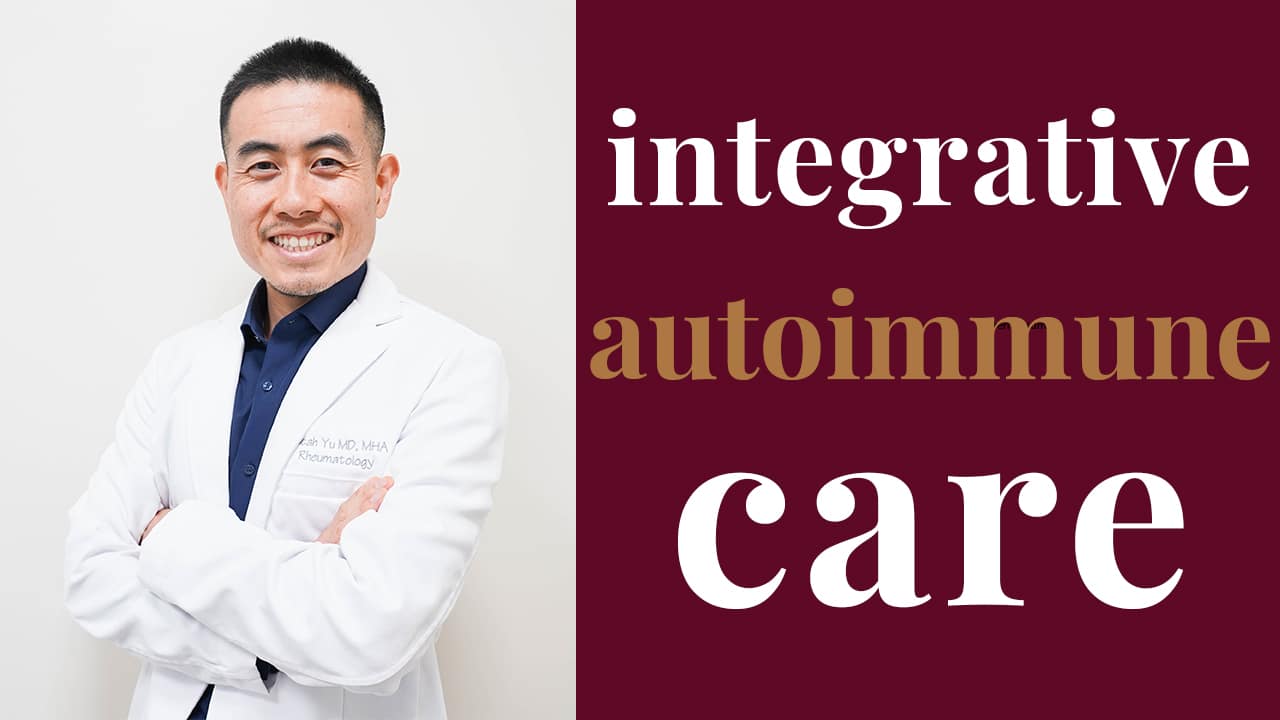
For many people living with autoimmune disease, seeing a rheumatologist can bring up a lot of uncertainty. Will they understand your interest in nutrition and lifestyle? Will the conversation focus only on medication? And is it possible to get care that brings all of these pieces together?
In this episode of the Autoimmune Wellness Podcast, I’m joined by Dr. Micah Yu, a quadruple board-certified physician specializing in rheumatology, internal medicine, integrative medicine, and functional medicine. Dr. Yu also lives with autoimmune arthritis himself, giving him a unique perspective on rheumatology as both a physician and a patient.
We talk about what integrative rheumatology actually looks like, how medication and lifestyle can work together, and how to build a healthcare team that supports the full picture of autoimmune health.
.
Watch the Episode
.
What Does a Rheumatologist Actually Do?
Rheumatologists care for a wide range of autoimmune and inflammatory conditions, and Dr. Yu describes the specialty as one that often requires a lot of detective work.
We discuss what rheumatologists are looking for when evaluating a patient, some of the misconceptions people have about conventional rheumatology, and why the structure of our healthcare system can make it difficult for physicians to spend significant time discussing nutrition and lifestyle.
That doesn’t necessarily mean your rheumatologist is opposed to these approaches—it may mean you need other members of your healthcare team to help address them.
.
Medication and Lifestyle Aren’t Either/Or
One of the most important themes of our conversation is that conventional treatment and lifestyle medicine don’t need to compete.
Dr. Yu explains why medications can be important for controlling inflammation and preventing permanent damage in some rheumatic diseases, while nutrition, movement, sleep, stress management, and other lifestyle interventions can address additional aspects of health.
We also talk about how patients who improve can work with their prescribing provider to reassess treatment over time rather than making medication changes on their own.
.
Getting More From Your Rheumatology Care
Rheumatology appointments can be short, so preparation matters.
Dr. Yu shares practical strategies for making appointments more productive, including bringing a concise health history, medication and supplement list, symptom timeline, and your most important questions.
We also discuss the value of building a multidisciplinary team. Your rheumatologist doesn’t have to provide every aspect of your care for nutrition and lifestyle to have a meaningful place in your treatment plan.
.
Resources
- Dr. Lifestyle
- My Autoimmune MD
- Instagram: @myautoimmunemd
- Podcast: Autoimmune Alchemy
.
Prefer to Listen Instead?
.
Episode Timeline
00:00 – Why rheumatology and lifestyle medicine don’t have to be either/or
02:15 – Introducing Dr. Micah Yu
03:41 – Dr. Yu’s personal journey with autoimmune arthritis
07:40 – Rheumatology 101: What does a rheumatologist do?
10:15 – Common misconceptions about rheumatology
16:15 – What integrative and functional rheumatology looks like
19:40 – Getting the most out of a rheumatology appointment
22:02 – Combining medication with diet and lifestyle
25:27 – Hope for people living with autoimmune disease
27:34 – Building an autoimmune healthcare team
28:22 – Wrap-up and where to follow Dr. Yu
.
Transcript
Below is the full transcript of Episode 97 of the Autoimmune Wellness Podcast. This transcript is provided for accessibility and reference.
Title: Integrative Rheumatology: Bridging Medicine, Nutrition & Lifestyle with Dr. Micah Yu (Ep 097)
Integrative Rheumatology: Bridging Medicine, Nutrition & Lifestyle with Dr. Micah Yu (Ep 97)
Mickey: For many people living with autoimmune disease, the word rheumatologist can bring up a lot of emotions. Maybe you’ve waited months to get your appointment. Maybe you’ve been told your labs look normal even though you feel not that great. Maybe you’ve wondered if you’ll be pressured into medications before anybody asks about your diet, your sleep, your stress, or your lifestyle.
Or maybe you’ve avoided seeing a rheumatologist altogether because you weren’t sure they could support the approach that you want to take. The truth is rheumatologists play a critical role in diagnosing and managing many autoimmune diseases, but the best outcomes don’t come from choosing between conventional medicine and nutrition or lifestyle.
They come from understanding how those pieces can work together. Today we’re talking with a physician who is helping bridge that gap.
Welcome back to the Autoimmune Wellness Podcast. I’m your host, Mickey Trescott, and today’s conversation is one I’ve been especially excited to share. I first met today’s guest when he invited me onto his podcast, and one of the things that immediately stood out to me was how balanced and thoughtful his perspective was.
As someone who’s spent more than a decade educating people about the role of nutrition and lifestyle in autoimmune disease, I deeply appreciate physicians who recognize that food, movement, stress management, and sleep all matter, but who also understand the incredible value of modern medicine when it’s needed.
Unfortunately, I think many patients feel like they have to choose between the two worlds. Either they pursue conventional care and they completely give up on lifestyle medicine, or they avoid specialists altogether because they’re worried their goals won’t be supported. But it doesn’t have to be that way.
Today, we’re talking about what integrative rheumatology actually looks like, how patients can build a collaborative relationship with their rheumatologist, and how nutrition, lifestyle, and conventional medicine can complement one another to create the best possible outcome. We’ll also hear about our guest’s own journey living with autoimmune disease, and how that personal experience has shaped the way he cares for his patients.
[00:02:15] Introducing Dr. Micah Yu
Mickey: Dr. Micah Yu is a quadruple board-certified physician specializing in rheumatology, internal medicine, integrative medicine, and functional medicine. He completed his medical training at Loma Linda University and the Andrew Weil Center for Integrative Medicine Fellowship at the University of Arizona. He’s the co-founder of Dr. Lifestyle and founder of My Autoimmune MD, where he helps patients address autoimmune disease through evidence-based integrative care.
What makes Dr. Yu’s perspective especially unique isn’t just that he is a rheumatologist. He’s also a patient living with arthritis himself. That personal experience, combined with his extensive medical training, has given him a deep appreciation for both conventional treatments and the powerful role that nutrition, lifestyle, and whole-person care can play in helping people live well with autoimmune disease.
So, Dr. Yu, thank you so much for being here, and welcome to the Autoimmune Wellness Podcast.
Micah Yu, MD: Thank you so much for having me on the show. It’s an honor to be on here.
Mickey: Well, I just feel like I won the lottery in terms of finding somebody who not only has the background and expertise in all of these areas, and then the personal history. So that’s kind of where I want to start, is your own story. I really think that that’s what makes your perspective unique.
Again, you’re not just a rheumatologist, but you live with arthritis yourself.
[00:03:41] Dr. Yu’s Personal Journey with Autoimmune Arthritis
Mickey: Can you tell us a little bit about your journey with autoimmune disease and how it shaped the physician that you have become?
Micah Yu, MD: Yeah. So my journey started many, many, many years ago. I was diagnosed with gout at the age of 17 in high school, it was very, very painful at the time. And then I continued to have flares throughout the years into my 20s in medical school.
But the disease really transformed into something that was not consistent with gout flares. I started having pains anywhere from my TMJs all the way down to my feet with unexplainable reasons why. I saw different rheumatologists. They couldn’t explain why I had my symptoms. They said that, “You have gout, yes, but you might have something else that’s going on, and we don’t know why. All your antibodies are negative.” But I did have high inflammatory markers at that time.
No one ever mentioned to me that, “Hey, you can change your diet to bring down inflammation.” So I continued eating Hot Pockets, fast food, and anything that was a quick bite, just to get through school and medical school, ’cause you know how busy it is, and how stressful it is.
So I would go to school and even go through residency with pain. I would flare anywhere from every two weeks to every month. And I was hoping that wouldn’t flare without medications, and I wasn’t given immunosuppressants because at that time, no one really knew what was going on. So I did take my gout medications at that time.
So it was a struggle. It was very painful, and I was hoping that one day I would find something natural to help myself. And I did notice that there was some correlation with food because when I would drink coffee at Starbucks, I would flare. so I was like, “Hmm, maybe there’s some correlation here.”
But in medical school you don’t learn enough about nutrition to tie the two and two together. So it wasn’t until I discovered a whole food plant-based diet that I gave this a shot. And I started getting better.
And I did forget to mention that I got diagnosed with a second disease called spondyloarthritis, and that was during residency. And spondyloarthritis is an autoimmune condition that can cause you to have joint pain from head to toe, and it’s very similar to rheumatoid arthritis. I was given medications to go on. I refused it. I’m not the best patient for doctors. So these were my own bosses that I refused medications from, because I saw my bosses as my rheumatologist.
So I discovered whole food plant-based diet, and I did that diet, and then I went to remission. I was doubting myself that I was getting better. One week would go by, one month would go by, two months go by, three months go by, I was pain-free. I was kinda shocked. I was waiting for a flare. And I got my labs done and my inflammatory markers did go negative. So that was very pleasant to see that objectively my inflammation numbers were also going down as well.
So that led me down the path of, “You know what? Maybe what I learned during my medical training isn’t the only answer here. Maybe there’s something better and greater to learn about.” That’s why I did a two-year fellowship at Andrew Weil’s Integrated Medicine Fellowship in University of Arizona. That’s why I went on to do functional medicine training. That’s why I’ve gone through all these different conferences to keep learning, because is a lot to learn about there regarding just not only health in general, but specifically autoimmune disease.
Mickey: Wow, thank you for sharing that, and definitely it makes sense that you started to have your own personal experience during residency, because I don’t think it’s an accident that somebody ends up with quadruple board certifications in integrative and functional medicine. So it definitely sounds like that experience led you on the path to figuring out more about how to help people with this, ’cause I can definitely relate to that story, so thank you.
[00:07:40] Reumatology 101: What Does This Specialty Do?
Mickey: Let’s back up. For anybody listening who doesn’t know what rheumatologists do, I actually grew up with a grandfather who was a rheumatologist, so I grew up kind of learning a little bit about what he did, but he always described it as being the detective of autoimmune disease. I’d love to hear from you.
What is a rheumatologist, and why would somebody see one?
Micah Yu, MD: Yeah, I totally agree with your grandfather. I believe they are detectives too. So a rheumatologist is a specialist in connective tissue diseases, and oftentimes when people think of rheumatologists and even other doctors, they think of autoimmune disease specialists. So yes, we do cover a lot of autoimmune diseases, especially of the connective tissue.
So anywhere that relates to tendons, bones, muscles, any autoimmune disease related to that, we cover. But we also cover non-autoimmune diseases as well that are rheumatic. So we cover osteoarthritis, which right now is not known as an autoimmune disease. It’s known as a wear and tear disease. It might change later on. We cover gout, we cover osteoporosis, so we just cover joint pains in general.
I usually describe rheumatologists as something similar to Dr. House. We’re always thinking, we always take the most complicated cases. When other specialists don’t have an answer, will give it to rheumatologists as sometimes a last resort to try to figure things out. So we give a lot of immunosuppressive medications, so a lot of medications that you might, as a listener, might be taking, we give those medications. We give a lot of medications that deal with pain as well. And we also deal with fibromyalgia.
So there’s a lot of different diseases that we treat. We probably treat over 50 diseases, most of which you probably never heard of ’cause they’re not that common.
Mickey: Yeah. Thank you for that overview, and I really have a lot of respect for rheumatology just because I know that often the patients that come to you, they have been through a lot of other specialties and while rheumatology doesn’t encompass all of autoimmune disease, it really does end up being the place that a lot of autoimmune patients end up just because of how the bones, the skin, the joints, and all of this connective tissue.
Actually, a lot of people are surprised by this. So I have psoriatic arthritis, which is a condition that is diagnosed by and cared for by a rheumatologist, but the connective tissue actually affects the skin and the eyes. So my first sign was actually uveitis, which is inflammation in my eye, and that’s how I got my referral to rheumatology and ultimately my diagnosis.
So it is kind of surprising sometimes how those paths can lead to rheumatology.
[00:10:15] Common Misconceptions About Rheumatology
Mickey: But let’s talk a little bit about some common misconceptions. So there’s a perception among some patients that rheumatologists aren’t interested in nutrition or lifestyle, and that the appointment is just going to focus on medications. What are some of the biggest misconceptions that you hear about rheumatology, and how do you approach those conversations differently with your patients?
Micah Yu, MD: Yeah. So the one you mentioned, rheumatologists aren’t really interested in nutrition and don’t believe in integrative care. That’s true to a certain extent. The conversation is changing. There are more interest in this, but you still have doctors who dismiss this idea all that food is medicine, and anything else outside of immunosuppressants can be helpful.
So is changing slowly. So that’s a misconception that all rheumatologists are not interested. I, myself, am very interested in nutrition. There are other doctors out there that are interested in nutrition. But I would say most of the doctors are still not very into this, and the ones that are into this don’t know enough about it.
They don’t have the training for this, so they don’t talk about it with their patients. They tell their patient, “Just go on a Mediterranean diet,” or, “Just go look it up online. It might help you. I believe in it, but I don’t know enough about it.” I think that’s where most doctors are at right now with this.
The second misconception is that rheumatologists don’t care. I get that sometimes. I wouldn’t say they don’t care. It’s the fact that they don’t have enough time. If you see a doctor in the insurance system, sometimes you get 20 minutes out of them, or half an hour, but sometimes that’s not enough for a rheumatology patient when you have symptoms from head to toe, not just of the joints. And it’s certainly not enough for follow-ups when you have 15 minutes and you have all these complicated questions and symptoms that you’re presenting with, and your doctor, they’re going down an algorithm. They’re giving you medications, and they want to see their next patient.
That’s how they do it in the clinics these days. And they have to do it to keep the door open. Or else if they spend a whole hour with you in the insurance system, they’re not going to have a practice that’s open. Rent’s expensive, staff is expensive, so there’s a reason why the system is the way it is. It’s ’cause it’s not survivable.
And doctors in the clinic that are employed by the hospital system, they have to meet metrics. If they don’t meet metrics, they’re going to fall behind, or they get yelled at by the administrators, okay? So a lot of the complicated cases, unfortunately, the healthcare system is not built to listen to you. And even these complicated rheumatic cases, the history is very important, so time spent with patients is really important. This is why I got out of the insurance system because I wanted to spend time listening to my patients get the full story, to treat them properly.
So I would say number two is your doctor just doesn’t have enough time for you. It’s not that they don’t care, okay? And number three is the most common misconception also is that I have an autoimmune disease, but my doctor doesn’t want to diagnose me. I would say sometimes a lot of these symptoms look like autoimmune diseases, the brain fog, the fatigue, but you actually don’t have an autoimmune disease. have other conditions that look like autoimmune diseases, such as mast cell activation syndrome, Lyme disease, fatigue, dysautonomia, POTS, Ehlers-Danlos. These are not specifically autoimmune conditions in rheumatology, so a rheumatologist probably isn’t going to diagnose you with this.
So you have to go outside of rheumatology and maybe talk to three doctors, four doctors, other specialists to get the right answer. Unfortunately there’s a lot of diagnoses in integrative medicine that regular doctors are not going to diagnose you with, are not going to look into. So sometimes you have to go to naturopath, sometimes you have to get a blend of all the different fields of regular medicine and alternative medicine to come up with the right diagnosis.
I know it’s very difficult to hear that, but being a doctor that lives in both worlds, I see all the different diagnoses in my clinic, so sometimes I am that final answer for the patient after all the years of being gaslit and seeing 20 doctors. Doctors are always evolving and learning, so you gotta seek a second opinion if your doctor doesn’t give you the right answer.
Mickey: Yeah. I think it’s really frustrating but also really good to hear the perspective from the doctor side. ‘Cause I think from the patients, you know, of course we want answers. We want to find the correct answer and then find the correct treatment and blend of treatments or something that’s going to work.
But sometimes it’s so frustrating to then be like, “Well, it’s not rheumatology. We need to go somewhere else.” But I will say that describing kinda what you’re seeing on your end with the insurance system and not having time. I mean, that is just an incredible issue in rheumatology just because, like, I waited eight months to see my rheumatologist after I almost went blind in one eye.
And they even were like, once my eye was recovered, kept pushing me out because I wasn’t in a flare, and there’s a lot of people that need to see rheumatology in my area. But when I did finally sit down with that doctor in the physical exam, she identified, like, the tiniest bit of pitting psoriasis on my nails, and that was actually the thing that tipped me over into being able to get the diagnosis of psoriatic arthritis, which doesn’t have antibodies.
Some of these conditions are just so challenging to diagnose, and that history and the time is really important. And if doctors are constantly squeezed into these tinier and tinier chunks of time a lot of things can go missed. So yeah, thank you for describing that and why it’s so hard. So maybe hopefully everyone can go in really informed, which we’re going to talk about in a little bit.
[00:16:15] What Integrative and Functional Rheumatology Looks Like
Mickey: But the next thing that I want to talk about is, so we talked about a little bit conventional rheumatology. Talk to us about what integrative rheumatology looks like. So you have these four board certifications in not just internal medicine, rheumatology, integrative and functional medicine. Talk to us about what integrative rheumatology actually looks like in practice, and how you combine evidence-based medicine with the nutrition and lifestyle interventions.
Micah Yu, MD: So my integrative medicine practice, it’s much different than a regular rheumatologist clinic, but also it’s different from other integrative rheumatologists. I say that because I have extra training beyond just integrative medicine. So regular integrative medicine, you’re just talking about diet, sleep, and these lifestyle factors, and maybe give you some supplements. I take it a step beyond that.
So my integrative medicine practice, of course I’ll look for your rheumatology problems. But sometimes you don’t have a rheumatology problem, so I will look for other potential diagnoses. Do you have SIBO? Do you have mast activation syndrome? Do you have Lyme disease? Do you have mold illness? I look for some of these things that regular rheumatologist doesn’t look for. And then not only do I talk about nutrition, lifestyle factors, sleep, stress, I discuss trauma with you.
Mickey: I
Micah Yu, MD: talk about other supplements, other herbs, maybe some homeopathic treatments that you can try to maybe help yourself.
So that’s what my clinic really looks like, and I also talk about regular rheumatology. So I will offer regular rheumatology medications to my patients. I will offer biologics. I will offer the immunosuppressive medications. If a patient doesn’t want to take it, that’s okay with me if we have time, meaning if a patient isn’t that sick, then we have time on our side to try some of these alternative medicine treatments.
However, if you’re really sick, you’re on the verge of going to the ICU or the hospital, will push you to go on medications just to bridge us over so that we can give the alternative medicine treatment some time to kick in. Because these alternative medicines, or in-integrative medicine therapies sometimes doesn’t work overnight. We don’t want to get you in the hospital. We want to keep you alive and well-functioning.
So if a patient is doing okay, they’re having some pain and aches, but they’re still living their life, then maybe we have some time on our side. We can give diet a chance. We can give supplements a chance and herbs a chance. And then eventually, if we do need medications, we just blend those medications in, and I do use medications and herbs and supplements all at the same time, including homeopathy and other treatments.
Mickey: love that. I’ve always said, all the tools in the toolbox, they should be all be available to everyone who wants to live well, and we should have no shame in picking a path that is blended. I mean, that’s what I’ve used in my own journey, and really, I just want to live a healthy life , you know?
And sometimes the medications and the lifestyle and the diet and everything together is, is what helps. And, especially, like, when I had my eye situation, I mean, you can go blind in a week without treating something like that. So I was very, very happy for the powerful medications that they had to get me out of that flare. Thank you for sharing that.
[00:19:40] How to Get the Most of a Rheumatology Appointment
Mickey: Let’s circle back a little bit about just how to get the most out of a rheumatology appointment. So for anybody who’s maybe preparing for an appointment, and you know that whether or not this rheumatologist is in the conventional system or even if they’re working more integrative like you do, Dr. Yu, how can a patient prepare themselves for that appointment and get the most out of it, to be an active partner in their care?
Micah Yu, MD: So the best way to prepare for a rheumatology appointment, I would say is keep a diary of your symptoms. And if you have a long history of diseases and medications you’ve been on spanning like five years, 10 years, 20 years, the best thing you can do is write a timeline out on the computer, whether it be on Microsoft Word, and bring it to the clinic.
And write down which medications you’re actively taking and which medications you’ve tried in the past. Because as a rheumatologist, I want to know what other diseases you have and what other medication you’re on, especially if you’re on a rheumatic medication. I want to know what you’ve tried and what you what’s working for you and what you’ve failed. Because that will determine what else I give you next.
From an integrative perspective, I would love to know like what supplements you’re taking, what herbs you’re taking, what other integrative modalities you’ve done, whether it’s, plasmapheresis, EBOO, homeopathy, hyperbaric oxygen therapy. I want to know all those things because that tells me what’s next on my list to give you if those things haven’t worked out. And it’s important that you come ready with questions to your doctor.
The first doctor you see might not be the right doctor for you. You gotta move on and find another rheumatologist and maybe ask those hard questions to your rheumatologist. What diet can work for this? What supplements have been proven to work? And also, what other potential diagnoses can I have if I don’t have this diagnoses that you’re giving me, especially if you’re not getting better.
Mickey: Yeah. All really, really great advice, and especially the symptom tracking. I always feel like when I go into the doctor and they’re like, “Ah, how you feeling?” It’s like, “Ah,” you know? But having a list I like to rank my tendon pain and my joint pain on a scale of one to 10, just so that I can see how that’s fluctuating over time, so when I go in and I can actually tell if my pain is getting worse or getting better, but that’s all really good advice.
[00:22:02] Dr. Yu’s Approach to Combining Medicine with Diet and Lifestyle
Mickey: So let’s talk about the lifestyle pieces alongside medicine, and we already talked about your approach to combining medication. But I know that you’re also a big believer in nutrition and lifestyle. How do you think about how that combination works? Can you describe a little more about how maybe somebody who is on a very powerful medication, which by the way, like, I know that the joint damage that comes with some of these autoimmune diseases is often permanent.
So I love that you mentioned that you don’t hesitate to use medication when it is clinically very appropriate because, you don’t want people having joint replacements and things because they failed to take a medication when they were in a really big flare. But once, you know, somebody’s coming to the table, maybe they’re on a medication, they’re feeling good, how do you combine that with lifestyle and nutrition?
Micah Yu, MD: So if a patient’s doing well in my clinic, and they’re on a good anti-inflammatory diet and they’re on medications, do open the discussion up about weaning them off of medications. So for example, if you’re on methotrexate, I would wean you off. If you’re on 20 milligrams, I would go down to 15 milligrams, and I’ll see you in a couple weeks or a couple months. And if you’re still doing well, and I keep weaning down the medications, to a point where, you get to a level there’s pain, then I stop there. That means your body can’t go any lower down.
Then I start opening the discussion about other alternative therapies. Do we need to add another supplement or herb to you? Do I need to give you a integrative medication to lower the pain burden? Do I need to do some other forms of healing? Do I need to give you acupuncture, or something else? Or is there something else we’re missing, a root cause like mold and Lyme that’s inhibiting you from healing completely? So I open that discussion up with my patients, and we go down the path of other alternatives.
Mickey: I think that’s a really reasonable, and of course, everybody should be having these discussions with their prescribing provider. But I think just mentally a lot of people who start diet and lifestyle on medications have this concern of, well, am I going to be able to tell if the diet and the lifestyle works?
And my practice as a nutritionist, I often tell people that, try to do everything you can to feel the best you can, and then work with your prescribing provider, like Dr. Yu, to then determine a plan of weaning or changing the different levers. Something that I do for my psoriatic arthritis, I realized I didn’t need to start something like methotrexate because I was able to use like a topical NSAID, for when I have a joint flare, which isn’t very often, and it spares like my gut the taking the oral NSAIDs.
So I determined that plan working with my rheumatologist, and we figured out that I can manage my pain when I have some flares without taking that medication. So this is the type of discussion I know a lot of people just don’t feel very empowered to have because they’re afraid of the medications or they’re afraid that their doctor isn’t going to want to wean them off.
But I think if you come at them from a position of health, is what I’m hearing you say, then you have a lot of leeway to adjust the plan and see what works for you. And there’s no shame in if your body really needs that little bit of medication or even a lot of medication to feel really great.
That’s what you need, and you deserve to feel great, right?
Micah Yu, MD: Exactly. Exactly. Yeah, there’s so many ways of healing.
[00:25:27] Hope for Autoimmune Patients
Mickey: So let’s talk a little bit about hope. So autoimmune diseases are lifelong conditions. Both you and I have that personal experience there. Even though we’ve overcome so much, there’s always this little piece of you that’s kind of like, “Uh-oh, I feel vulnerable.” And it can feel really overwhelming, especially when somebody is newly diagnosed.
What gives you hope today that maybe wasn’t true 10 or 20 years ago, both as a physician and as somebody that’s living with arthritis?
Micah Yu, MD: Yeah. What gives me hope is that these alternative therapies can work. Lifestyle medicine is becoming more of a conversation in modern healthcare, so future physicians will be educated on this topic of lifestyle playing a major role. And what proves to be true time and time again is that integrative medicine is, even though sometimes it’s called woo-woo, eventually modern medicine will come around find out that some of these integrative therapies are working and have evidence. They’re just not proven yet.
It gives me hope that in the future, more of these autoimmune patients will have more integrative treatments going forward. Also, these complex illnesses like Lyme and mold, they’re being recognized more and more each day, so hopefully 10 years, 20 years from now, this will be part of mainstream conversations.
Mickey: Yeah. I love that, and I really see a lot changing in the research landscape. I know a lot of people say, “We don’t research this,” but actually what I’m seeing in these research groups are actually a lot of interest in diet and nutrition and stress management, and in combination with conventional care.
And I think that everybody knows that it takes time for this stuff to be trickling down, but I agree with you, we’re going to get to a place where, this is much more mainstream because the results are there, and that’s what everybody wants, right? They want to feel better.
And once the word gets out, then I think we’re going to see a lot more of this. So thank you for that.
Micah Yu, MD: Of course.
[00:27:34] Dr. Yu’s Advice on Building a Healthcare Team
Mickey: If you could leave our listeners with one piece of advice about navigating autoimmune disease and building a healthcare team that truly supports them, what would that be?
Micah Yu, MD: Yeah. So if you are going to build a healthcare team, then definitely have a rheumatologist if you have a rheumatic disease. But also you want to find a therapist if you have trauma and stress, ’cause that plays a huge role with autoimmunity. And you want to find a dietician or nutritionist that’s well-versed in the conversations of autoimmunity, because there are a lot of dieticians out there and nutritionists that are general, but you want to find someone that understands the anti-inflammatory diet and the nuances of an anti-inflammatory diet. And don’t be scared to seek out a naturopath, a Chinese medicine doctor, Ayurveda, because some of these things can actually help you move forward and heal.
[00:28:22] Wrap-Up and Closing
Mickey: Dr. Yu, thank you so much for joining me today. I really appreciate the perspective that you bring to this conversation, both as a rheumatologist and as somebody who is an autoimmune patient yourself. I hope one of the biggest takeaways for everybody listening is that this doesn’t have to be an either/or conversation.
We don’t have to choose between working with a rheumatologist and paying attention to nutrition, movement, sleep, stress, all the things that we talk about on this podcast day in and day out. The goal is to build a team that respects the full picture and to use the tools that make sense for each of us, and I hope you learned a lot more strategies in how to do that today.
Before we wrap up, Dr. Yu, can you let everybody know where they can follow you, learn more about your work, and connect with you online?
Micah Yu, MD: Yeah. So you can find me at drlifestyle.org, DRLifestyle.org. That’s my clinic. I do a lot of telemedicine throughout the US, and I see consultations all over the world as well. And you can find me in my clinic in Newport Beach, California, if you want to come in person. And I am licensed in 16 states. So just go on the website.
And also, if you want to find me on social media, I’m at My Autoimmune MD. That’s M-Y Autoimmune MD. I’m on YouTube, TikTok, Facebook, and Instagram. And you can find me at myautoimmund.com if you want to look at my courses and more information. And you can listen to our podcast at Autoimmune Alchemy on Spotify and Apple.
Mickey: Yeah, you’re everywhere. And honestly your content is so great, so you guys definitely go give Dr. Yu a follow. He’s got some really great resources and interviews all over the internet and social media. I don’t know how you do it on top of being a rheumatologist, but I guess this is the type of person who gets quadruple board-certified.
So we’re going to include all of those links in the show notes. Thank you again for being here and helping us see what’s possible. And to everybody listening, thanks so much for joining us, and we’ll see you next time on the Autoimmune Wellness Podcast.




0 comments