

Eating differently can feel like a much bigger deal than it actually is.
Not because of the food itself — but because of the social dynamics around it. Dinner parties. Work lunches. Family holidays. First dates. Travel. The subtle pressure to explain. The awkwardness of declining. The internal negotiation about how much to share and how much to keep private.
In Episode 76 of the Autoimmune Wellness Podcast, we begin a new Small Bite series called AIP in Real Life — conversations about what it actually looks like to live this way long-term. Not just the food lists or the science, but the social navigation, mindset shifts, and emotional maturity that come with time.
If you’ve ever wondered:
How do I care for my health without making every gathering about my diet?
How much do I explain?
How do I decline something graciously without over-apologizing?
This episode is for you.
.
Listen to the Episode
.
Why This Feels Hard
Changing how you eat isn’t just a logistical shift — it’s a relational one.
Food is woven into our friendships, workplaces, family routines, and cultural rituals. When your needs change, the adjustment touches more than what’s on your plate. It affects belonging.
Many of us were never taught how to state a dietary boundary clearly and calmly. We’re used to going along with the group. So when we need something different — especially as women — it can feel unfamiliar and uncomfortable.
Early on, it’s easy to:
- Overexplain
- Apologize repeatedly
- Avoid social situations altogether
- Or treat your food choices like a performance
But eating differently doesn’t have to require constant explanation. It requires clarity and practice.
.
1. Decide Before You Arrive
Most social stress happens when you’re trying to figure out what to eat in real time — while also making conversation and managing expectations.
Decide in advance.
If you’re going to a restaurant:
- Look at the menu ahead of time
- Identify one or two options you can modify
- Call during off hours if you need clarification
- Choose restaurants that can reasonably accommodate you
When you walk in already knowing what you’re ordering, internal negotiation disappears.
If you’re going to someone’s home:
- Communicate with the host in advance
- Offer to bring a substantial dish
- Eat a small protein-forward snack beforehand
- Participate in holiday planning when possible
If needed — and when appropriate — bring your own meal. That preparation doesn’t make you rigid. It makes you calm.
If you’re traveling:
- Pack portable protein (jerky, compliant bars)
- Bring a reliable breakfast option
- Assume airport and roadside options are limited
When you have a backup plan, you’re far less likely to feel pressured into eating something that doesn’t work for you.
.
2. Keep Explanations Short
You do not need to deliver your full health history at the table.
Simple, neutral language works:
- “I’m eating a specific way right now.”
- “I’m working on my health.”
- “I feel best eating this way.”
- “I’m good with this, thank you.”
Then pause.
When you treat your food choice as ordinary, it usually becomes ordinary. Long explanations often invite more questions and unintentionally turn you into the topic of conversation.
Confidence closes the loop. Overexplaining opens it.
.
3. Gratitude Is Not the Same as Apology
You can be gracious without framing yourself as a burden.
Gratitude sounds like:
- “Thank you for hosting.”
- “I really appreciate the invitation.”
- “This looks beautiful.”
Apology sounds like:
- “I’m so sorry, I know I’m difficult.”
- “I hate being this way.”
- “I know this is annoying.”
Those tones communicate very different things.
You are managing your health. That does not require self-diminishment.
The more neutral and steady you are, the easier it is for others to relax around your choices.
.
4. Focus on Participation, Not Perfection
The goal of a gathering is connection — not dietary perfection.
Participation might look like:
- Sitting at the table with your own plate
- Quietly modifying the simplest menu option
- Bringing a dish you can share
- Eating beforehand and focusing on conversation
- Holding sparkling water or a mocktail so you’re part of the rhythm
Engage. Ask questions. Be present.
Most people won’t remember what was on your plate. They’ll remember how you made them feel.
There may be moments when the meal isn’t ideal — but it’s close enough. Discernment grows with experience. Presence matters more than perfection.
.
5. Accept That Not Everyone Will Understand
Some people will be supportive.
Some will be curious.
Some will say, “Can’t you just have a little?”
You don’t need everyone to agree with your choices in order to make them.
Simple responses work:
- “Nope, that still doesn’t work for me.”
- “I’ve tested that before, and it didn’t go well.”
- “I’m good with what I have.”
- You don’t need to debate. You don’t need to escalate.
Over time, consistency speaks louder than explanation. When you respond calmly and steadily every time, most people eventually stop questioning it.
And in the situations where they don’t — you still have clarity.
.
Identity & Long-Term Integration
Living this way long-term often involves an identity shift.
It can feel like leaving behind an old version of yourself — the person who didn’t need to plan ahead or think about ingredients. That adjustment takes time.
Over the years, what once felt amplified becomes routine. The urgency to explain fades. The discomfort softens. Eating differently becomes one part of how you live — not the headline.
You don’t have to perform your diet for anyone.
You don’t have to turn it into a teaching moment.
You don’t have to minimize it either.
Steadiness becomes normal. And that steadiness allows connection to remain intact.
.
AIP Foundation Series: Support for Getting Started
If you’re earlier in your AIP journey—or want to revisit the basics—the AIP Foundation Series is a great place to start.
This free, 5-day email course includes:
- Printable food lists
- Beginner-friendly meal plans
- Clear explanations of each AIP phase
- Tools to reduce overwhelm
👉 Sign up for the AIP Foundation Series
.
The New Autoimmune Protocol
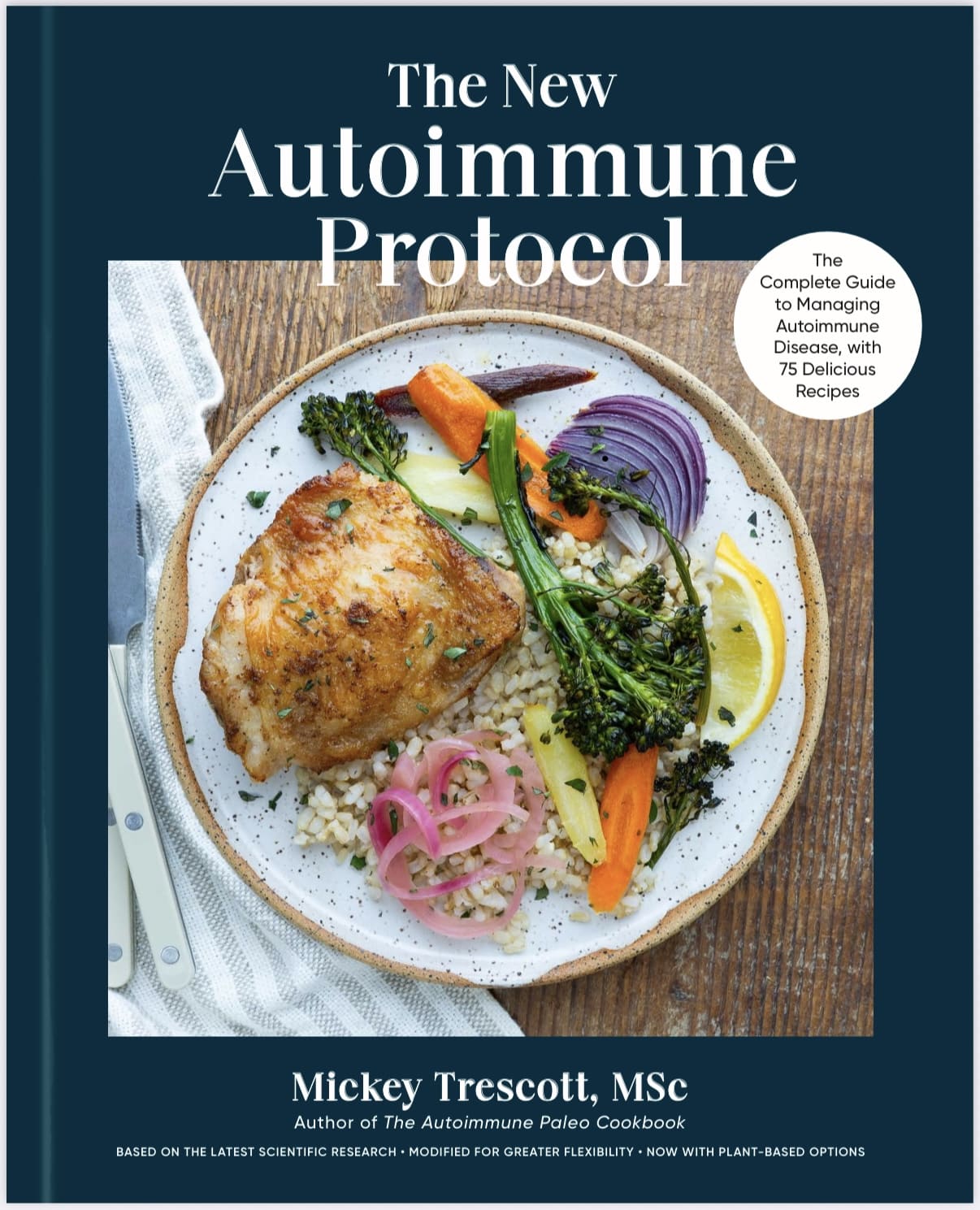
If you’re looking for a structured long-term framework for integrating AIP into real life — exactly the way we discussed in this episode — consider pre-ordering The New Autoimmune Protocol.
The book lays out updated guidance in a way that’s practical and sustainable, not just for starting AIP, but for living with it over time.
👉 Pre-order The New Autoimmune Protocol
.
Episode Timeline
00:00 – Why eating differently feels bigger than it is
02:34 – Why this feels hard
04:01 – Decide before you arrive
08:57 – Keep explanations short
11:04 – Gratitude vs. apology
12:36 – Participation over perfection
15:25 – Accept that not everyone will understand
17:19 – Identity & long-term integration
18:57 – Wrap-up
.
Episode Transcript
Below is the full transcript of Episode 76 of the Autoimmune Wellness Podcast.
This transcript is provided for accessibility and reference.
Title: AIP in Real Life: Eating Differently Without Making It a Big Deal | Small Bite (Ep 076)
Mickey: Eating differently can feel like a much bigger deal than it actually is. Not because of the food that you’re eating itself, but because of all of the social dynamics around it. How you navigate things like dinner parties, work lunches, family holidays, first dates, travel.
How do you care for your health without turning every gathering into a conversation about the way that you’re eating? How much do you explain? How much do you keep private? And how do you decline something graciously without over apologizing or over educating?
For many people, this part of AIP feels harder than the food list, because belonging and acceptance by our peers is so important, and figuring out how to take care of yourself while still feeling socially at ease takes practice.
Welcome back to the Autoimmune Wellness Podcast. I’m your host, Mickey Trescott. Today we’re starting a new Small Bite series called AIP In Real Life. Conversations focused on what it actually looks like to live this way over the long term, not just the food lists or the science, but the social navigation, the mindset shifts, and the practical maturity that comes with time.
I started AIP about 15 years ago when I was 26 years old, and at that time, none of my peers were dealing with chronic illness. Nobody had dietary restrictions for medical reasons. I was the very first in my social circle navigating different needs, and that felt so isolating. At that stage in my life, I often felt unsure how to communicate what I needed. I was young and I didn’t have language that felt steady or confident, and because of that I pulled back from a lot of social situations altogether, and I did lose a few relationships during that season. Not because of any conflict, but just out of discomfort and misunderstanding related to my illness.
It took time to realize that eating differently doesn’t have to become a performance. It doesn’t have to require constant explanation, and it doesn’t mean opting out of connection. It just requires clarity and practice. And that’s what we’re going to talk about today, how to eat differently without making it a big deal for yourself or for anybody else.
And before we get started, a quick reminder, this podcast is for informational and educational purposes and is not intended as medical advice.
All right, let’s get into it.
[00:02:34] Why This Feels Hard
Mickey: Let’s start by talking about why this feels so hard. Changing how you eat isn’t just a logistical shift, it’s a relational one. Food is woven into our daily life in so many ways. It shows up at work, in our friendships and family routines. When your needs change, the adjustment touches more than just what’s on your plate. And part of the difficulty that so many of us face around eating differently is simply communication.
Most of us were never taught how to state a dietary boundary clearly and calmly. We’re used to flexibility, going along with a group. So when we need something different, especially as women, it can feel so unfamiliar. There’s also a learning curve and separating what requires explanation from what doesn’t. Early on, it’s easy to overexplain or avoid situations entirely.
I definitely found myself here when I was in my original AIP and bumbling around trying to figure out how to have a social life a while eating a way that was vastly different from other people.
[00:03:38] A Practical Framework for Eating Differently in Real Life
Mickey: And all I can say is that it is a skill to learn how to communicate your needs clearly, and it becomes easier with repetition. And so that’s what we’re going to talk about today.
So these tips form a practical framework for eating differently in real life. And the first tip that I have for you is simply to decide before you arrive.
[00:04:01] 1. Decide Before You Arrive
Mickey: Most social stress happens when you’re trying to figure out what to eat in real time, while also making conversation and possibly managing expectations of the people around you. So making that decision before you get there can be absolutely transformative.
If you’re going to a restaurant, first, you want to pick a restaurant that can actually serve you food that you can eat. You’re going to have looked at the menu, probably online. You maybe have even called ahead and asked them, negotiated a meal, this is something that I have done time and time again.
Maybe you have identified one or two options that can be modified. Maybe you have already talked to the host who has communicated with the kitchen and they already know you’re coming. There are so many restaurants out there now that cater to allergen free diners, that there are places that you can actually just go to and know that you will be served a safe meal.
But the key here is that you are deciding in advance what options you have and what substitutions that you’ll request. And again, if it’s a fine dining kind of place, which honestly a lot of fancier restaurants, if you’re going out on a nice date or something, are actually pretty capable of providing allergen free meals if they are given some warning, and that is negotiated ahead of time.
So if needed, call ahead, during off hours, ask some simple questions about preparation that might help you hone in on what kind of meal you’re going to have, or even determine if that restaurant is something that you can safely dine at. Then when you walk in, you already know what you’re ordering. That alone reduces internal negotiation.
These days, there are so many restaurants. I live in Portland, Oregon. There are so many restaurants that actually cater to my specific sensitivities that I actually get overwhelmed when I go to a restaurant and I can eat most of the things on the menu because I’m so used to this practice of really having my spots and knowing exactly which items on the menu are best for me. So that’s a, a funny flip-flop, which most people go out to eat thinking that every option is on the table for them. But if you have autoimmune disease and you’re navigating AIP. This is something that you might need to negotiate ahead of time.
Now, if you’re going to someone’s home, you’re going to want to discuss with the host. Are they someone who you can trust to prepare safe food for you? Do they really know what that means? Now, a lot of time the answer is going to be no. And not because this person maybe doesn’t love you enough or understand enough, but just because the energy of negotiating, the exactness of cross-contamination and the ingredients is just a lot of work.
So some of my strategies for this situation is just to let them know maybe that you’re going to bring a dish, maybe you are bringing something that is substantial enough that it can serve as your main meal if necessary. You could also eat a small protein forward snack before you leave so that you’re not showing up super hungry. And then maybe you’ll eat after.
If it’s a holiday, definitely ask if you can be a part of the planning and the structuring. And if all of these are just not on the table, I have done this where I have brought my own holiday meal to my family’s holiday gathering and just simply heated up my plate and eaten it. Of course, I’m in a situation where I’m with my family members who know and love me and respect my boundaries and are okay with that.
So, if somebody invites you over for dinner as a casual thing, that’s probably not going to work. You’re definitely going to want to decide ahead of time versus just showing up hungry and then scrounging for a piece of fruit in their kitchen or something.
If you’re traveling, you definitely want to decide ahead of time what food is going to nourish you on your journey. So I’ll usually pack a portable protein, like some jerky, maybe a compliant bar, maybe a starch, like some cassava chips or some plantain chips.
Bring something that you know that you can rely on for breakfast. And actually these days I have reintroduced oats and I have a dry protein oat mixture that I just add a hot water. It has walnuts and flax and all it needs is some hot water. I actually bring that with me when I travel so that I can just heat it, eat it wherever I’m going so that I have a meal.
Also assume that airport and roadside options are limited if you are on AIP. So definitely bring some of your own food. So when you already know what you’re eating or that you have a backup plan, you’re less likely to feel reactive or pressured into eating something that you really don’t want to eat.
And that preparation doesn’t make you rigid, it makes you calm and able to settle in to the fact that you have a plan.
[00:08:57] 2. Keep Explanations Short
Mickey: Now, the second tip I have for you is keep explanations short. I wish that I had learned this so much earlier than I actually did. You do not need to deliver a full health history at the table, and you also don’t need to preemptively justify yourself.
So simple, neutral language works well whenever you have to discuss your dietary needs to a group of people. I’m eating a specific way right now. Full stop. I am working on my health. I feel best eating this way. I’m good with this, thank you.
Then you pause, you let the silence do some work. And one of the best pieces of advice that my former partner, Angie Alt, used to say was, “don’t be weird.” And what she meant by that wasn’t to minimize it or hide anything, she just meant don’t bring intensity to something that doesn’t require it.
So if you speak calmly, briefly, without any defensiveness, most people mirror that. If you treat your food choice like it’s weird or controversial, the conversation is going to become charged. Everyone is going to start to weigh in or say, I tried this thing, and then you’re on the defense, right? So if you treat it like it’s ordinary, it usually becomes ordinary.
Avoid launching into detailed explanations unless somebody pulls you aside and maybe sincerely asks. Avoid apologizing excessively and avoid oversharing in an attempt to make other people comfortable.
If somebody presses you for more information, you can decide in that moment whether you want to elaborate. But you’re definitely not obligated to. A short answer delivered calmly communicates confidence, and confidence tends to close that loop. Long explanations often invite more questions. All of a sudden, you are the subject of a dinner table conversation that maybe you don’t want to be the subject of.
I have been here myself. So I’m here to tell you that those short answers create normalcy. Moving on, nobody will remember.
[00:11:04] 3. Gratitude Is Not the Same as Apology
Mickey: And then the third tip that I have for you is gratitude is not the same as an apology. There’s an important distinction here. You can be gracious without framing yourself as a burden.
Gratitude sounds like, thank you for hosting. This looks beautiful. I really appreciate the invitation. Thank you for including me, I’m so happy to be here.
Apology sounds like I am so sorry. I know I’m difficult. I hate being this way. I know this is so annoying. And those two tones communicate very different things. When you apologize for your dietary needs, you’re subtly signaling that you’ve done something wrong, that your presence is this inconvenience, that your boundaries are disruptive and they’re not. You are simply managing your health. It’s appropriate to be appreciative. It’s not necessary to diminish yourself.
One helpful way to think about it is this: speak about your needs the same way you would speak about someone else’s. If a friend had a food allergy or a medical restriction, you wouldn’t expect them to apologize repeatedly. You would expect them to communicate clearly and participate the best they could.
And so you can do the same here. If somebody makes an effort to accommodate you, thank them sincerely. If something doesn’t work for you, decline simply. Gratitude maintains that connection, and apology creates this tension. So the more neutral and steady you are, the easier it is for others to relax around your choices, and over time, your steadiness becomes the norm.
[00:12:36] 4. Focus on Participation, Not Perfection
Mickey: My fourth tip for you is to focus on participation, not perfection. The goal of gathering is to connect with your people, right? It’s not dietary perfection. When you remember that the pressure shifts. Sometimes participation looks like sitting at the table with your own plate, ordering the simplest option available and modifying it quietly, eating beforehand so you’re not distracted by hunger while you’re hanging out with your people, bringing a dish that you can share, even if that’s the only thing that you personally are eating, or holding a drink, even if it’s sparkling water or a mocktail, a kombucha, so that you’re a part of the social rhythm.
Participation also means engaging. Asking questions, listening, being interested, and being present. Nobody is going to remember what was on your plate as much as they remember how you made them feel.
And I have attended many weddings where I prearranged to bring my own meal, and it was served alongside everyone else’s. Sometimes that means that I actually had to go back in the kitchen once and put my salad with some grilled chicken on a plate and bring it out myself because the caterer didn’t want to deal with the liability. Other times I’ve had caterers who were happy to heat it up for me and serve it out alongside everybody.
And once that is handled in advance, it stops being a topic beyond other people at the table being like, oh wow, that’s really interesting, I didn’t know that you could do that. I have attended events where most people were drinking and I brought kombucha or ingredients for a simple mocktail so that I could participate without compromising my needs.
And over time I’ve shifted some relationships that were heavily centered around eating and drinking out into ones built around other shared activities, going on walks together, creative projects, spending time outdoors. Food is just one way to connect, but it’s not the only way.
So participation also includes knowing when to let go of perfection. There might be moments where the food isn’t ideal, but it’s close enough. And what I’m talking about here is a meal that’s maybe technically AIP compliant, but like it doesn’t have the exact quality of meat or fats or vegetables that you would be cooking at home. There might be times when your priority is staying regulated and connected rather than achieving this flawless meal.
You might not be getting the level of nutrient density or the amount of vegetables or fiber, but you’re just going to accept that you’re just eating some grilled chicken on a salad with a boring dressing at a restaurant that is probably costing too much that it’s worth. But you’re getting to be and connect with your people, and that discernment grows with experience.
You just need to be present. And presence is what people respond to.
[00:15:25] 5. Accept That Not Everyone Will Understand
Mickey: And then tip number five is accept that not everyone will understand. This is such a hard one, and I still have people in my life that 15 years later they are saying things like, a little bit won’t hurt. Why can’t you just take a bite? I made this for everyone. Some people are going to be curious, some people are going to be supportive and some people are going to make comments. Right?
And I understand where it comes from. When someone’s needs are invisible, it’s easy to minimize them or make them a weird thing. Chronic illness doesn’t always look dramatic from the outside, and food reactions don’t always show up immediately or publicly. But here’s what I’ve learned. I don’t need everyone to agree with my choices in order to make them. I also don’t need to debate them.
When somebody says, can’t you just have a little? A simple response works. Nope, that still doesn’t work for me. I’ve tested that before and it didn’t go well, or, I’m good with what I have, and then stop. Even if it is this family member that I have in my life that has been doing this, every single holiday gathering. You do not need to convince them. You do not need to defend and you don’t need to escalate, and in some cases people adjust quickly and other cases they might not fully understand.
Over time. What I found is that consistency speaks louder than explanation. When you respond the same way every time, calm, steady, non-defensive, most people eventually stop questioning it.
And then in the situations where they don’t, you still have clarity. Acceptance doesn’t mean agreement from others. Sometimes it simply means you’re comfortable holding your boundary without needing that validation from them.
I’m here to tell you, you are allowed to prioritize your health. You are allowed to decline just a little. You are allowed to participate in your own way, and when you remain steady, your steadiness becomes the norm.
[00:17:19] Identity & Long-Term Integration
Mickey: Now that we’re done with the tips, there’s one more layer to this conversation that goes beyond logistics I wanted to touch on.
Eating differently over the long term often requires an identity shift. It can feel like leaving behind an old version of yourself, the person who ate whatever was served, who didn’t need to think about ingredients, who moved through social situations without any planning, and it can feel like outgrowing a familiar social script.
The adjustment is just going to take some time. Again, when I started AIP at 26, I felt acutely aware of being different. I was young. None of my peers were dealing with chronic illness. I did not have that steadiness that comes from lived experience. So every social interaction felt amplified. And now at 40, I don’t know if part of it is perimenopause, but it feels so different. Not because my needs have disappeared or changed, but because my sense of self is just more settled. I don’t really feel that urgency to explain. I don’t feel like people need to understand and I don’t feel the same discomfort taking up a little space.
And that shift didn’t happen overnight. It came from repeating these tips that I have told you throughout this episode. From navigating situations imperfectly and realizing that most people adapt when you’re consistent.
So you don’t have to perform your diet for anyone. You don’t have to turn it into a teaching moment, and you don’t have to minimize it either. Over time, eating differently becomes less of an identity and more of a routine. It becomes one part of how you live, not the headline.
[00:18:57] Wrap-Up and Closing
Mickey: I hope that if this is an area that you have found yourself struggling, how do I communicate with people? How do I eat out? How do I act normal? I hope that I’ve given you some, tools for figuring out how to navigate and how to work through that yourself.
If you’re looking for a structured long-term framework for integrating AIP into real life, exactly how we’ve discussed today, consider pre-ordering my forthcoming book, The New Autoimmune Protocol. We’re getting so much closer to release. The book lays out the updated guidance in a way that’s practical and sustainable, not just for starting AIP, but for living with it over time.
You can find more information in the show notes, and I’ll see you in the next episode.
.







0 comments