
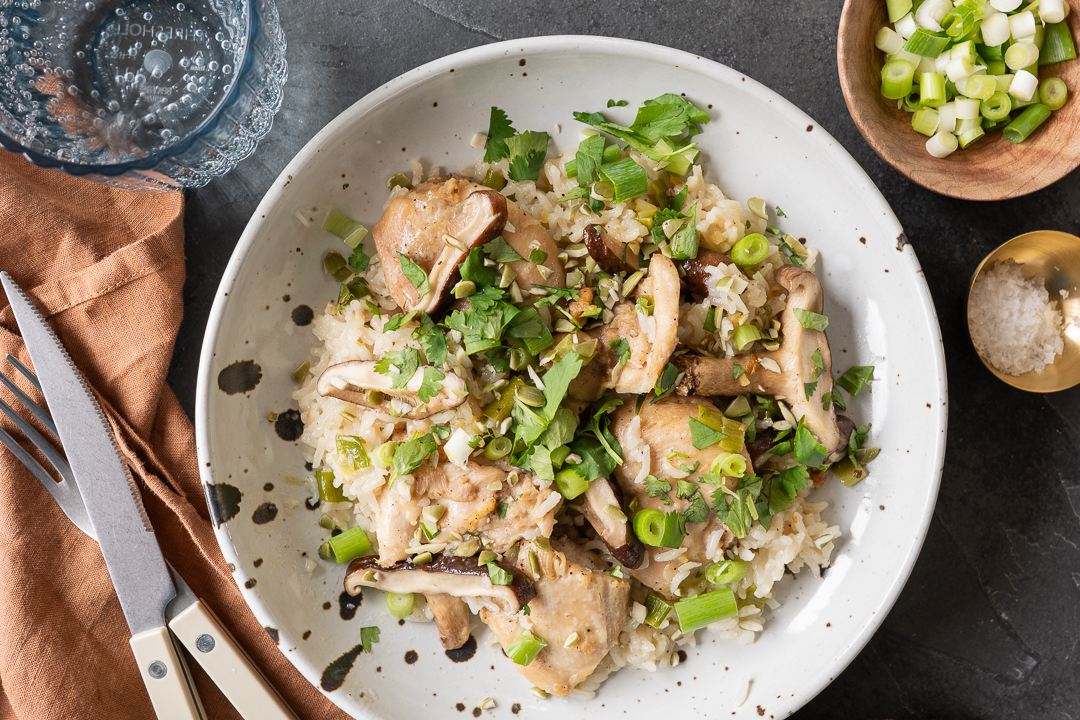
 If you’ve ever looked at an AIP-friendly recipe and thought, this looks amazing…but I don’t have the energy for multiple pans and a sink full of dishes, this episode is for you.
For many of us, the hardest part of eating well with autoimmune disease isn’t knowing what to eat—it’s figuring out how to make nourishing food work on ordinary days. The tired days. The decision-fatigue days. The days when cleanup feels like the last straw.
In Episode 68 of the Autoimmune Wellness Podcast, I’m continuing the Beyond the Recipe series with a meal that’s built for real life: Creamy Cilantro Chicken and Rice, a one-pot Dutch oven dinner adapted for Modified AIP. I’m joined by my friend Mary (my Hashimoto’s BFF of more than a decade), and together we talk about why one-pot meals are more than a convenience—they’re a strategy for consistency.
.
Listen to the Episode
.
Cilantro Coconut Chicken and Rice – Full Recipe
- 3 pounds boneless, skinless chicken thighs, each cut into 2 equal-size pieces
- ¼ cup avocado oil, divided
- 2 teaspoons sea salt, divided
- ½ teaspoon black pepper, divided
- 1 (2-inch) piece fresh ginger, minced
- 3 cloves garlic, minced
- 1½ cups white basmati rice, rinsed well
- 1¾ cups bone broth
- 1 (13.5-ounce) can full-fat coconut milk
- 6 ounces shiitake mushrooms, thinly sliced
- 1 bunch green onions, ends removed and white and green parts thinly sliced, divided
- Minced sunflower seeds
- Minced fresh cilantro
- Preheat the oven to 375°F.
- Place the chicken thighs in a large bowl. Rub with 1 tablespoon of the avocado oil, then season with 1 teaspoon of the salt and ¼ teaspoon of the pepper.
- Heat 2 tablespoons of the remaining oil in a large Dutch oven over medium heat. Working in two batches, brown the chicken, turning once, about 5 minutes total per batch. You’re looking for good color here—the chicken does not need to be cooked through. Transfer to a plate and set aside.
- Add the final 1 tablespoon of oil to the empty pot, along with the ginger and garlic. Cook until fragrant, about 30 seconds, stirring constantly to prevent burning.
- Add the rice and stir to coat it in the oil and aromatics. Pour in the bone broth and coconut milk, then add the mushrooms, half of the green onions, the remaining 1 teaspoon salt, and ¼ teaspoon pepper. Stir well, scraping up any browned bits from the bottom of the pot—this adds great flavor.
- Nestle the chicken pieces (along with any accumulated juices) into the rice mixture. Bring everything to a gentle boil.
- Cover the Dutch oven and transfer it to the oven. Bake until the rice is tender, the liquid is absorbed, and the chicken is cooked through, about 25 minutes.
- Serve warm, garnished with the remaining green onions, minced cilantro, and sunflower seeds, if using.
Why One-Pot Meals Matter So Much on AIP
One-pot meals aren’t trendy—they’re practical. They lower the barrier to actually feeding yourself well.
When capacity is low, the challenge isn’t motivation. It’s bandwidth. And meals like this one reduce:
- steps
- dishes
- mental load
- decision fatigue
This recipe is a great example of what “kitchen confidence” looks like in real life: not doing the most, but choosing methods that make it easier to come back and cook again.
.
About the Recipe: Creamy Cilantro Chicken and Rice
This dish is made entirely in a Dutch oven, going from stovetop to oven in under an hour. You brown chicken thighs first, then build a rich base with coconut milk and bone broth, add vegetables like green onions and shiitake mushrooms, and let the rice cook underneath the chicken so it absorbs all that flavor as everything finishes together.
It’s cozy and complete without being heavy—exactly the kind of dinner that feels special, but doesn’t ask a lot of you.
.
Why This Works So Well for Modified AIP
One reason this meal feels so satisfying is that it fits beautifully into Modified AIP, which includes rice. Rice can add a comforting, supportive element—especially for active households or anyone who needs a meal that truly sticks with them.
And when the rice cooks in a flavorful sauce right in the pot, it turns the whole meal into something that feels restaurant-level comforting…with weeknight-level effort.
.
Dutch Oven Cooking: Confidence + Convenience
This episode also includes a practical conversation about Dutch ovens—why they’re one of the most forgiving, flexible tools you can use for AIP cooking, and how they help reduce cleanup by letting you brown, simmer, and bake all in the same pot.
We also share a key safety reminder: cast iron handles stay extremely hot when moving between the oven and stovetop (it’s an easy mistake to make—learn from ours).
.
Leftovers, Storage, and “Future You” Support
One of my favorite parts of one-pot cooking is how naturally it supports leftovers. This meal reheats beautifully, and you can even refrigerate the leftovers right in the Dutch oven (when food safety and portion size make sense), which reduces container clutter and cleanup.
Meals like this don’t just feed you once—they support consistency across multiple days, which is a big part of what makes AIP sustainable.
.
Resources
.
Episode Timeline
00:00 – Why low-energy cooking matters
01:13 – Today’s recipe + Beyond the Recipe series
01:58 – Introducing Mary (Hashimoto’s BFF friendship)
02:44 – Visual description of the dish
03:38 – Why this recipe works in real life
06:52 – Dutch oven cooking: stovetop to oven
08:45 – Cast iron brands and sizes
09:57 – Dutch oven safety tips (hot handles!)
11:20 – Clean-as-you-go + reducing overwhelm
13:12 – Leftovers, reheating, and stretch meals
13:56 – Wrap-up + where to find the recipe
.
AIP Foundation Series: Support for Getting Started
If this episode helped you think differently about what actually makes AIP sustainable—especially on lower-capacity days—you may also like the AIP Foundation Series, a free beginner-friendly email course designed to help you:
- understand the structure of AIP
- learn what to eat in each phase
- build simple, supportive meals
- reduce overwhelm and confusion
Episode Transcript
Below is the full transcript of Episode 68 of the Autoimmune Wellness Podcast. This transcript is provided for accessibility and reference.
Title: Beyond the Recipe: Creamy Cilantro Chicken and Rice with Mary | Small Bite (Ep 068)
Beyond the Recipe: Creamy Cilantro Chicken and Rice with Mary | Small Bite (Ep 068)
Mickey Trescott: If you’ve ever looked at an AIP recipe and thought, this looks great, but I really don’t have the energy for multiple pans and a sink full of dishes, this episode is for you.
For a lot of us, the hardest part of eating well with autoimmune disease isn’t knowing what to eat. It’s figuring out how to make nourishing food work on regular or ordinary days, days when you’re tired, when you have a little decision fatigue and days where cleanup just feels like the last straw.
And that’s why one-pot meals matter so much. Not because they’re trendy, but because they lower the barrier to actually feeding yourself well. They have fewer steps, fewer dishes, and less mental load, which means you’re more likely to come back to that recipe again and again.
Welcome back to the Autoimmune Wellness Podcast. I’m your host, Mickey Trescott, and this is a Small Bites episode. Today’s episode is part of my Beyond the Recipe series. In these episodes, we take one recipe and talk about what makes it work in real life, why it’s supportive, how it fits into AIP, and what it can teach us about cooking in a way that’s sustainable and confidence building, not overwhelming.
[00:01:13] Today’s Recipe: Cilantro Coconut Chicken and Rice
Mickey Trescott: Today we’re talking about Cilantro Coconut Chicken and Rice. This is a recipe that I adapted from a New York Times Cooking dish called Sticky Coconut Chicken and Rice by Kay Chun. It has been thoughtfully reworked for Modified AIP, and it’s exactly the kind of meal I find myself wanting to make again and again.
The whole thing comes together in a Dutch oven, goes from stove top to oven, and is on the table in under an hour. It’s the kind of meal that feels just a little bit special, but doesn’t ask a lot of you, which is exactly what most of us need on weeknights. I’ve published the full Cilantro Coconut Chicken and Rice recipe on the Autoimmune Wellness Blog. You’ll find it linked directly in the show notes so that you can cook along, bookmark it, or come back to it later.
[00:01:58] Introducing Mary: My Hashimoto’s BFF
Mickey Trescott: And today I’m not talking about this recipe alone. I’m joined by my friend Mary, and we’re going to talk about why this kind of cooking works so well in real life, especially when energy and capacity are limited. Mary and I met over 12 years ago in a Hashimoto’s Facebook group, back when a lot of us were just trying to make sense of our symptoms and figure out how to support our bodies.
Over time, that online connection turned into a real life friendship. And ever since we’ve been the kind of friends who love talking nutrient-dense cooking, swapping kitchen tips, and sharing what’s actually working for us in real life. So let’s get Mary on the call.
Hi Mary. I’m so glad you’re here. How are you doing today?
Mary: Hi Mickey. It’s great to be here.
Mickey Trescott: I’m so excited to be talking about this recipe with you today.
[00:02:44] Visual Description of the Recipe
Mickey Trescott: But before we dive in, I want to take a minute to describe this recipe because everyone is just going to be listening along, doesn’t have the recipe pulled up in front of them.
Today we’re talking about Cilantro Coconut Chicken and Rice. A one-pot meal made in a Dutch oven. So you start by browning chicken thighs on the stove top, and then build a rich, nourishing base with coconut milk and bone broth. Throw in some vegetables, like green onions and shiitake mushrooms, and then you add the rice to cook with the chicken on top, so it soaks up all of that flavor and then everything finishes together in the oven.
When it comes out, you’ve got this tender, fragrant rice, juicy chicken and the whole dish feels cozy and complete without being heavy. It gets topped off with some fresh green onions, cilantro, and minced sunflower seeds for some green and a little bit of texture, and it’s the kind of meal that smells incredible while it’s cooking and feels deeply satisfying to sit down to.
[00:03:38] Why This Recipe Works in Real Life
Mickey Trescott: So now that everybody can picture it, Mary, I would love to hear what you thought of the recipe the first time you made it, and what stood out to you once you actually cooked and ate it?
Mary: It was fantastic and very, very efficient. The process to make it was super easy, and the flavors are some of my favorite because I love anything that has coconut milk and lime and cilantro, sort of that profile.
Mickey Trescott: Something that stands out for me is just that it feels comforting and complete without being complicated. When I saw the New York Times recipe, I thought, this is so close to Modifed AIP and the method was really the thing that attracted me to it.
Mary: I just was struck by how much these days, if it doesn’t look easy, I am reluctant to do it. Even though I’m capable of cooking a more complex meal. I’m really drawn to anything that is simple.
Mickey Trescott: I think that’s a good observation. ’cause a lot of us, especially those of us who’ve been eating special diets for a long time are probably pretty proficient in the kitchen. But when you look at a recipe and you see it involves all of these different processes or even a lot of detailed chopping and prepping. It’s not something that I’m going to want to do for a regular dinner.
One of the reasons I love this recipe is because it fits well into Modified AIP and Modified AIP is the new version of AIP that includes rice. I think that’s an important part of why it feels satisfying.
Did having rice in the dish change how filling or supportive it felt to you compared to some other one-pot meals that you’ve made in the past?
Mary: There’s an ease with rice, I feel like it’s sort of one of those universal comfort foods. The rice is huge for us, because if you’re active like we are in our house, it’s nice to have a little more richness, calories, carb loading when you need it kind of thing. Normally when I make a dish with rice as a side, I’m trying to make a dish that has a sauce anyway because I want sauce for the rice. ’cause it reminds me of if I’m eating out at a restaurant, and you know, it’s Thai, for example, I want curry or something that flavors the rice, and so this took care of that.
Mickey Trescott: Let’s talk for a second about one-pot meals. With this meal, you brown the chicken, you kind of use those juices and those little bits to build a base, and then it all finishes together in the oven. When you’re thinking about what to cook on a busy or a lower energy day, how much does that one-pot factor influence what actually ends up on your table?
Mary: It is a huge factor for me. I’m good about reading a recipe ahead of time, that’s sort of cooking 101 at this point. I would say certainly on a weeknight or a night where I have less time, it has to be simple. But even on a weekend, I’m less inclined to choose something if it seems like it’s going to add a lot of prep or oh, I had to remember to marinate something, or whatever, and so choosing one-pot, I’m always drawn to a recipe that says, fast and easy. Because the reality is I want it to be straightforward.
Mickey Trescott: Less cleanup, fewer decisions and dinner still feels nourishing. I think that combination really matters a lot and probably more than we really give it credit for.
[00:06:52] Dutch Oven Cooking: Stovetop to Oven Confidence
Mickey Trescott: One thing I want to spend a minute on is the way that this recipe uses a Dutch oven. So for people listening who aren’t familiar, this is a large cast iron pot. It has a lot of flexible uses, which in this recipe, it starts on the stove top. It moves everything to the oven. That’s like a classic use of a Dutch oven. And I know for some people it can sound kind of intimidating at first, but it’s actually one of the most forgiving vessels to cook with.
You can use it for that initial browning and flavor development and then the oven does the steady even work of finishing the meal. And you can even finish meals on the stove top.
Do you use a Dutch oven in your cooking and what are your favorite uses for it?
Mary: We use Dutch oven all the time, particularly I would say nine months out of the year. I associate it with anything sort of fall, winter, comfort type of food. We use it probably slightly less in the very hot summer months, but that’s true of any stove cooking, right? You’re looking for, anything with less heat. But the Dutch oven is in regular rotation in our house in different sizes too, depending on the need of the dish. In this case, I believe we used the five and a half or five and a quarter quart. And it was perfect for that.
Mickey Trescott: What I love about a Dutch oven is it holds that heat really evenly. So something like this where you have rice and chicken, the rice cooks really gently, the chicken stays juicy. Everything kind of can finish together without a lot of fuss.
Because I know people will ask, let’s talk about what kind of Dutch ovens you mentioned you have a couple different sizes and brands. Talk to me about what you’ve got in your kitchen.
Mary: Definitely, the ones that we use most frequently are enameled, cast iron Dutch ovens. One Le Creuset, we have one that is Staub, S-T-A-U-B. I know those are higher price points, but there’s also some great options now. I’ve seen great enamel cast iron at Costco and sometimes you can find them at Home Goods or Marshalls or TJ Maxx type of place. If you’re looking for the enamel cast iron versus just the pure kind of classic lodge type of cast iron, which is even more affordable and a great tool in your kitchen. The ones that we use most often are the Le Creuset and the Staub, because the cleanup is so easy.
Mickey Trescott: Yeah, and I know that people love collecting different sizes and colors. I’m actually kind of a minimalist. I only have one Dutch oven and mine is a 30 centimeter Staub, so that holds 8.8 quarts, which is just enormous, it’s really good for batch cooking, I can make about eight to 10 servings of something.
And of course, like the Staub and the Le Creuset, they are both investments. I have family members that have the enameled Dutch ovens by Lodge. Lodge makes just pure cast iron ones, they make enameled ones. They work really well, pretty affordable. And they have a seven and a half quart, which I think is a really good starter size for people who want to cook for your family, or you want to do some batch cooking. It’s about a hundred dollars. So I’m going to drop all those links in the show notes that you guys can get some inspiration if you’re looking to include a Dutch oven.
[00:09:57] A Word of Caution Using Dutch Ovens
Mickey Trescott: There is one risk about Dutch ovens that people should know about that I think you and I have been on the wrong side of before. You want to tell us about that, Mary?
Mary: Yes, learn from my mistake, it only took once. Because it’s efficient and you can go from stove to oven and then you take it out of the oven and you maybe put it back on the stove to test it, taste it, adjust seasoning. Maybe it goes back in for a few more minutes. It’s really easy to forget just how hot the cast iron gets in the oven.
And if you were holding it initially on the stove, your instinct is to grab the handles and not think twice of it. So one thing I’ve learned, I have multiple sets of pot holders laid out in front of me right next to the stove and the oven so that I can’t mess it up, because it’s one heck of a burn if you grab that heated cast iron.
Mickey Trescott: That is a great warning and any pot that I have that goes in the oven and the stove top, I have this problem with, I have a carbon steel skillet that for some reason that’s the one for me. I’ll pull it out of the oven and the risk is when it’s out and it’s sitting on the stove top, cooling. Sometimes I will even like wrap it in a oven mit because I just don’t want to forget because those burns are bad. So be careful you guys.
And on the topic of Dutch ovens, I just want to ask you, Mary. I love this style of cooking, put everything together and throw it in the oven for, this recipe cooks for about 20 to 30 minutes unattended, and then it’s just ready to go. What do you like to do in that little piece of time while something is cooking?
Mary: Anytime something goes in the oven, that’s when I am cleaning the cyclone, hurricane, tornado that happened in my kitchen. In this particular case, because it’s such a straightforward recipe, it wasn’t as crazy because I just had a few bowls for the items that I needed to have chopped ahead of time. The green onion, the mushrooms. It wasn’t a typical like dishes everywhere sort of situation. But I always try to clean when something like that is happening because it just means less work once the meal’s done.
Mickey Trescott: I’m just like you Mary. I’m a clean as I go kind of person probably, it’s my whole personality. One of my favorite things about this type of recipe and even like a Dutch oven, is actually we will eat a couple servings from the Dutch oven. We’ll let it cool in there, and then we’ll stick the whole Dutch oven in the fridge.
And guess what? Not only do I not have to clean that pot, but there is a storage vessel for the next day. And sometimes depending on, you know, quantities, I don’t like reheating, maybe four servings of something, and then using two and having it cooled down, that’s not very good food safe practice. But this type of recipe, actually, in my household, I have a partner who eats lots of food, and this makes about four servings for us.
So we can eat about half of it, throw it in the fridge, in the Dutch oven, the next day, just reheat it on low. And then I only have to clean that pot once. I don’t have any leftover food containers that I have to clean, and it just makes things so much easier.
Also want to say if somebody listening doesn’t have a Dutch oven, it doesn’t mean that this recipe is off limits. Any heavy oven-safe pot with a lid can work here. You really need the lid so that everything steams and that rice cooks completely.
[00:13:12] Serving, Leftovers, and Making It Work Beyond One Meal
Mickey Trescott: The last thing I want to talk about is just because this cooks everything together so gently, it sets us up really well for leftovers, which I know we both appreciate.
Mary: I never make anything without having enough for leftovers. I mean, that’s one of my core principles, I always want to be able to have more than one meal. I also am a savory breakfast person, so I think I had one day where I ate it for breakfast and then another day where I ate it for lunch. Cause there was plenty, we made enough that we had about six servings total.
Mickey Trescott: I love to pre chop the sunflower seeds, the green onions and the cilantro and have that in a little container so that all I have to do when I heat the rest of it up is just sprinkle that on top and it’s good to go.
[00:13:56] Takeaways and Closing
Mickey Trescott: So meals like this definitely remove friction. They make it easier to eat well without needing extra motivation or planning, which is so important when you’re managing low energy or symptoms. And I think that’s one of the quiet superpowers of recipes like this. They don’t just taste good, they support consistency.
This dish brings together so many of the things that we talked about today. Modified AIP flexibility, one-pot cooking, nourishing ingredients, and a method that lets you set things up and then just step back. It’s the kind of recipe that builds confidence because once you’ve made it once you know you can come back to it again.
Mary, thank you so much for having this conversation with me. I love that we still get to do what we’ve been doing for years, which is talking through what actually works in our kitchens and our lives on the regular.
Mary: Thanks Mickey.
Mickey Trescott: To our listeners, if you’d like to try this recipe yourself, the full Cilantro Coconut Chicken and Rice is published on the Autoimmune Wellness Blog, and you’ll find the link in the show notes so that you can save it or cook along.
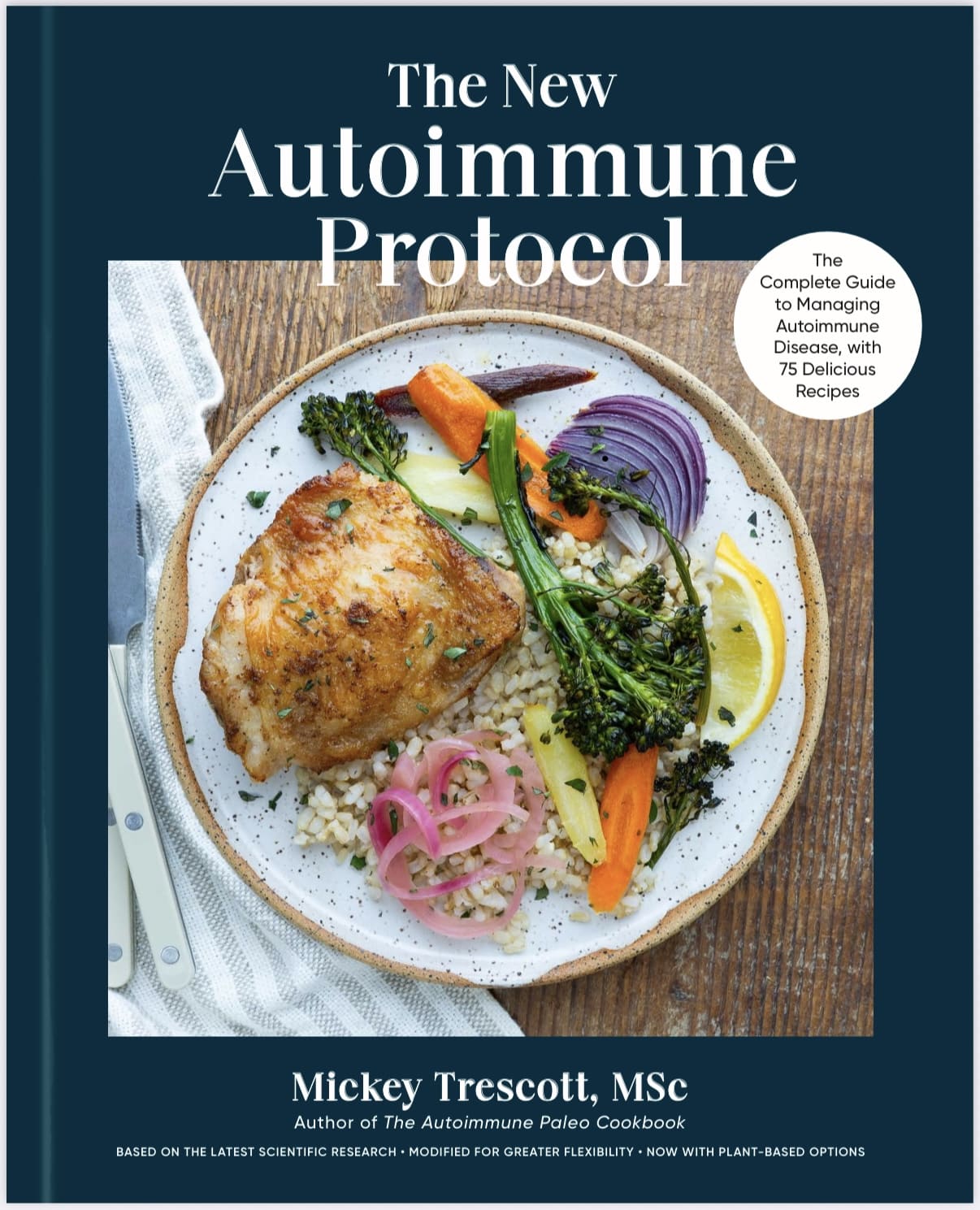
And if you’re looking for more support around making AIP work in real life, especially when it comes to flexibility, confidence in the kitchen, and adapting recipes in a way that feels nourishing and sustainable, I invite you to pre-order my upcoming book, The New Autoimmune Protocol. The book brings together everything we’ve learned about AIP over the years, including updates around Modified AIP, and how to apply the protocol in a way that supports real bodies and real lives.
Pre-orders are incredibly helpful and they directly support getting this work into the hands of more people who need it. Thanks so much for spending this time with me and Mary today. I’ll see you next time for another Beyond the Recipe episode.






0 comments