
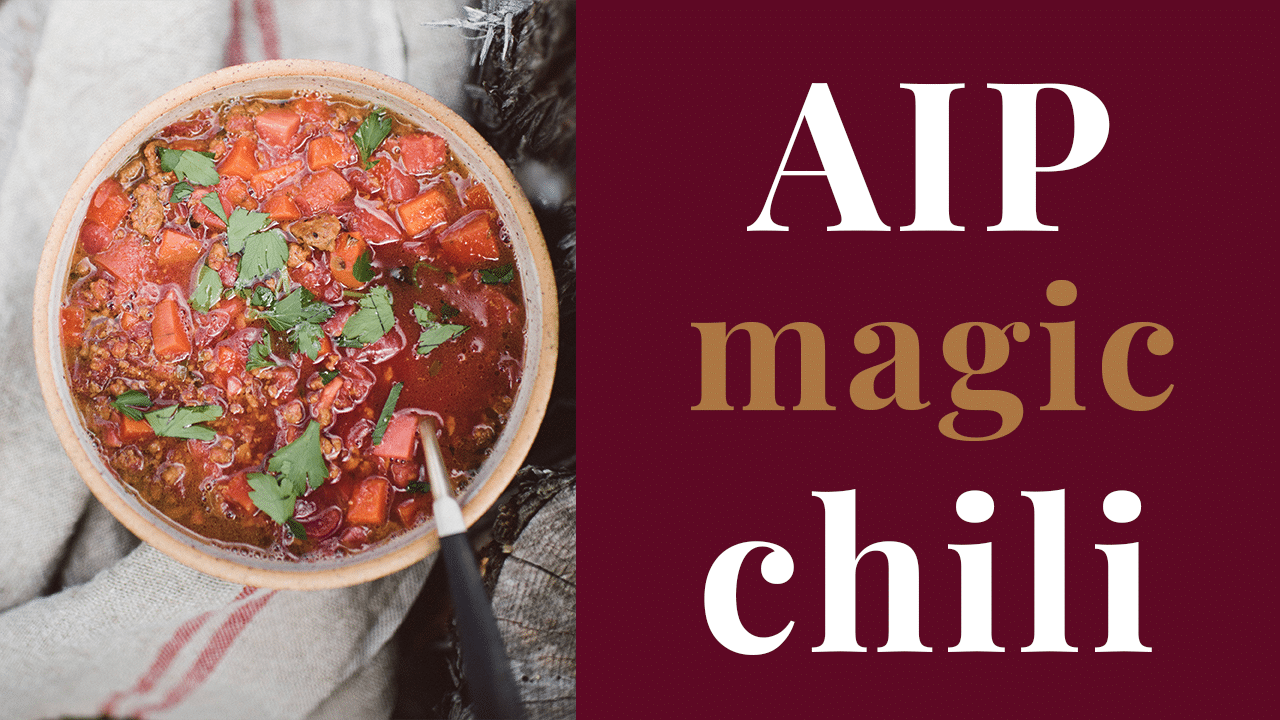
If you’ve ever worried that starting AIP means saying goodbye to your favorite comfort foods forever, this episode is for you.
Chili is one of those nostalgic meals—rich, red, hearty, and grounding. But traditional versions rely on tomatoes, beans, paprika, and chili powder—all nightshades. So what happens when you remove them?
In this Small Bite episode of the Autoimmune Wellness Podcast, we take a deeper look at Magic Chili—a completely nightshade-free version that somehow still delivers the color, texture, and savory depth you expect from a classic bowl.
This is part of the Beyond the Recipe series, where we go beyond instructions and into the “why” behind recipes that actually work in real life, this time with Marie-Noelle Marquis of Urban AIP Meal Delivery.
.
Watch the Episode
.
Get The Recipe
- 1 tablespoon solid cooking fat
- 1 large onion, chopped
- 4 cloves garlic, minced
- 4 cups bone broth (3 cups for the Instant Pot version)
- 2 parsnips, chopped into 1½-inch pieces (about 2 cups)
- 3 carrots, chopped into 1½-inch pieces (about 2 cups)
- 1 large beet, grated (about 2 cups)
- 2 tablespoons minced fresh oregano
- 1 teaspoon onion powder
- ½ teaspoon sea salt
- ½ teaspoon garlic powder
- ⅛ teaspoon cinnamon
- 2 pounds grass-fed ground beef
- Parsley sprigs, for garnish
- STOVETOP
- Heat the solid cooking fat in a heavy-bottomed pot on medium heat. When the fat has melted and the pan is hot, add the onions and cook, stirring, for about 7 minutes, or until the onions are beginning to brown. Add the garlic and cook another 1 minute, until fragrant.
- Add the bone broth, parsnips, carrots, grated beet, oregano, onion powder, salt, garlic powder, and cinnamon. Bring to a boil, then turn down to a simmer and cook, covered, for 20 minutes. (If your stovetop can’t manage a covered simmer on the lowest setting, you can set the lid ajar to allow some heat to escape.)
- Meanwhile, place the ground beef in a skillet over medium-high heat. Cook for about 10 minutes, stirring to break up the pieces and brown evenly, until the meat is fully cooked and the juices are reabsorbed.
- When the vegetables are finished, add the ground beef to the pot and simmer, covered, for another 15 minutes.
- Serve garnished with fresh parsley.
- INSTANT POT
- Follow step 1 using the Sauté function on the Instant Pot.
- Add 3 cups of bone broth, the parsnips, carrots, grated beet, oregano, onion powder, salt, garlic powder, and cinnamon. Close and lock the lid and cook on Manual High Pressure for 5 minutes.
- Meanwhile, place the ground beef in a skillet over medium-high heat. Cook for about 10 minutes, stirring to break up the pieces and brown evenly, until the meat is fully cooked and the juices are reabsorbed.
- When the timer goes off, use the quick release method to release the pressure. Carefully open the lid and add the ground beef to the pot. Close and lock the lid and cook on Manual High Pressure for 2 minutes.
- Serve garnished with fresh parsley.
.
Why Comfort Foods Still Matter on AIP
One of the biggest fears people have when starting the Autoimmune Protocol is that their comfort foods are gone forever.
But healing isn’t about permanent deprivation. It’s about creative reconstruction.
Magic Chili proves that comfort can exist without inflammatory ingredients. By focusing on flavor architecture instead of restriction, it’s possible to recreate something that feels deeply familiar—even if the ingredient list looks different.
The goal isn’t to trick anyone. It’s to build something so satisfying that nothing feels missing.
.
How This Chili Works Without Tomatoes
The foundation of this recipe is grated beet.
Not chunks of beet. Not a strong earthy flavor. Just enough finely grated beet to melt into the base, providing:
• A rich red color
• Subtle natural sweetness
• Depth and body
When combined with caramelized onions, garlic, bone broth, oregano, and a touch of cinnamon, the result is layered and savory—not “beet-y.”
The cinnamon doesn’t make the chili sweet. It adds warmth. The oregano brings familiarity. The long cooking time deepens everything.
This is flavor building with intention.
.
From Home Kitchen to Urban AIP
This episode also explores what happens when a home recipe moves into large-scale production.
At home, this chili makes about six to eight servings. At Urban AIP, it’s prepared in batches large enough to feed one hundred clients at a time—while still maintaining caramelization, texture, and consistency.
Instead of one giant pot, the recipe is divided into multiple batches to preserve flavor development. Cooking time increases significantly. Testing ensures the balance remains intact.
It’s a reminder that quality doesn’t happen by accident—it’s designed.
.
Adaptations and Protein Swaps
One of the strengths of this recipe is flexibility.
While the original version uses ground beef, it can easily be adapted with:
• Turkey
• Bison
• Venison
• Lamb
It can also serve as a base for other nightshade-free meals—spooned over spaghetti squash, paired with sautéed greens, or used as a thick “nomato” style sauce.
Think of it as a template, not a rigid formula.
.
Resources
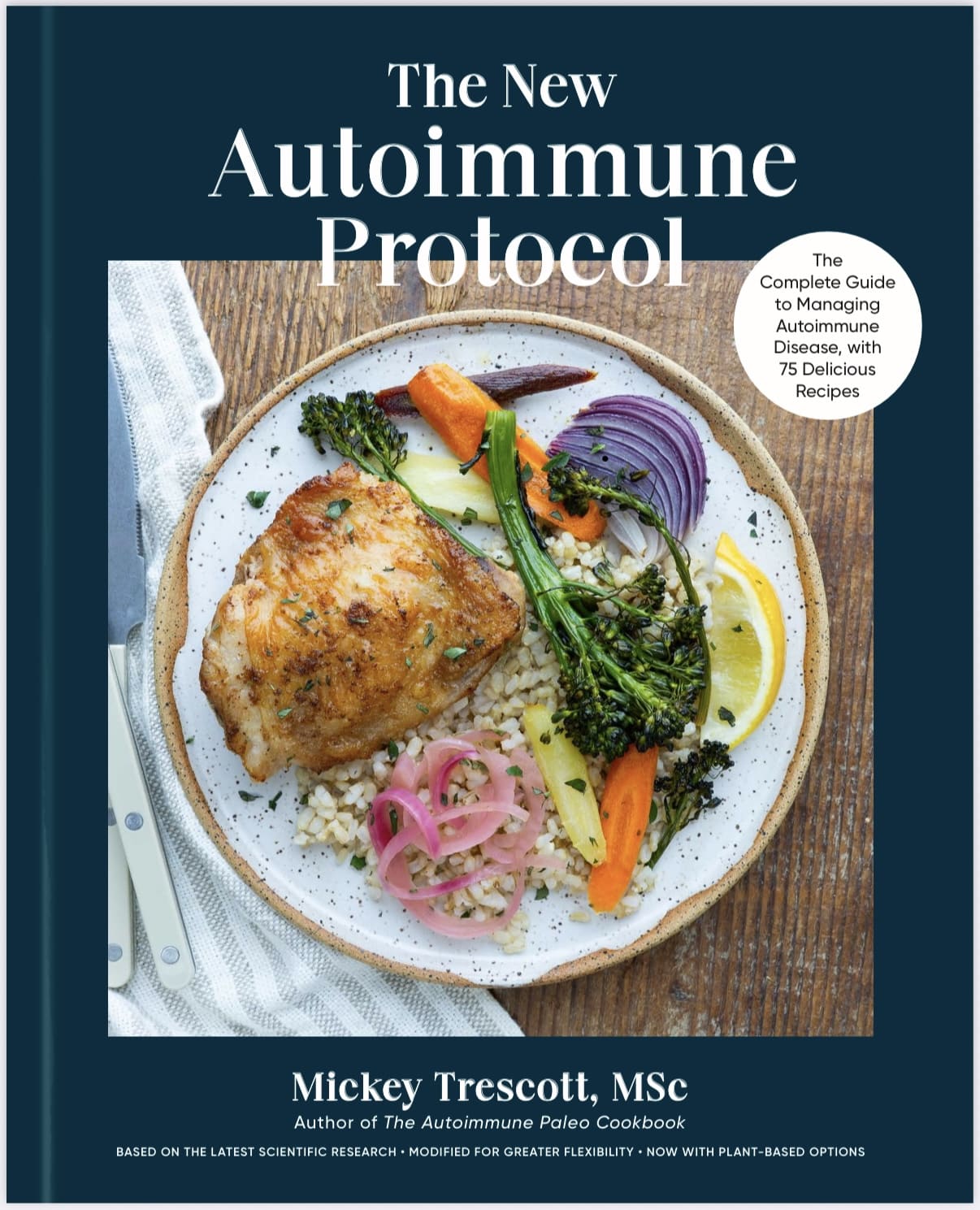
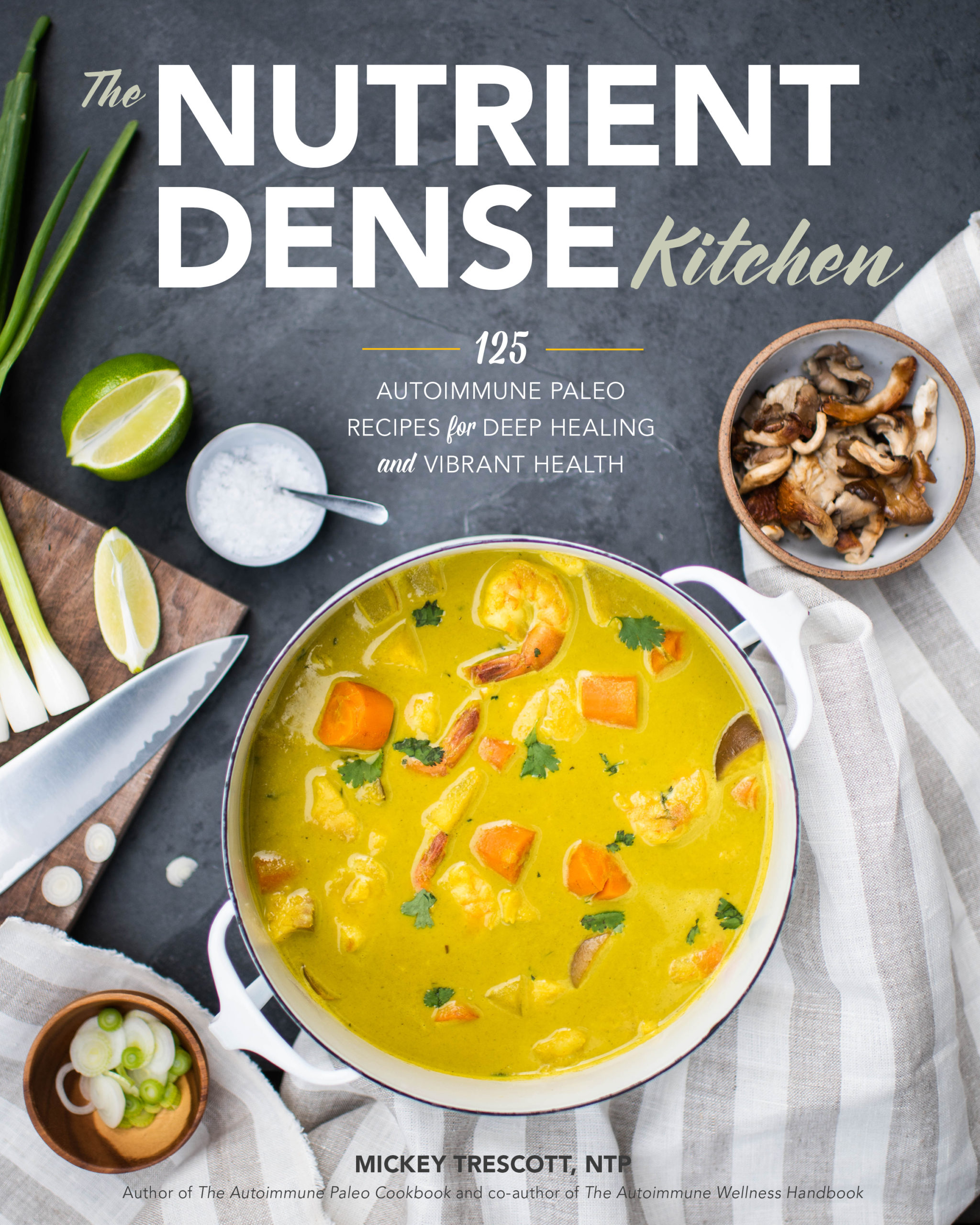
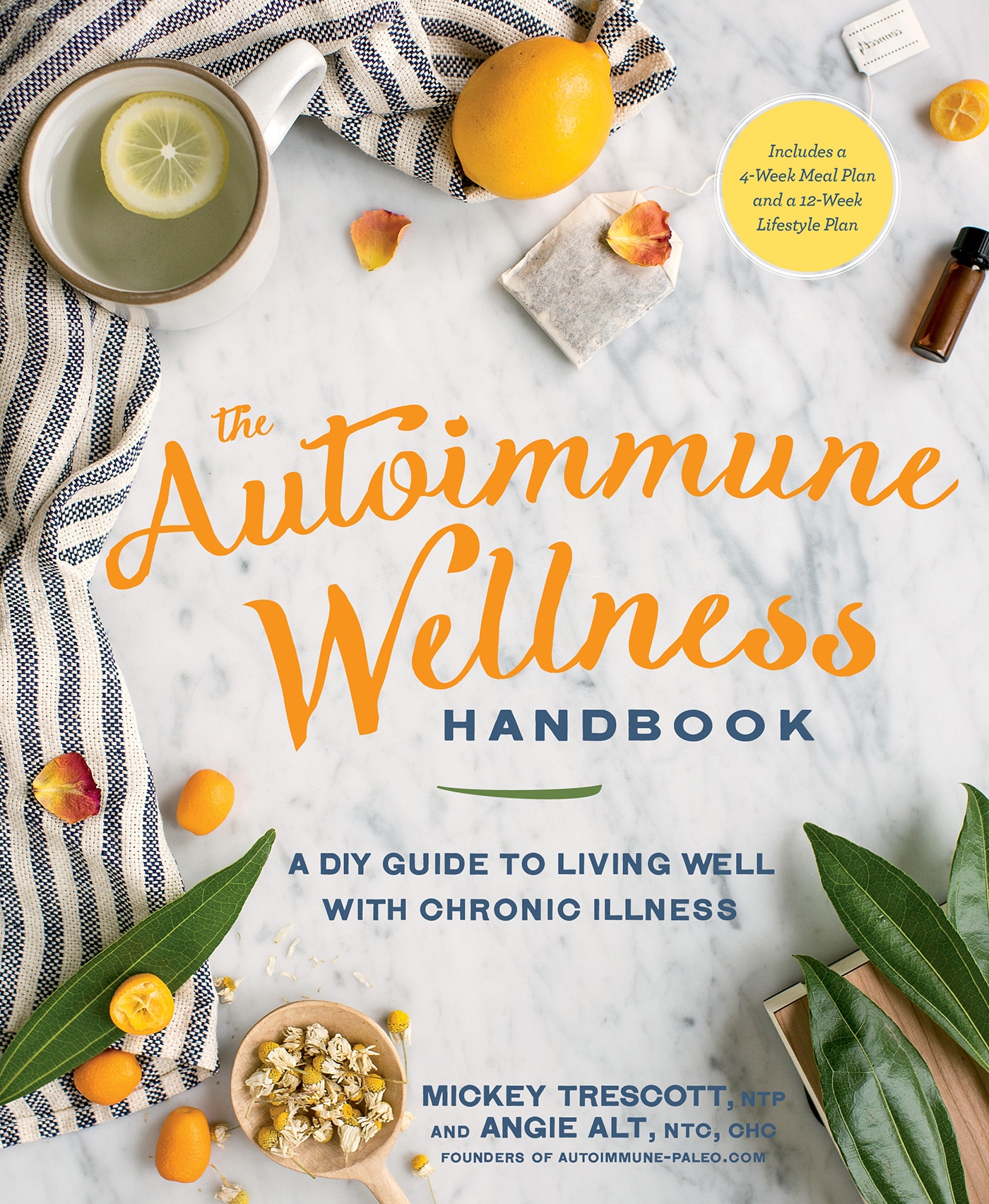
- The Nutrient-Dense Kitchen Cookbook by Mickey Trescott
- Urban AIP Meal Delivery
Prefer to Listen Instead of Watch?
.
Episode Timeline
00:00 – Rethinking chili without tomatoes or nightshades
01:19 – Introducing Marie-Noelle Marquis of Urban AIP
02:13 – Why Magic Chili belongs on the menu
05:02 – The beet base and flavor depth
07:36 – Scaling from home kitchen to commercial production
10:51 – Protein swaps and versatility
11:49 – Inside Urban AIP’s therapeutic meal delivery
17:42 – Final reflections on abundance and creativity
.
Episode Transcript
Below is the full transcript of Episode 74 of the Autoimmune Wellness Podcast.
This transcript is provided for accessibility and reference.
Title: Beyond the Recipe: Magic Chili with Marie-Noelle of Urban AIP (Small Bite) | Episode 74
Mickey Trescott: Let’s talk about chili, but not the kind with tomatoes or beans, not the kind with chili powder or paprika. Let’s talk about a chili that is completely nightshade free and somehow still rich, red, deeply savory, and satisfying enough that nobody asks, wait, what is missing? Because one of the biggest fears people have when they start the Autoimmune Protocol is that their comfort foods are gone forever.
And today we’re going to prove that they’re not.
Mickey Trescott: Welcome back to the Autoimmune Wellness Podcast. I’m your host, Mickey Trescott, and this is another Small Bite episode. These are shorter, focused conversations designed to go deeper than just reading a recipe. We’re talking about how to think about AIP cooking in real life.
This is part of a series I’m calling Beyond the Recipe, and today we’re diving into the Magic Chili from my second cookbook, the Nutrient Dense Kitchen. A recipe that has become a favorite, not just in home kitchens, but also through Urban AIP, where it’s made and delivered frozen to clients who need deeply nourishing meals ready to go.
I’ve never shared this recipe outside of the book before, but I’m providing it for all of you guys on the Autoimmune Wellness Blog Linked in the show notes.
[00:01:19] Introducing Marie-Noelle Marquis of Urban AIP
Mickey Trescott: Joining me today is Marie-Noelle Marquis. Marie-Noelle is a Nutritional Therapy Practitioner and AIP Certified Coach with over five years of clinical experience supporting individuals with autoimmune disease and complex chronic conditions.
She’s the founder and CEO of Urban AIP, a therapeutic meal delivery company focused on nutrient dense, anti-inflammatory meals made with 100% organic produce and high quality responsibly sourced proteins. Through both her clinical work and Urban AIP, she really bridges that gap between nutrition coaching and practical daily nourishment, which makes her the perfect person to talk about how this chili moves from a home kitchen to a large scale production without losing its magic.
Marie, I’m so excited to cook and talk chili with you today. Let’s get into it!
Marie-Noelle Marquis: Yay. Thank you so, so much for having me. I’m so thrilled to be here, so thank you.
[00:02:13] Segment 1: The Magic Chili
Mickey Trescott: When we first met and talked about bringing Magic Chili to the Urban AIP lineup, you immediately said yes. And that meant a lot to me. But from your perspective, as somebody who is feeding people with these frozen meals every single day, what made this recipe feel like such a good fit for Urban AIP’s offerings?
And what did you see in it that made you think this totally belongs on our menu.
Marie-Noelle Marquis: Yeah, that’s a great question. I think there’s two things, right? For Urban AIP I want to offer both like really innovative dishes. So things that you don’t know, you’re discovering new flavors. And also I think it’s really important to have the traditional comfort food that is just like you said at the start of the show is, maybe it’s gone forever, right?
Obviously like a chili is something that like I personally love and when I was starting the Autoimmune Protocol, the Core elimination phase, it was like, oh my gosh, I’m never going to have that again! So I think this is a recipe that our customers want, that people can relate, that nostalgia of having it, it’s comfort, right?
So we want that, and then there’s also the “Mickey” factor, because I think not all AIP chilis are created equal. But I’m familiar with your recipes and I’m always so impressed and I love all your recipes, so I knew that it was bringing the perfect comfort to our customers and that it was going to be absolutely magic, created by you.
So, yeah.
Mickey Trescott: Aw, I love that. And for everybody listening, I just want to describe what we are looking at here. So this is a deep, rich red chili, which you know, you might think is hard without tomatoes. It’s thick, it has some body, it’s got bone broth, but it’s definitely not watery. It’s very velvety and substantial. And you’ve got some browned, ground beef, some tender chunks of carrots and parsnips that almost mimic the hardiness that people expect from beans.
And it’s got this really beautiful color that comes from a little bit of grated beet, which by the way, you can’t taste as beet for anybody who is a little bit worried about that. That’s the magic part. The beet melts into the background. It gives color, it gives depth, and it gives a little natural sweetness to balance the savory notes. Then you have all of these layers happening underneath. There’s some caramelized onions, some garlic, some broth, and then the oregano for that classic chili vibe and just the tiniest bit of cinnamon.
Not enough to taste sweet, but just enough to create some warmth. So it’s comforting, it’s grounding, and the wild part, of course, there are no tomatoes, no beans, no paprika, no chili powder. No nightshades at all, and it totally works.
[00:05:02] Segment 2: The Beet Base & Flavor Architecture
Mickey Trescott: So Marie, I would love to know when you first saw this recipe use beet instead of tomato. What was your reaction?
Marie-Noelle Marquis: Being on AIP right? I’ve definitely tried my share of the no tomato, let’s use beet instead? I think like most people, you’re like, uh, that’s not what I’m expecting. Right? I knew there was some AIP chili recipes, and the one thing I absolutely don’t want to bring onto our menu lineup is like a disappointing experience, right? I want people to be wow and be like comforted and excited. If it wasn’t your recipe, I would’ve been more like, it’s going to be beet-y, but so much of it is a trust of, I know, there’s going to be the magic in there I have the faith that came with knowing you’ve crafted it.
Mickey Trescott: And why do you think the beat works so well from a culinary or like a cooking standpoint?
Marie-Noelle Marquis: The fact that the beat is grated in the recipe, you’re not experiencing, they like, oh, this is a chunk of beet. Clearly that was not a tomato, you know? It melts in the background and then you’ve got this base and then you’re seasoning over that.
So you’re bringing the flavor of the beet that you want to use and that sweetness, and then you’re maybe like a little too much earthiness that you can cover up by using the herbs, like the oregano that balances the flavors out. But I think it’s a really great base. I think it is a great way to get that red color, right? Because there’s the visual aspect too. You know what you expect that the chili’s going to look like, and if it doesn’t look like that, you’re like, eh. So it’s part of the experience, but yeah.
Mickey Trescott: Yeah, and some other elements that I’ve really tried hard to consciously bring, build some other notes, caramelizing the onions. I know we haven’t really talked a lot about that yet on the podcast, but that is just such an important step in cooking, in developing flavor, and then just adding that tiny bit of cinnamon for some heat, along with that garlic. Can you talk about how those little unexpected things help flavor develop a little bit?
Marie-Noelle Marquis: Yeah, I think absolutely like caramelizing that extra step, right? I think there’s one thing too with a commercial kitchen sometimes, like when you’re at home, it’s a smaller batch, you’ll take time to caramelize. And then you’ll see like in batch cooking, like commercial kitchens, they’ll just throw in there’s onion, there you go. Right? But taking that extra step, you’re really like caramelizing, getting the flavors and getting more depth, absolutely, in the recipe.
I love the cinnamon because I feel like it brings a little bit of that warmth, that sweetness to it. It doesn’t taste at all like cinnamon, but it again, it’s like one of this unexpected ingredient that really adds depth to the dish.
Mickey Trescott: It definitely brings the flavor out. I love it.
[00:07:36] Segment 3: From Home Kitchen to Urban AIP
Mickey Trescott: So when you take a recipe, and a lot of people probably haven’t thought of this when we’re making a batch of this chili, when I make it at home, the recipe makes about six to eight servings. I like to make it in a big pot, and I’m making it for batch cooking, I’m freezing a couple jars, but it’s a reasonable amount.
When you scale things up, so you’re taking this recipe and you’re making, I don’t know how many portions of chili you’re making at once, but talk to us about how that works? How do you maintain that consistency? You already touched on caramelizing the onions in a huge batch is actually something that’s a logistical challenge, right?
Because we don’t want to steam the onions. We want them to all brown and caramelize consistently. How do you actually tackle that at scale with Urban AIP.
Marie-Noelle Marquis: Yeah, that’s a great question. When we first brought in the recipe, we first made it, obviously this is the size, like the portion size that you created for? Right? So we can really see like what exactly are the flavors. So we’re not like just throwing in and we’re not just taking the recipe and making this time a hundred.
So we want to make sure that the flavors are perfect, right? When we make a batch of chili, we make for a hundred plates. So we’ll we use the entire stove top. Instead of making one giant pot that has a hundred worth of portions in it, we’ll split it up so that we can get really like the caramelized onion and every batches get cooked and then making sure everything’s uniform. And then at the very end when it just finishes like slow cooking, then we’ll combine everything, make sure all the flavors are right.
But the first sort of few steps we’re splitting it into multiple. So it’s like the whole thing is covered in chili pans.
Mickey Trescott: I can’t imagine the logistic challenge, like my background is as a personal chef working in home kitchen, but not on that production scale. So thinking about that just really stresses me out. But also really cool for all of us that we get to experience the flavor and the quality of something that you might make at home, but cooked for you and frozen and shipped to your door.
Marie-Noelle Marquis: I think one thing that was interesting too, like one challenge is the cooking time, right? We’re not actually cooking this for 20 minutes anymore because we have 60 pounds of ground beef, right?
We had to run like several tests to be like, no longer, longer. What’s the perfect time? Right? So it is like a two hour cooking process.
Mickey Trescott: Mm-hmm. And why do you think that a chili like this is such a popular item on your menu?
Marie-Noelle Marquis: I think it is that comfort. Well, it’s delicious, first of all. So we do get like customers commenting like, oh my gosh, this chili like, oh my gosh, people are super excited. I think it brings comfort and the excitement of having something where. Normally we’d all go like, mm-hmm. Yeah, right. It’s chili and then you’re like, wild diet. Right? So there’s a lot of excitement to it.
Mickey Trescott: I love that. Yeah. I have served it to family members and friends over the years who are not AIP and everybody always loves it. They are not fooled. They do not think that it is a traditional chili. Obviously it is not spicy, there’s always hot sauce in the fridge. So if somebody wants to like add a little extra, they think that’s great. And then the AIP person is usually super happy that they have something really comforting and flavorful and fits AIP and still tastes really good.
[00:10:51] Segment 4: Personalization & Adaptation
Mickey Trescott: If somebody wanted to swap out some proteins, like this is a very flexible and adaptable recipe, what would you think about in terms of swapping proteins or using it as a template for other nightshade free meals?
Marie-Noelle Marquis: You can make so many different versions of it. Turkey, we do have customers that don’t eat beef. You could do bison meat or you can do deer, venison, right? Like depending on the season, even if you want a little lighter feel, maybe you want to do like a poultry in the summer and then if you want to get towards the winter month and you want the more like bison buffalo thing.
And then I think you could actually use that as a base for a nomato sauce and then, use it with like spaghetti squash and as a topper, add more greens to it, saute like some kale and mixed greens. So it’s, yeah, it’s really versatile.
Really delicious.
Mickey Trescott: Yeah, I recently made it with lamb last week, and it was really delicious. It’s definitely a really versatile template.
[00:11:49] Urban AIP Details
Mickey Trescott: Thank you so much for sharing your perspective on this. For everybody listening, I do have the recipe linked in the show notes, so definitely don’t miss that one. This is one that’s been exclusive to the Nutrient-Dense Kitchen since that book came out in 2019.
And before we close, I want to give Marie-Noelle an opportunity to tell everybody about Urban AIP. Because if you don’t feel like cooking this, you can actually buy this and have it shipped frozen to your door if you live in the US.
So Marie, tell us about Urban AIP and a little bit about our partnership. You guys make some of my recipes and you have these amazing offering of AIP frozen meals for people who need to add some food that they don’t have the ability to cook to their routine. So tell us about that.
Marie-Noelle Marquis: So Urban AIP, the concept is really to take the stress off your plate when it comes to cooking. So as you mentioned, we are an AIP compliant meal delivery service. I really want to create like this elevated restaurant experience. Like a lot of time meal deliveries, you’re thinking, ah, it’s going to be a tiny meal. It’s going to be kind of, uh, and Urban AIP is all about like feeling pampered enjoy, and the portions are bigger.
I think something that’s really unique is the meals are created by a Nutritional Therapy Practitioner, someone who’s an AIP Certified Coach. So I always make sure that it’s not just that the food is compliant, but it is super nutritious as well. Like the nutrient density is really there. So you know that when you’re ordering like you’re taken care of.
We use organic produce, high quality animal protein. And not to say that you can’t heal on AIP without those things, but for me, if you take the time to own a company doing it, then I want to offer the top tier available. It was two years on Christmas that we launched, so it was still pretty new and growing. It’s so exciting to, be a part of the community and really support our fellow autoimmuners. We started working together in July. And it’s just so exciting to be able to share your recipes again.
I’ve been familiar with your work since like my day one of diagnosis pretty much. So having that opportunity is super exciting for me personally. So we have the Moroccan chicken, all your dishes are just like flying off like what do you mean we have to make more? We just, I know, I know. I know. We just, we need to make more Moroccan chicken. So we have the Moroccan chicken, that’s great. The lamb skewers are super popular.
So we are in our own private AIP dedicated kitchen. But we’re in a building with other businesses and every time we make the lamb skewers, we have people walking by. We’re like, what you guys making? What is that? I’m like, oh, you want to try it? And not AIP people and they’re like, oh my gosh. Like the, oh, you making those lamb skewers again, huh? Like, yeah. So that’s really, that’s really fun. The Bacon Chard Turkey Skillet is just really awesome. It’s breakfast option that’s super popular as well.
I love featuring you because you have so many amazing recipes, right? So even like featuring like the green goddess sauce and things like people can find in some of our meals. We did do a pumpkin fudge for Thanksgiving, which was super popular and I under prepared, I didn’t realize how popular it was going to be and I didn’t have enough molds, so I was around the clock making a little pumpkin, ’cause I was like, this is going to be really cool. They’re going to be in like little pumpkin shape. But I didn’t have enough molds for the quantity of orders. So it was like, okay, okay. Every two hours we had in a freezer we gotta swap. And it was like, people are like, you want to keep this the whole year round?
I’m like, no, no, no. We’re going to get more molds for next year. People are always so thrilled. So I’m just really, really excited that we get to collaborate together and just share more with our community.
Mickey Trescott: Well I know that everybody that I’ve talked to that orders from you and also I’ve had many situations where I will just order a box of Urban AIP because I’m traveling and I just don’t have the ability to cook. And so it’s so nice to show up somewhere and have all of my recipes for breakfast, lunch, and dinner, and it’s really amazing what you have created for the community and also the level of quality and care that you put in to making sure that the ingredients are sourced really good and that the recipes have to be adapted because you can’t just make 20 times whatever I wrote in my book.
So that takes a lot of thought and care, but the end product is really delightful. So I know for anybody listening who’s interested in that, I know they will be really happy. Yeah. And that’s, Marie for people who are watching, it comes frozen, in my kitchen I like to freeze in jars, but if you order from Urban AIP, you get, packaged in paper and all compostable and recyclable, really cool packaging, and they slot really nice in the freezer. So you can see, when you have a collection of different recipes, you can easily see what you are going for and there’s really detailed instructions for reheating.
Marie-Noelle Marquis: That was a big, big thing, and I forgot to mention that. Our meal trays are plant-based, so they’re bamboo and sugarcane weaved and then the liner, ’cause you can’t get those almost compostable, but it’s still lined in plastic. The liner is also sugar cane, so it’s a hundred percent plastic free, completely compostable. That was huge for me, to not make sure other food does not come in contact with plastic. I’m incredibly annoying about that in the kitchen as well. So we don’t have anything plastic. Even like the plastic wrap film is not plastic, it’s also plant-based. So everything, everything, everything.
Then our lidding film is supposedly bisphenol free. I just have my own doubts. So we use a little parchment paper that we put to protect the food just in case. And just in case why not?
Mickey Trescott: Yeah, I know a lot of people really appreciate the thought and care that you go into packaging everything and you’re going to take the time to create all of this beautiful food and ship it across the country. It might as well be packaged in a way that is as safe as possible.
[00:17:42] Wrap-Up and Closing
Mickey Trescott: Thank you so much Marie-Noelle, and for everybody listening, I hope that whether you make this Magic Chili at home and perhaps do a little batch cook, put a couple jars in your freezer, or if you have it show up at your door from Urban AIP.
I hope this episode encourages you to see AIP cooking as creative and abundant and not restrictive. You can find links to Urban AIP, the full recipe for this Magic Chili and the book in the show notes, and we’ll see you next time on the Autoimmune Wellness Podcast.
Marie-Noelle Marquis: Thank you so much.
.




0 comments