
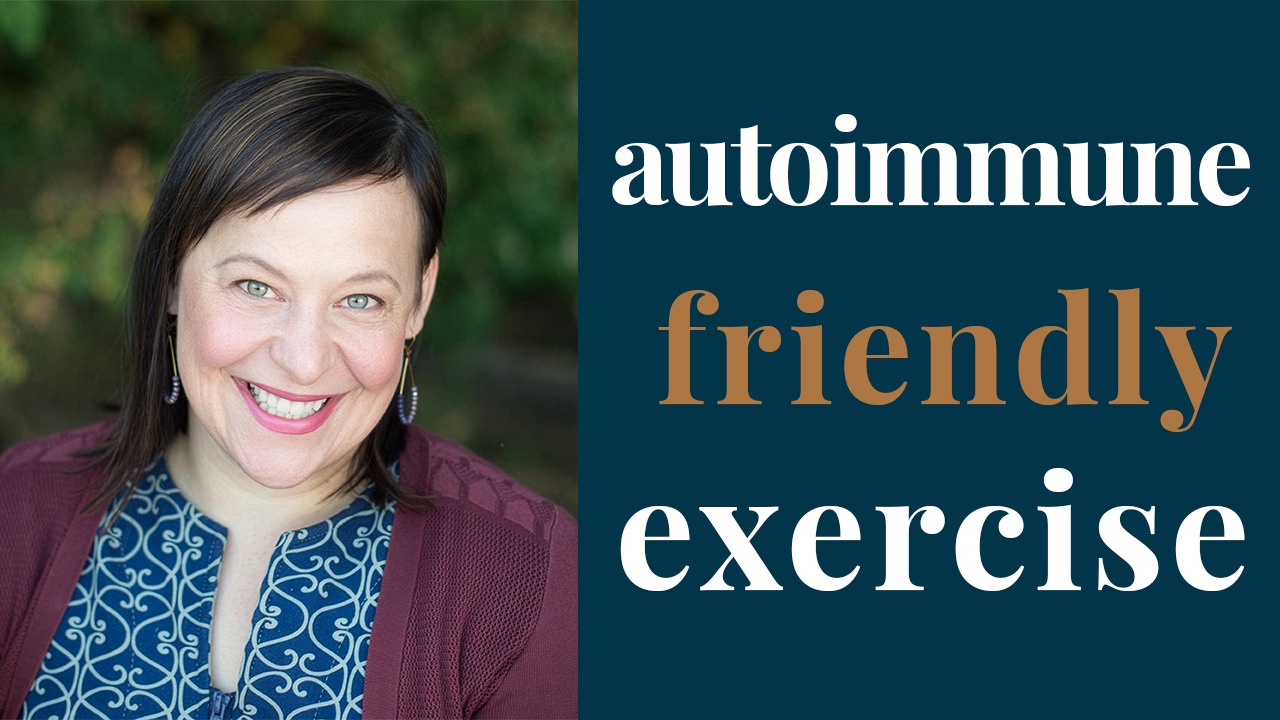
When you’re living with autoimmune disease, movement can feel loaded. You may know it’s “supposed” to help—but figuring out how to start in a way that feels safe, supportive, and sustainable is another story.
Questions like How much is too much? What if I flare? What if my body can’t handle what it used to? leave many people stuck between avoiding movement altogether and pushing themselves into pain or exhaustion.
In Episode 67 of the Autoimmune Wellness Podcast, I sit down with Beth Trimark-Connor, a licensed physical therapist and certified personal trainer, for a grounded, practical conversation about how to start (or restart) movement in a way that actually works for an autoimmune body.
.
Watch the Episode
.
Meet Beth Trimark-Connor, PT
Beth Trimark-Connor is a licensed physical therapist, certified personal trainer, and lifelong athlete who specializes in helping people rebuild strength safely after illness, injury, and major life transitions.
She holds a degree in human physiology from Michigan State University and a master’s degree in physical therapy from the University of Colorado Health Sciences Center. Beth has completed extensive additional training in strength and conditioning, endurance coaching, nutrition, and evidence-based menopause coaching. Her work bridges the gap between rehabilitation and real-life strength—particularly for people navigating autoimmune disease, menopause, injury recovery, and fluctuating capacity.
Beth also brings lived experience to her work, managing her own celiac disease and Hashimoto’s thyroiditis. That perspective deeply informs her compassionate, realistic approach to movement—one that prioritizes safety, adaptability, and long-term sustainability over pushing through symptoms.
On a personal note, Beth is also the physical therapist who helped me rebuild strength after years of severe exercise intolerance following my autoimmune crash. When I didn’t know how to move beyond walking and stretching safely, she met me exactly where I was and helped me build a foundation that eventually allowed me to return to strength training—and even activities I never imagined I’d do again.
This conversation is rooted in that real-life experience.
.
Starting Where You Are—Not Where You “Should” Be
Rather than prescribing workouts or exercise plans, this episode focuses on how to think about movement when your body has limits.
Beth walks us through a framework that begins with identifying your personal “why,” assessing real-life capacity, and letting go of the idea that exercise has to look a certain way to “count.” We talk about why starting smaller than you think is often the key to consistency, and how short, low-intensity sessions can stack up over time.
We also explore how autoimmune disease, fatigue, stress, and menopause can intersect in the body—and why that makes curiosity and flexibility essential parts of any movement routine.
.
Building a Sustainable Relationship With Movement
This episode reframes movement as a relationship rather than a rulebook.
We discuss:
- Using perceived exertion instead of rigid prescriptions
- Tracking data without judgment
- Adjusting movement based on sleep, stress, and symptoms
- Planning for real life so movement doesn’t become another source of pressure
- Letting go of activities that no longer serve you—and finding ones that do
The goal isn’t to do more. It’s to build something that lasts.
.
Resources
Beth Trimark-Connor, PT
Website: https://gotrainingwithbeth.com
Instagram & Facebook: Go Training With BethFree Movement Resources
Download Beth’s movement self-assessment, workout tracker, and companion worksheets to support what we discuss in this episode:
https://autoimmunewellness.com/move
.
Episode Timeline
00:00 – Why movement feels complicated with autoimmune disease
01:43 – Introducing Beth Trimark-Connor
05:50 – Step 1: Start with your “why”
09:54 – Step 2: Assess real-life capacity and constraints
12:27 – Step 3: Start smaller than you think
19:25 – Building a daily check-in routine
20:48 – Tracking data without judgment
26:30 – Pre-solving problems so life doesn’t derail you
30:55 – Key takeaways and closing reflections
.
Listen to the Episode
Episode Transcript
Below is the full transcript of Episode 67 of the Autoimmune Wellness Podcast. This transcript is provided for accessibility and reference.
Starting an Autoimmune-Friendly Movement Routine: Interview with Beth Connor, PT (Ep 067)
Mickey Trescott: If you’ve ever thought, I know movement is important, but I’m not sure how to start in a way that actually feels safe for my body, this episode is for you.
For many people living with autoimmune disease movement comes with a lot of questions like, how much is enough? What is too much? And how do you begin again, if your body doesn’t tolerate exercise the way that it used to?
It’s really common to feel stuck between doing too little and overdoing it, especially if your past attempts have led to pain, fatigue or a flare of your autoimmune symptoms. And while we hear a lot about the benefits of movement, there’s often very little guidance on how to approach it realistically when you’re managing symptoms, limited energy or have taken a long break from activity.
So today we’re going to talk about how to start a movement routine from scratch in a way that’s practical, supportive, and sustainable without pushing through or trying to force your body into something that it’s just not ready for.
Mickey Trescott: Welcome back to the Autoimmune Wellness Podcast. I’m your host, Mickey Trescott. Alongside the Deep Dive episodes, I also share longer expert interviews like this one. Conversations designed to help you apply what we know about autoimmune health in everyday life.
This episode is especially for anyone who doesn’t currently have a movement routine, feels unsure or cautious about how to begin or has been told to just exercise without clear guidance on how to do that safely.
And before we begin, a quick reminder that this podcast is for educational purposes only, definitely not medical advice. And always consult your healthcare provider before making changes to your movement routine or your treatment plan.
[00:01:43] Introducing Our Guest: Beth Trimark-Connor
Mickey Trescott: So before we dive in, I want to introduce today’s guest, somebody who has played a very meaningful role in my own health journey. Her name is Beth Trimark-Connor.
And Beth is a licensed physical therapist with a master’s degree in physical therapy, a certified personal trainer and a lifelong athlete who helps people bridge the gap between rehab and real life strength. She holds a degree in human physiology from Michigan State University and a master’s degree in physical therapy from the University of Colorado Health Sciences Center. She’s also completed extensive additional training, including certification as a strength and conditioning specialist through the NSCA and ACSM certified personal trainer, RRCA distance Running Coach, Precision Nutrition level one and level two, and an evidence-based menopause coaching certification.
Beth blends evidence-based movement, strength training, recovery, and lifestyle support to help clients build long-term sustainable health, particularly for people navigating autoimmune disease, menopause, injury recovery, and major life transitions. She also brings her lived experience to her work, navigating her own celiac disease and Hashimoto’s thyroiditis, which deeply informs her compassionate, practical approach to supporting clients with chronic conditions.
In addition to the clinical and the coaching work, Beth’s approach is grounded in a commitment to inclusive, socially aware wellness, informed by ongoing training in social justice, diversity, inclusion, and self-awareness within fitness and health spaces.
And on a personal note, if that wasn’t enough, this is why today’s conversation isn’t just theoretical for me, back in 2019 I hired Beth to help me get stronger. So you guys know all about my autoimmune crash in 2012 and movement had really narrowed down to just walking and stretching for many years after that, which was really appropriate for that season of my life.
But I just didn’t know how to move beyond that safely. And at the time I was living on the farm, I had a very small apartment, very limited equipment, just a few weights, some kettlebells. And I hired Beth to help coach me here, and she really met me exactly where I was. So we started with breath work, core work, stability, and slowly built a foundation that felt safe and doable. And over time, that process brought me back to strength training and eventually even to higher intensity activities like pickleball, which I really never imagined that I’d be able to do years earlier.
So when we talk today about starting a movement routine from scratch, this isn’t hypothetical. Beth is literally the person who helped me navigate that exact question in my own life in a way that felt supportive, sustainable, and empowering and that is why I wanted to have her here to speak today.
So after that very long introduction, Beth, I’m so glad you’re here. Thank you so much for joining us.
Beth Trimark-Connor: Thank you so much for having me. This is so a favorite zone for me when I’m working with new people is this step is how do we get started? What makes sense?
Mickey Trescott: I love that. We actually had planned a little episode for you guys and I was like, this just needs to be the full deal because there is so much wisdom here that you guys need to know about. So thank you so much, Beth.
Will you, before we get started, tell everybody a little bit about the workout tracker and the additional resources that we’re going to talk about today, so that they can get started with those.
Beth Trimark-Connor: Right. So we got really excited and then we got a self analysis slash questionnaire, and a tracker. So like you can take this information in and just relax and listen and then you can go to Mickey’s website, autoimmunewellness.com/ move, and you can find our downloadable nuggets. You’ll click on that and that’s going to take you to a pathway so that you can access these documents.
Mickey Trescott: Beth has created these companions so that as you guys listen along today, those resources are really helpful for anybody who is actually going to be putting into practice the thing that we’re going to talk about.
[00:05:50] Step 1: Start With the “Why”
Mickey Trescott: I’m really excited to get started. One of the things that I love about your approach, Beth, is that you don’t start with just like what exercises to do. We’re not going to talk about like, here’s your workout, go do these things.
You love to start with the “why”. Talk to us about why that matters so much, especially with people that have autoimmune disease.
Beth Trimark-Connor: Absolutely. Like everybody, I think you could ask any human on the street, like, tell me five exercises. What should I do to get healthy? And they could probably give you some good information.
So I like to start with why, because it connects you, it anchors you to a deeper meaning with the movement. Is it because you want to get back to playing a sport. Do you want to resolve a chronic soreness? Do you want to be able to pick up your kid or your grandkid? Go on vacation and feel confident going on a tour or doing five miles of walking in Spain, or wherever, maybe less exotic, Ohio, wherever you’re vacationing.
It’s really just about also using your imagination. I feel like when I was diagnosed, I got sort of old information, this is over 10 years ago, of like, you’re overdoing it, don’t do that. It was disorienting to me, and, over the years, I had to figure out, what do I want to look like at as an athlete? And it’s going to change during different life phases.
Using your imagination, where will I be in a year? Where will I be in two years? Where will I be in five years? And I think you mentioned your crash, but I think with a lot of folks, learning that you have an autoimmune condition changes your self -perception.
Mickey Trescott: Yeah, I think that’s true, especially for people who may be like, this is my experience, but like I was very athletic in my younger life and that was something that I used to relieve stress and was like a very positive part of my life and I really liked it. And then I got sick and I just kind of said, oh, I’m never going to be able to do this again.
And like you said about imagination, I wasn’t really imagining a life where I was capable and strong again. I actually really like this “why,” I mean, we do this with food in the transition phase. We really need to hone in on that “why” because it really informs all of the next things and that motivation.
Beth Trimark-Connor: I feel like it really fuels the excitement. It gets you a little excited. I want to just a little bit touch on here in the “why” section, what does research say with autoimmunity? When I got that information, I was marathon training and really into endurance exercise and my doctor was like, that’s too much, you’re overdoing it.
And we don’t really have evidence that says exercise is bad for folks with autoimmune disease. We actually have information that says it’s supportive. It’s not going to make it go away, but it can support you in your autoimmune journey. It can improve your fatigue. It can improve your endurance. It can improve maybe a very modest or gentle improvement in some of your markers for certain conditions.
I don’t know if you ever got that information or if anybody who’s listening ever got the, like, be careful, but do something type of information. We have good research that says movement is going to help you.
Mickey Trescott: And actually Beth, the research that I’ve seen is a lot of like rheumatic conditions where people have rheumatoid arthritis and they have joint pain. And a lot of those patients think that because they have pain, that movement is actually going to cause them more pain. But the studies that I’ve seen show that physical therapy designed for an autoimmune body, actually improves things over time because that movement is just really important for your joints.
I think a really good message is that movement can be helpful and I think on the other side, with Hashimoto’s, I had exercise intolerance and telling that to my providers and them being like, you should be able to exercise like a normal person because your thyroid levels are normal. So it can be both ends of the spectrum, fear of exercising and then also experiencing symptoms that are not really, acknowledged by the system
Beth Trimark-Connor: Yes.
Mickey Trescott: A little bit of gaslighting there. Which is frustrating.
[00:09:54] Step 2: Take a Realistic Look at Your Life
Mickey Trescott: But do want to talk about something that you do in your approach is really emphasizing empathy and realism and just taking the pressure off. The next step for people might be like looking at their life and figuring out where movement fits without setting themselves up to fail.
I experienced this, everybody has these logistical constraints when it comes to an exercise routine. Not everybody has a gym membership or a personal trainer, or literally the space. I just love your approach because it’s so tailored.
What should people really be looking at when they’re starting to design their entry into movement?
Beth Trimark-Connor: Transitioning from like now you know why you’re doing what you’re doing. What does your real life look like? Who are you taking care of? That’s cats, that’s older humans, that’s littles, that’s a house renovation. Like what is really going on? Are you coming off an illness? Is travel coming up? Do you have big projects? Looking through some life binoculars, looking ahead a little bit. What’s going on now? What’s coming up? Movement needs a place to live on your schedule. So a little bit of like a lifestyle assessment, like, oh, Monday mornings really work because X, Y, or Z. Maybe I get started on Saturday. I have a little space to myself.
Thinking one or two days a week that you can reserve and that might also require talking to your people that you cohab with. Like, I need you guys to make lunches on Monday night and that might require you to teach your kid how to make their lunch. There might be a little bit of set up work.
And if you can look at and prepare, it’ll make the transition a lot easier. It also might mean a little less scrolling. You might need to limit some spaces that you’re losing time. I’m sure everybody who’s listening feels like, I’m so busy. But! There’s going to be some spots. There’s going to be some little spots you can rearrange or compress things and find a little space for that.
Mickey Trescott: With the scrolling and just thinking of movement as something that you can do for a small amount of time, that was really transformative for me. I used to think a workout was an hour. I was so
Beth Trimark-Connor: Oh,
Mickey Trescott: the whole like the hour long workout myth and now I’m like a big fan of the 15 minute, and multiple times. So it would start as a 15 minute, maybe once a day. And then when you realize, there might actually be a couple little 15 minutes in a day just because it is really approachable. I think 15 minutes is a lovely amount of time to start with.
[00:12:27] Step 3: Start Smaller Than You Think
Beth Trimark-Connor: Absolutely. Moving into why are we doing this? Where is it going to go? And what are we doing? And for how long? If you went from doing nothing to doing something once a week, you’ll have done something 52 times this year. That stacks up.
We all know the big guidelines, 30 minutes of moderate intensity, five days a week or 75 minutes of higher intensity, two days a week. And then as far as lifting recommendations, it’s a minimum of two days a week and there’s not a specific time on that one. We’re moving towards that. I think altogether that’s like 250 to 300 minutes a week if we were meeting those standards. Even if you did 25% of that, if you did 50% of that, you’re going to get those benefits.
So, I recommend starting with one thing. One thing for 15 to 20 minutes, one to two times a week. So, most of my clients, we’re starting with a two time a week target, because even if you like miss one and you only get one, then you’re getting that one time a week. Maybe you set up two spots and you just shoot for getting one.
But one thing, one to two days a week, 15 to 20 minutes and try it for four to six weeks. Another helpful thing is to get super specific on what you’re going to do. Give yourself a little bit of a time cushion, so if you are someone like me who has a hard time transitioning from activity to activity, if I’m doing a 15 minute workout, it’s going to look like 25 minutes. By the time I get myself to a place, pick up, I use a written tracker because I can’t be trusted with my phone.
The thing you’re looking for, it could be something simple, like I’m going to go and walk for 10 minutes. That’s like a 15 minute thing. Maybe because walking is often, I think the first thing healthcare practitioners say a lot, we also need to acknowledge that there are people who would not feel safe being outside, maybe their neighborhood, but maybe there’s a lot going on in the world or other reasons don’t feel safe being outside. They’re in a rural setting? There are like walk in place videos, there’s chair exercise videos, super beginner Pilates, Tai Chi.
Whatever it is, get super specific about it. You could even start with a lifting program, so like a short warmup, three to five moves and working at a 4 to 6 out of 10 on a RPE scale. I add this in because that’s the effort. Even if you’re getting a walking video online how hard should you be doing it?
So RPE stands for the rate of perceived exertion so how hard am I working. And zero’s not very hard 10 is all out. So Like medium, you’re working at right about 50 of your effort, four to six. This is a great way to get started, but not hurt yourself.
So whatever you choose, give it a 4 to 6 type of effort. If you’re lifting, one way we can talk about RPE is if I’m working at a 4 to 6 effort. If I’m working at a 4, I could do this exercise six more times before I really feel tired. If I’m working at a 6, I could do four more repetitions of this exercise. If I’m doing a cardiovascular thing, I can easily talk and I feel like I’m putting out about 50% of my effort.
Mickey Trescott: I love introducing a subjective scale instead of saying, you need to be doing this move, because we can apply that to literally anything we do,
Beth Trimark-Connor: Mm-hmm.
Mickey Trescott: You can scale it. I remember a time when exercising for me was like walking a block or two blocks or three blocks and that 4 to 6 scale, walking a couple blocks was like a 7.
You know,
Beth Trimark-Connor: Right.
Mickey Trescott: For it, which some people might be listening and being like, wow. But like really we are all starting at different places. Even now where I’m strength training and I can think about like deadlifting. I love that. Just how hard is this for me? How long can I do it? What is my perceived effort? I think that’s something that autoimmune people at any point can just really hone in on.
Beth Trimark-Connor: And it stacks up against research. Like, it’s a great tool. I’m not making it up. It is just really highly applicable, and it’s a great starting point.
One other thing I want to touch often, so like, I start people slow because it’s about the habit formation and physiological adaptation. You’re going to start slow, so your body’s going to adapt. It’s not going to be overwhelmed if you go crazy on your first workout and you’re exquisitely sore for two weeks and, you know, you have disrupted sleep.
I just wanted to put like a tiny asterisk here because most people with autoimmune disease are people who are assigned female at birth. That usually lands in the 30 plus crowd. And then that’s going to dovetail a bit with perimenopause and menopause.
So if you are thinking of your 19-year-old self, like, pole vaulting or you were like captain of the whatever team. And then you’re starting and it feels like that person was cool. They were cool. But this person might be going through autoimmune things, but also perimenopause and menopause things, which have a significant shift.
And there’s even a name for it in research called the musculoskeletal syndrome of menopause. And it’s just that estrogen works systemically, and as it decreases, it literally affects our ligaments, our bones, our muscles, our joint matrix.
So it’s nothing to be scared of. This is very much like our perimenopause and menopause journeys are very much like autoimmune journeys. No two can be compared or to be even close to the same. Just be aware if you are 30 plus, you might have a little dovetailing, and the good news is exercise helps autoimmune disease and exercise helps perimenopause symptoms too.
We just have to do that smart, curious relationship building with our body.
Mickey Trescott: Love the way that you frame that as something to be curious about instead of like looking for like with dread.
Beth Trimark-Connor: Yes.
Mickey Trescott: having autoimmune disease is already hard and
Beth Trimark-Connor: Yes!
Mickey Trescott: I first encountered a lot of the menopause stuff, I was like, ah, something to not look forward to. And I’m just so grateful for people like you who are really sharing empowered and positive information about how we can work with this instead of being afraid of it or resisting it.
Because it really is a beautiful process, learning how our bodies need something different and finding out how to work through that figure that out.
So I love that.
Beth Trimark-Connor: There’s like a whole meno verse out there. There are people where you can learn more about the musculoskeletal syndrome of menopause, the cardiovascular things. And just know everything that we do for autoimmune jazz pretty much directly translates to all the things that we would do for perimenopause and menopause symptoms.
[00:19:25] Step 3: Build a Check-In Routine
Beth Trimark-Connor: I’d like to move on to working on a little self check-in. Before you work out, and this is a skill, so like you’ve got the habit forming is a skill and the self check-in is a skill.
How did you, on a zero to 10 scale, how did you sleep? How was your diet yesterday? What’s the stress level like? Because these things are going to help you to turn up or turn down or just become aware that your body is there and the things that it is interfacing with in your home, in the world. If you had a great night’s sleep, good. You know, I feel pretty good today. I’m a seven. I’m coming off a cold. It’s been so stressful. I’m a three today. Okay, just jot it down and you’re noggin or on your tracking sheet just so you have an awareness.
Mickey Trescott: This community is definitely no stranger to tracking because this is something that we do very diligently through the elimination phase and the reintroduction phase. And this is how we tell if people are sensitive to foods. But I love applying this to movement because movement is actually a little different because our capabilities are going to shift on a given day.
So checking in and noting our sleep and our soreness and our symptoms is really applicable to what kind of movement we’re going to do. So once people are checking in and tracking, what kind of things will they do with that information?
[00:20:48] Step 4: Track the Data (Not the Judgment)
Beth Trimark-Connor: Okay, so now that you got your self check-in, I would love for folks in some way to track what they’re doing. So you know why, you know when, you know what. Okay, you checked yourself in. Now, write down what you did. Whether you do, there are a ton of fitness trackers. I prefer pen and paper for myself. My clients all use True Coach, and a mixture of wearables. There are so many ways to track, but just track it.
If you don’t track what you’re doing you don’t really have a next step. If you feel great, if you feel terrible, you don’t really know why, like was it the workout or not?
And then, let’s say you plan four sessions. See if you can get three of them in the month. If you plan eight, shoot for six or better. We’re not shooting for perfection. We’re just shooting for most of the timeness. It’s not an all or nothing. It’s a all or something.
Let’s say you do four to six weeks and you’ve tracked and it was great and you feel good. You could just keep doing that. Just keep doing what you’re doing. You don’t have to have an exponentially increasing expectation of yourself.
Mickey Trescott: Oh my gosh, Beth, this is something that, I recently have gotten to the point where I’m like, I’m happy with the amount that I’m moving, it’s good. And my brain is going, but you need to do more, because we’re always told that. Right? So I love that. Yeah. You don’t have to increase.
Beth Trimark-Connor: I think we’re told that and then we see videos of someone doing a kettlebell complex, but that’s probably all they do. Some of our wonderful wellness influencers, not a crack, but like that takes up a lot of time. If you’re wanting to do a 90 -minute workout several days a week, sure, sure, you can get there, but it just depends on you.
This step, the tracking the data is where the juice lives, because you’re learning about this relationship with yourself, do you want to incorporate your kids more? Do you want to try to do something with your partner? Like, this is where it lives.
I do want to touch on, let’s say it went terribly, That is also no sweat. Also, like, double air horn celebration, ba baa, because you tried, and now it’s a time to look at, you know what, there’s no way after dinner’s going to work. I’m a mess, the kid’s a mess, our dogs need a walk, like, recalibrate.
It’s time to look, maybe you need more help, an accountability buddy, something, maybe you need to leave and go to a gym, like, sure, it’s going to take more time and energy, but maybe you need to remove yourself from the family milieu to have the cognitive and just the literal space to take care of yourself.
Mickey Trescott: So many awesome tips. And also just having license to be like, this doesn’t work for me. Just like we would try a food and be like, you know what? I know how that feels when I do that thing. Recently I realized that yoga is not good for me. I have psoriatic arthritis, my tendons are just wonky and that’s fine, I do a lot of other things. But yoga, I just was wanting to do it, and it would cause me so much pain every time I did.
And finally I was like, you know what? There’s so many other things I can do. Not that. That negative feedback, even though it’s frustrating when it’s something that like we might want to do, we can channel that into something else, finding something that just makes us feel joy or good or capable and just like chase that.
Beth Trimark-Connor: I really like that you brought up having to be like, that’s not working right now. I think there’s a lot of people who are like, there’s nothing I can’t overcome. And sometimes it just doesn’t work. And we’re in different phases of life too. You mentioned your athleticism earlier in life and, my choices now are way different than my choices as an 18-year-old.
This is the point where you’re like, Okay, I’m going to try something new and not feel like it’s a moral failure. It’s just data. That’s just the data I’m getting. None of this is working. Or maybe it’s somewhere in the middle, it sort of worked and you just need to practice more.
I think of a stretching out expectations and stretching out your vision to months, a year.
Mickey Trescott: I love that about your approach, just because I’ve experienced it personally. When we started our work together, the goal was just breathing and stretching and just a little core stability. And it really did take six months until the vision could get bigger into picking up weights, you know? And I think
Beth Trimark-Connor: Yes.
Mickey Trescott: if I would have gone into it thinking I need to pick up the weights, because that’s what I really want to do, it wouldn’t have worked because I needed to go through that process. And so I think that is just so beautiful how you describe just acknowledging how things take time, how our bodies change, and how that imagination really just can change over our lifespan and our health span and how our bodies are always evolving. And how different feel
Beth Trimark-Connor: Yes.
Mickey Trescott: fun to us at times. I think back to the 18, 19-year-old, 20-year-old me and thinking, I want to run a marathon someday. I never got to experience that. Now I’m like, no thank you. You know what I mean? Like, there’s other things like, I want to play pickleball, that’s fun. And I’ve discovered that, but I could never have imagined that when I was like 19. It just, it changes, you know?
Beth Trimark-Connor: Yeah, be, willing to squeeze like a fresh lemon, on your expectations. Be willing to think completely outside of the box of what I used to. I almost can guarantee for some people they might be able to reboot some old things. That’s a hundred percent possible, maybe scaled to where they’re at right now? But I think you’re right for the most part we are always growing and changing and our family needs are growing and changing, so I think most of us will be looking at something a little bit different.
[00:26:30] Step 6: Stack the deck and pre-solve problems (So Life Doesn’t Derail You)
Beth Trimark-Connor: Okay, Mickey. I just want to end with a few hot tips. So… Life is going to happen left and right. You know, pet’s going to get sick, your kid’s going to need to get picked up. So let’s preplan, according to your life. So for me, I’ve got a lot of oldies. There’s always like a lot of oldie emergencies going on. I’m caregiving for some lovely elders.
One thing I always do when there’s something urgent, I’ll be like, is this urgent or is this emergent? Is it okay for me to finish what I’m doing right now? So I have that little check-in? Another thing is like maybe if you didn’t sleep well, you have a less intense workout, you’re going to cut the time in half. Do you have any advanced problem solving tips?
Mickey Trescott: Adjusting is something that I do a lot, you know, don’t sleep well, it’s better to not go to not exercising or I would even call it exercising, like, bringing in a little breath work or meditation or like a little rollout with some mobility stuff, instead of doing nothing because that kind of compounds the not feeling good from not sleeping.
I really find the checkpoint of doing something like you mentioned earlier, something or nothing, I learned that from you, just helps me stay like on track with whatever my routine is, even if I’m not doing the perfect whole expression of that.
Beth Trimark-Connor: Yeah, and having, because every family is so unique, have your top 10 things that sideline you, like, or top three, and have a solution for them. Solution as much as you can, ’cause you’re going to be the best wisdom and knowledge holder for how your household works.
You can put your workout outfit, your keys and water bottle all in one zone. You can put your tracker and your yoga mat together so when you go to exercise it’s right there. You can put your tracking app on the homepage of your phone. Like little things to just bring it to the front. You could also habit stack. So let’s say every morning you immediately get up and put your exercise clothes on. Like, can you twin things that you’re already doing and just, like, pair ’em together?
I got real excited about hot tips. I think that’s the last of my hot tips for right now.
Mickey Trescott: The one that I learned from you is to keep handy the little mobility things in my house. So in my office I have a roller. I have a little foam calf stretcher, and I have some balls. And I’ve just found that just having it here and not having to go in the room where I do that a workout just makes it so I can get a little hit for five minutes and I get so much more just because it’s accessible and it makes it easy.
And wearing the right outfit. You mentioned changing into it. I don’t know why that’s such a mental thing, but it’s like you’ve already committed that you’re going to do the stretching and you’re ready to go. So I think that’s a great one. And filling the water bottle, you know,
Beth Trimark-Connor: Yeah, like your physical…
Mickey Trescott: ready to go.
Beth Trimark-Connor: Yes, your physical environment can really facilitate your success. And at the same time, you can wear, like, when you’re thinking about, like, your workout, maybe it’s, you want to do something where you don’t have to change your clothes. If that’s a barrier, problem solve around that too.
It is like a Mr. Rogers I’m changing for this purpose thing.
Mickey Trescott: Yep. And habit stacking is just so powerful. We have a lot of research just about how habits are built and back to, you mentioned scrolling. I know we talk about it as this thing that most of us do. But when you think about the time that I’ve just stopped doing that is before bed.
And when I’m not doing that, sometimes doing a little stretching and a little mobility, replacing something that’s not as helpful, with something that just helps grease everything up a little bit. I’m a really big fan of small doses of little mobility work to help my body feel good.
Beth Trimark-Connor: And I just want to pop in here to say, what is mobility? Just because we’re talking about it quite a bit. Mobility could even be a workout for some people. And that’s just a fancy way of saying like, I’m doing a few cat cows or I’m doing a little all fours rock. I’m doing my knees into my chest. It could be moving your arm in a real intentional circle. It’s just a little bit of moves to get into certain ranges of motion.
Mickey Trescott: Thank you for clarifying that and hopefully everyone has found this so helpful. I love talking to you and your perspective on movement and solving all of the little problems that people have and little barriers that we have to starting an exercise routine.
[00:30:55] Summary and Wrap-Up
Mickey Trescott: Before we wrap up, I want to take a minute to reflect back what we talked about today. This conversation wasn’t about finding the perfect movement plan or pushing yourself to do more. It was about learning how to start where you are and how to build movement in a way that feels safe, supportive, and sustainable over time.
So we talked about starting with your “why”, connecting movement to the things that you actually want to do in your life, not just a set of exercise rules. We talked about being honest about your capacity and your schedule, and making space for movement instead of trying to just force it in. And we talked about starting smaller than you think you need to, checking in with your body, and treating everything you notice as information, not as judgment or failure.
And then lastly, we talked about planning for real life. These are the days when your sleep is off, your energy is low, or things that don’t go according to plan. So that movement can stay part of your life without becoming another source of stress. And I really love this framing because it takes movement out of this all or nothing mindset. It turns it into a relationship. Starting small isn’t a failure, pausing isn’t quitting, and you definitely don’t need to see that whole path, just the next step.
So Beth, thank you so much for sharing this grounded and compassionate approach. I know it’s going to help a lot of people feel less afraid to begin again. And before we go, can you let listeners know where they can find you and learn more about your work?
Beth Trimark-Connor: Okay, www dot gotrainingwithbeth is my website. I’m on the Instagrams and I have a Facebook presence. So that’s where you can find me.
Mickey Trescott: Awesome. I will make sure that all of that is linked in the show notes. And for everyone listening, Beth created these worksheets and tracker that follow the steps that we talked through today. It’s definitely there to help you guys reflect, start small and check in with your body over time without pressure or judgment. Check out the link in the show notes or type in autoimmunewellness.com/move into your browser to get that free download.
And Beth, thank you so much and thank you to everyone for spending this time with us. I will see you in the next episode of the Autoimmune Wellness Podcast.
.










0 comments