
NOTE: This post has been updated as of January 2024 and reflects the most recent updates to the Autoimmune Protocol. Keep this page bookmarked to stay informed on the most current protocol instructions that reflect emerging nutritional science, straight from the source.
Important: You are here because you’d like all of the details about the reintroduction phase of the Autoimmune Protocol (AIP). AIP has been around for over a decade and there are various sources for protocol information, both online and in print. At this point, some resources contain inaccurate information or are simply out of date. Before beginning, understand that this page (and the Autoimmune Wellness site as a whole) is the best and most accurate public resource for information about AIP, because it adheres to the latest updates and research as taught in the AIP Certified Coach Practitioner Training Program. This post will teach you everything you need to know about reintroductions, whether you are entering from either option of the elimination phase.
The reintroduction phase
Reintroduction is the third and final phase of the Autoimmune Protocol (and if you aren’t familiar, you can read more details about the first two phases in The AIP Definitive Guide). After transitioning to the elimination phase and maintaining it for a proper amount of time, each person moves on to the reintroduction phase where each previously eliminated food is reintroduced to test for a response. After carefully navigating the reintroduction phase, each person is able to determine a customized dietary approach that best supports their best health long-term.
After the hard work of maintaining the elimination phase for months, it is important to navigate through the reintroduction phase carefully and systematically. This guide will tell you everything you need to know in order to plan and execute food reintroductions, no matter if you are coming from an AIP Core Elimination or an AIP Modified Elimination.
Reintroduction stages
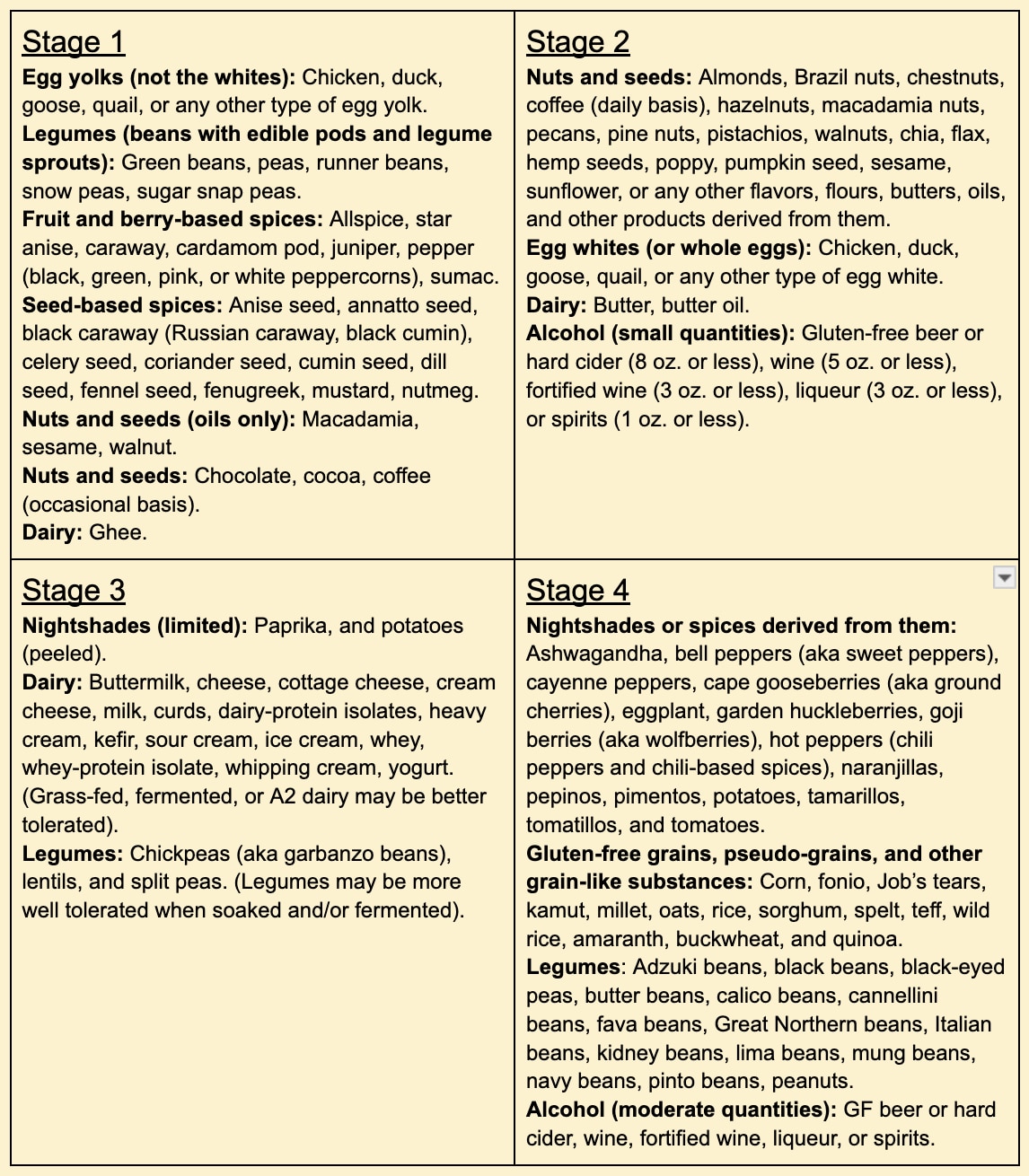
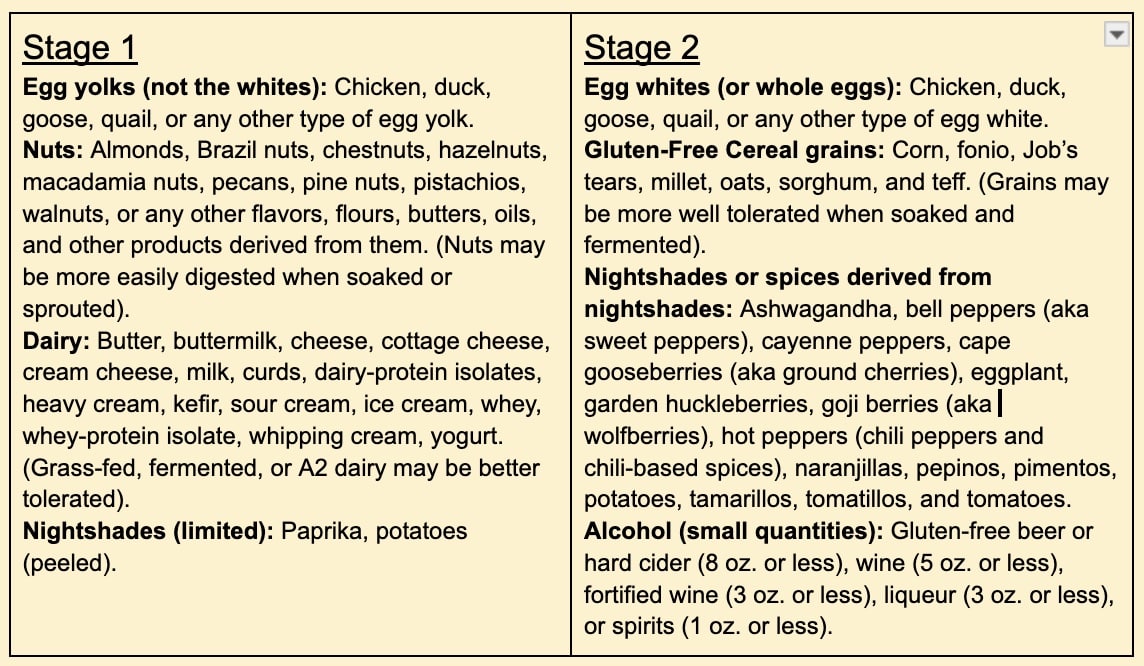
Foods eliminated during the elimination phase are grouped into stages to streamline the reintroduction process. It is ideal to attempt reintroductions of foods that are most nutrient-dense and least likely to cause a reaction first, and wait to attempt reintroductions of foods that are least nutrient-dense and most likely to cause a reaction last.
Because there are two options for the elimination phase, AIP Core Elimination and AIP Modified Elimination, there are two different starting places for the reintroduction phase, AIP Core Reintroduction and AIP Modified Reintroduction, as outlined below.
AIP Core Reintroduction Stages
AIP Modified Reintroduction Stages
Want handy, printable versions of these charts? Click here or on the image below to have them delivered to your inbox!

Why is it important to reintroduce foods?
Completing the reintroduction phase is an essential part of working through the Autoimmune Protocol. The elimination phase is not meant to be implemented long-term, and doing so can lead to negative effects on both mind and body. Some autoimmune patients feel so much relief in the elimination phase that they can be afraid to attempt reintroductions, lest their health decline to what it was before. So how do you navigate this?
First, the end goal of the Autoimmune Protocol should be acknowledged and emphasized. AIP is not a diet, but a way for each person to determine the least-restrictive diet that promotes their individual best health. The end result for each person, even those sharing conditions or symptoms may look very different to others. Some foods initially eliminated are nutrient-dense, affordable, and accessible food options to those that tolerate them. They can also help make eating well practical and sustainable, and increase a person’s ability to socialize or travel. All of these factors are an important reason to progress through reintroductions.
Lastly, each person’s experience navigating AIP helps them tune in to how their body is feeling and how to navigate the ebbs and flows of life with autoimmune disease. The process of elimination and reintroduction can be revisited as health status changes over time.
When is the ideal time to start reintroductions?
Generally the reintroduction stage is considered when a person has spent 30-90 days fully compliant in the elimination phase (either AIP Core or AIP Modified) and has experienced measurable improvement in symptoms over baseline, as evidenced by tracking, journaling, and/or lab testing.
If a person reaches 90 days in the elimination phase without improvements, it’s time to think about troubleshooting (see our handy troubleshooting guide here). This might look like engaging healthcare providers in lab testing for root causes, as there may be something underlying that needs treatment beyond diet and lifestyle changes and which is preventing your progress. AIP Certified Coaches are practitioners of all types that have been trained in implementing and troubleshooting AIP, and hiring one can be a great resource to help this process. The sooner those issues are dealt with the better, so that you can start reintroductions and enjoy expanding your diet again.

The reintroduction procedure
For best results, it is best to follow an organized plan for reintroducing foods following the elimination phase. This helps control variables and determine which foods are helping or hindering a person’s progress.
First, consider these important points:
- Limit variables – for example, avoid trying reintroductions when sick, traveling, or under an unusual amount of stress
- Follow the procedure – make sure a plan is in place to stay organized
- Track all the data – including which foods were reintroduced when, and any symptoms that were experienced afterwards
- Be willing to accept the conclusions – even if they are different from what was expected
Remember that some foods may be reattempted – sometimes foods reactions change over time
Reintroduction procedure:
IMPORTANT – If you know you have a severe allergy or a condition that prevents you from ever eating a particular food, do not attempt reintroduction of that food and always follow the advice of your medical providers.
Follow these steps:
- Select a food you wish to reintroduce (starting with a food listed in stage 1 is recommended) and prepare it in a manner that suits your taste and preferences. Take care that any additional ingredients in the dish or meal are all foods you tolerate well, excluding any that you have not yet reintroduced or have only recently reintroduced.
- Take a few moments to calm your mind and allow your parasympathetic nervous system to bring you into the “rest and digest” state.
- Eat a small* portion of the food as part of a regular meal. Do not eat any more of this food for at least 2-3 hours, or perhaps as long as 24 hours.
- If you do not notice any unusual symptoms during this time which could indicate an immediate reaction to this food, proceed to the next step.
- Eat a medium* portion of the food as part of a regular meal. Do not eat any more of this food for at least 3 days, or perhaps as long as 7 days.
- If you do not notice any unusual symptoms during this time which could indicate a delayed reaction to this food, you may now bring this food back into your daily diet as desired and can now try reintroducing another food.
*The exact size of a small or medium portion will vary depending upon the food and your personal preference. Here are some examples:
- A small portion of paprika could be just a pinch sprinkled on top of a bite of other food; a medium portion could be a more dense sprinkling on a bite or a pinch sprinkled on multiple bites.
- A small portion of butter could be just a small knob on top of a bite of other food; a medium portion may be a full tablespoon used to sautée a serving of vegetables.
- A small portion of cashews might be 4-5; a medium portion might be a full handful.
A small portion of oats might be one or two spoonfuls; a medium portion might be a quarter to a half of a cup.
It should be noted that this process of elimination and reintroduction is medically the “gold standard” for identifying food-driven symptoms, even more so than largely inaccurate food sensitivity testing. If you’d like to know more about that, you can read about it in the article Why Food Intolerance Testing Doesn’t Work.

Tracking reintroductions
It is essential that each person develops an organized way to track foods and symptoms during the reintroduction process. This can be done using pen and paper, or digitally using a text document, spreadsheet, or app on your computer or device. The best way to track is the one that is easy enough to use multiple times per day.
- Name of the food you are attempting to reintroduce
- The Date
- What time it was when you attempted a small amount of the food and your reactions
- What time it was when you attempted a larger amount of the food and your reactions
- Reactions on Day 2
- Reactions on Day 3
- Reactions on Days 4-7 (if you decide to take extra time between reintroductions)
- A little space for your reintroduction results (whether that food is a positive or a negative for you)
Symptoms of food sensitivities to look out for
One of the more challenging aspects of AIP food reintroductions is figuring out what constitutes a reaction. Outside of something very obvious, like suddenly breaking out in hives or vomiting, it can be a little confusing. And since food-driven symptoms can show up days later (although typically if you are sensitive you will notice within 48 hours), it can be especially tough to notice them or connect them to a food.
The good news is that once you’ve cleared the slate, taken ample time in the AIP elimination phase to improve your baseline, and tackled anything underlying that needed treatment, you’re likely to find that your body’s communication, even its more subtle clues, becomes very clear to you. Things that previously didn’t get your attention will be much more obvious.
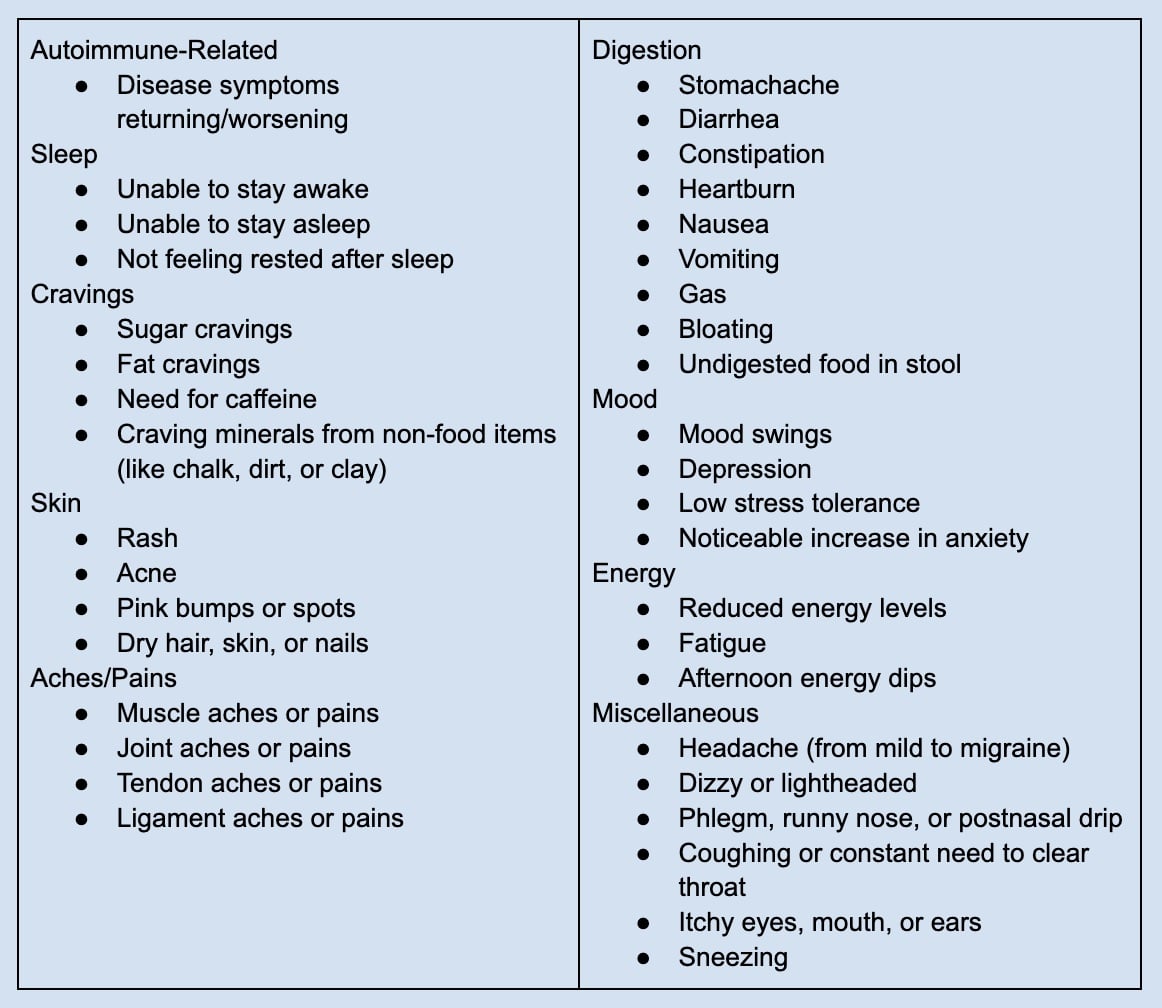
Below is a list of symptoms you might encounter when reintroducing a food back into your diet. You can run through this list during a reintroduction attempt to check-in with yourself each day (up to 7 days after you try a reintroduction, if you are being particularly cautious), to see if you are experiencing these things. Note any that you are experiencing, but which had been resolved prior to beginning the reintroduction process, on your reintroduction tracking page.

Possible reactions might be:

Want a handy print-out of the reintroduction procedure or the food reactions checklist? Click here or sign up below!
Reintroduction Frequently-Asked-Questions:
You still have questions, right? We get it and we’ve got answers! Check out our drop-down menu here:
If you aren’t feeling any improvement after 90 days on the elimination diet, it is important to enlist the help of a practitioner to troubleshoot some root cause issues that may be impacting your healing process. If you try to reintroduce foods before you start to feel improvement, you will have less ability to tell if a food is causing a reaction or not.
No, but you do need to see measurable improvement to create that “baseline” and gauge reactions. Even if you have not had total remission of your autoimmune symptoms, look for positive changes in other areas, like skin, digestion, mood, sleep, and energy. If those subtler changes are clear and measurable enough, you can start the reintroduction process.
Some autoimmune diseases, like Hashimoto’s thyroiditis come with symptoms that are more subtle and hard to track, such as energy and mood fluctuations. This is where very careful symptom journaling and tracking comes in. Certain indicators like bowel movement frequency and type (check out a Bristol Stool Chart for help), morning body temperatures, and monitoring thyroid hormones via blood work can be helpful. Even though progress might be harder to ascertain, you should be able to see forward movement using this information when combined with your symptom tracking.
This is what everyone is nervous about, as we don’t want to experience the disappointment that comes when a food reintroduction is not successful. While it is disappointing, it is also a valuable communication from your body.
Stop and do not include this food in your diet at this time. Depending on the severity of your reaction, go back to the elimination phase until you reach the baseline of health that you had before you started reintroducing foods. This could take a matter of days or weeks to achieve but it is important to “clear the slate” before you begin the process again with a new food. If you do not give time to the “clearing the slate” process, it will be difficult to gauge positive or negative reactions to the next reintroduction attempts. Remember that a food that did not work today may work in the future with more healing.
This depends on the severity of reaction. It could be a matter of days or weeks. It’s important to reestablish your improved baseline before starting again.
No, but it is recommended to try some other foods from that stage before moving on to the next stage. For instance, if you try ghee in Stage 1 and get a reaction, but you have successfully reintroduced green beans, cardamom, black pepper, and macadamia nut oil, you could consider moving on to foods in the Stage 2 list. However, if you find that you are reacting to most of the foods in a particular stage, you may need to wait for deeper healing before moving further.
Professional Support
If you are still feeling overwhelmed about reintroductions and feel like professional support might be helpful, we are one step ahead of you! Nearly 1,000 healthcare providers have been trained in implementing the Autoimmune Protocol according to current evidence, including how to customize and personalize depending on each person’s unique needs.
The AIP Certified Coach practitioner community contains both non-licensed and licensed providers from across the natural and conventional spectrum of healthcare, located all over the world, and working in many different languages. You can find health coaches, nutritionists, fitness professionals, bodyworkers, herbalists, naturopaths, medical doctors, and more. You can search listings to find a practitioner near you on the AIP Certified Coach website.
Looking for more AIP and reintroduction resources?
If you are looking for hard-copy resources for the Autoimmune Protocol, we’ve got you covered.
Our co-authored guide, The Autoimmune Wellness Handbook serves as an all-angles approach to every area those with chronic illness want to cover, from the Autoimmune Protocol to sleep, stress management, and connection (and it also contains a library of AIP recipes!). The Autoimmune Paleo Cookbook was the very first AIP cookbook and still a favorite in the AIP community. The Alternative Autoimmune Cookbook was the first to tackle the emotional side of healing along with delicious reintroduction recipes. And The Nutrient-Dense Kitchen contains an impressive library of AIP favorites with an extra focus on accessibility, quick meals, and nutrient-density.
We’ll be the first to tell you that you don’t need to buy any books to get connected to all the information you need to embark on AIP, because our mission here at Autoimmune Wellness is to share that information for free. There are over 100 articles on this site covering every detail of AIP, in addition to over 250 compliant recipes and even more resources and links on our resources page. You can also tune in to past episodes of The Autoimmune Wellness Podcast for an audio version of the information presented here.

Downloadable resources
If you are looking to get started with AIP, you will want to sign up to get the AIP Quick Start Guide. Just pop your email in the box below and we will send you the following resources over the course of a week:
- Complete, printable lists of the foods to avoid and include during AIP
- A 2-week AIP meal plan and shopping list
- A 90-minute batch cooking video from Mickey
- Printable guides on food reintroductions and reactions
You will then be subscribed to our occasional newsletter, where we deliver free, exclusive content in the form of tips, articles, recipes, news, and more. By signing up, you will be the first to know about what is happening in the autoimmune community!













206 comments
If I was previously intolerant to dairy, specifically to the protein in dairy, should I reintroduce it? In the past I can eat small amounts and if I eat more take an enzyme supplement and I either dont have issues or have very small issues. But when I would drink straight milk it was not good. Thank you for your help!!(:
Monica,
This is going to be up to you, but I would exercise caution with any foods you have a known reaction to. Chances are it will still be a problem. Wishing you luck!
Hi,
I have Hashimoto’s and have been trying to reintroduce dairy and eggs for three years now. Each time I’ve had a small serving of cheese or eggs, I have light menstrual spotting within the next day or so. I don’t see this listed as one of the expected bad reactions — is this something indicating an intolerance?
Thank you for this website. It’s been an invaluable resource over the years, especially during Covid.
Hi Dan!
That is definitely an interesting response, and I wouldn’t overlook it! My thought would be perhaps those foods are triggering some sort of a hormonal response. Not something I can help troubleshoot via the comments section, but definitely worthwhile bringing to the attention of your medical providers, as well as making sure you have a checkup to ensure everything is good. This is especially important anytime bleeding is involved.
Thank you so much for all the information. I’m currently in the core reintroduction stage 1. I’m a little confused. Do I test each food item listed in each category? Like all the spices, seeds, nuts etc. listed? Thank you
Lisa,
Yes, each food is to be tested individually! So once you get to seeds, you’ll do one seed at a time. Start with the ones you are most excited about, and then move down the list. Good luck!
Hi
I have done the AIP diet for 30 days. My osteoarthritis symptoms have not really improved that much. (Esp Heberden nodes on fingers). Does AIP generally work well for this? I suspect mine is hormone induced (last 12 months) due to menopause, so I do wonder how effective the diet could be, given it is not replacing any hormones. I don’t eat any red meat and normally occasionally have fish and chicken, so I have eaten a lot more than I would normally over the past 30 days for my protein intake. Is it possible to switch to AIP moderated version now for my protein? I’m also super busy and work/teach full time, so this is especially difficult for meal prep. Any advice would be very much appreciated. I don’t know whether I should start including legumes fully as if I was just starting on the AIP moderated.
Thanks
Hi Lil!
Sorry to hear your progress isn’t what you were hoping for–my feeling is that because you have osteoarthritis and not an autoimmune arthritis, that could be why. Osteoarthritis differs from autoimmune arthritis conditions in that it is caused by wear and tear, and not the immune system. I do think an anti-inflammatory approach could help, especially with nutrients that are helpful for supporting joints and tendons. I think it would be a good idea to start reintroducing foods to see your tolerance, especially since you’ve done the hard work of eliminating. You may have some food triggers in there, which will be helpful to know about–and also a dietary expansion is likely to help your stress levels. Wishing you luck!