
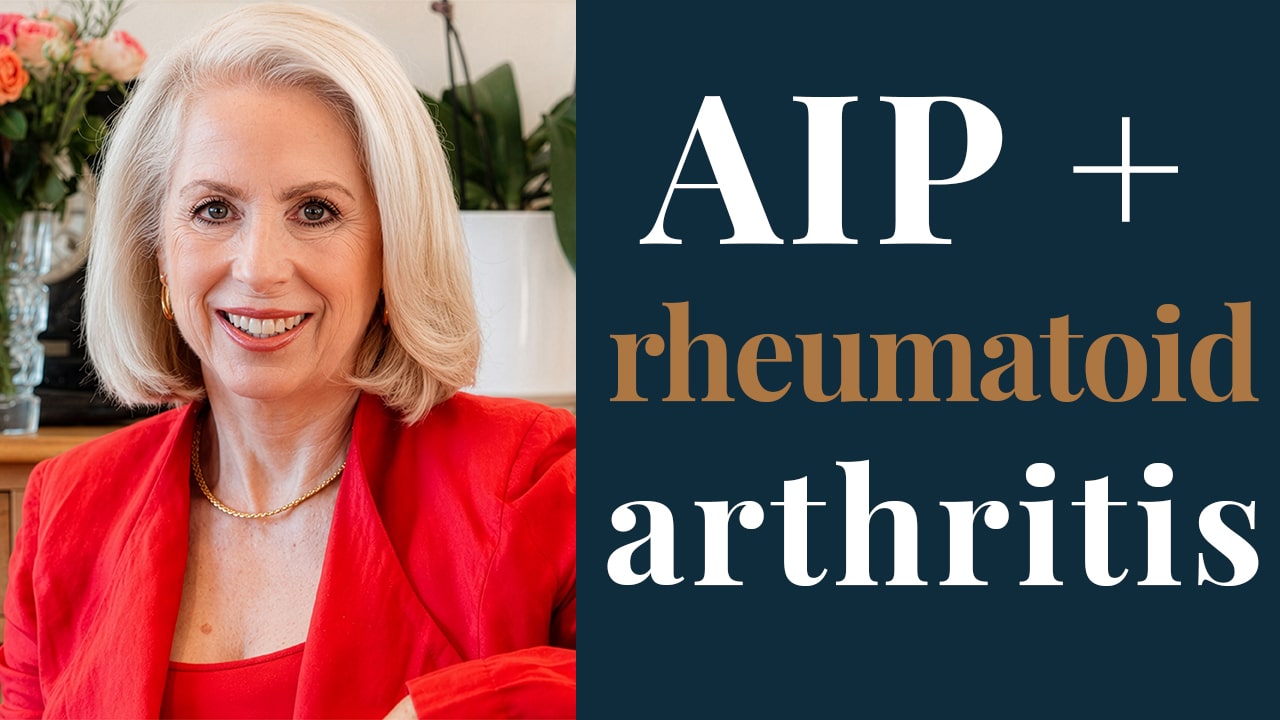
Rheumatoid arthritis is one of the most researched autoimmune diseases in nutrition science—yet many patients still struggle with fatigue, pain, poor sleep, and reduced quality of life even while receiving standard medical treatment.
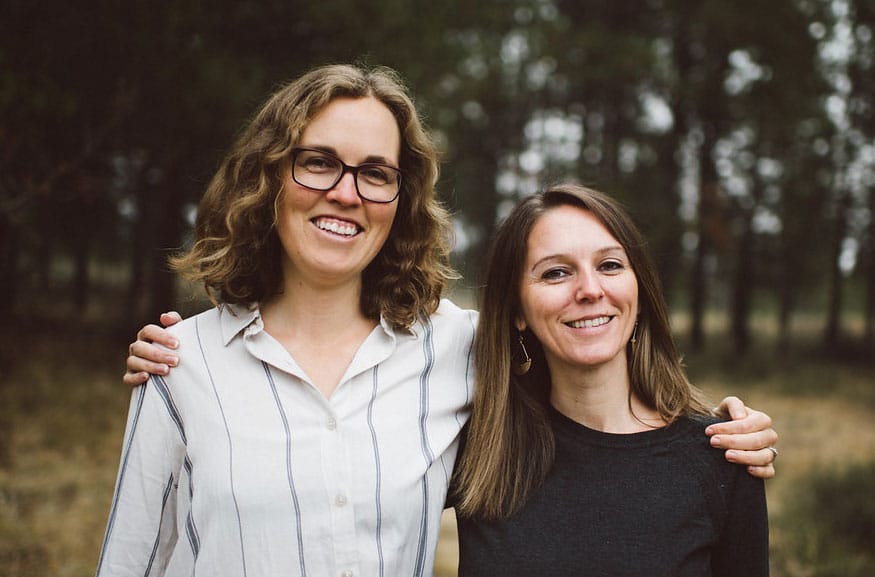
In Episode 88 of the Autoimmune Wellness Podcast, I’m joined by registered nutritionist, AIP Certified Coach, and PhD candidate Julianne Taylor to discuss the first clinical trial investigating the Autoimmune Protocol in adults with rheumatoid arthritis.
.
Watch the Episode
.
The First AIP Pilot Trial in Rheumatoid Arthritis
Julianne recently published the first pilot feasibility study examining the Autoimmune Protocol diet in people with rheumatoid arthritis.
The study explored whether an 8-week AIP intervention could influence patient-reported disease activity, pain, fatigue, sleep, and quality of life.
Participants completed validated rheumatoid arthritis questionnaires throughout the study, and many experienced meaningful improvements during the intervention—including several reaching remission-level scores by the end of the trial.
In this episode, Julianne explains how the study was designed, what the participants actually did, and why patient-reported outcomes like fatigue and sleep are so important in rheumatoid arthritis research.
.
What the Research Revealed
One of the most interesting parts of this conversation is the nuance. While many participants improved, the study also highlighted the variability of individual responses and some of the challenges people may encounter when implementing major dietary changes.
Julianne also shares insights from her broader scoping review examining decades of elimination and reintroduction diet research in rheumatoid arthritis—including common trigger foods that repeatedly appeared in the literature.
We also discuss:
- Why nutrient density may matter as much as food elimination
- How dietary quality changed during the intervention
- Why sleep and fatigue deserve more attention in RA care
- The potential role of nightshades and other common trigger foods
- Why future research on AIP and autoimmune disease is still needed
.
Resources
- The First AIP Pilot Trial in Rheumatoid Arthritis
- Elimination, Reintroduction Diets, and Oral Food Challenge in Adults with Rheumatoid Arthritis: A Scoping Review
- Paleo Zone Nutrition
- Julianne Taylor Nutrition
- Follow Julianne Taylor on Instagram
.
Episode Timeline
00:00 – Introduction to the first AIP rheumatoid arthritis pilot study
01:56 – Introducing Julianne Taylor
03:54 – Julianne’s personal health journey and early paleo research
11:34 – What a pilot feasibility study is
13:05 – The questionnaires used in the AIP RA pilot trial
17:07 – The AIP intervention and elimination phase
19:32 – Results of the rheumatoid arthritis pilot study
24:56 – Discussing adverse effects and individual variability
30:57 – Diet quality versus food eliminations
33:54 – Reviewing decades of elimination diet research in RA
38:48 – Common trigger foods identified in the literature
42:31 – Nightshades and rheumatoid arthritis
44:31 – Upcoming AIP and RA research
51:20 – What Julianne hopes clinicians and patients take away from the research
53:23 – Where to follow Julianne’s work online
.
Listen to the Episode
.
Transcript
Below is the full transcript of Episode 88 of the Autoimmune Wellness Podcast. This transcript is provided for accessibility and reference.
Title: The First AIP Pilot Trial in Rheumatoid Arthritis with Julianne Taylor (Ep 088)
Mickey: Can dietary change meaningfully improve rheumatoid arthritis symptoms? A recently published pilot study investigating the Autoimmune Protocol diet in adults with rheumatoid arthritis found improvements in patient-reported disease activity, pain, fatigue, sleep, and quality of life measures, with several participants reaching remission level scores by the end of the intervention.
In today’s episode, we are going to explore what this first of its kind trial actually found, the important limitations and nuances of the research, and what a broader review of elimination and reintroduction diets in RA might reveal about how food affects autoimmune disease.
Mickey: Welcome to the Autoimmune Wellness Podcast, where we explore evidence-based strategies for living well with autoimmune disease through nutrition, lifestyle, mindset, and community.
I’m your host, Mickey Trescott, and today I’m joined by Julianne Taylor, a registered nutritionist from New Zealand, whose work many longtime members of the AIP community might already recognize. In fact, I first discovered Julianne’s work well over a decade ago through her Paleo Zone Nutrition blog.
She was writing about dietary approaches to managing RA long before these conversations were mainstream. In fact, this was one of my initial introductions to the Autoimmune Protocol. So I have Julianne to thank for this path that my life has taken. We later met in person when I traveled to New Zealand during the book tour for the metric edition of The Autoimmune Paleo Cookbook.
And over the years, Julianne has remained an active and respected member of the AIP community, including becoming an AIP Certified Coach. So now that you guys know some of my personal background with Julianne and her work, I’m going to read you guys her official bio.
[00:01:56] Introducing Julianne Taylor, Registered Nutritionist and PhD Candidate
Mickey: Julianne Taylor is a registered nutritionist with the Nutrition Society of New Zealand. She’s an AIP Certified Coach, and she’s a New Zealand Registered General and obstetric Nurse. She recently completed her PhD coursework at Auckland University of Technology, where her research focused on dietary strategies for rheumatoid arthritis, particularly elimination reintroduction approaches and the Autoimmune Protocol diet.
She’s got one final hurdle to clear before her PhD is official, and we are all cheering her on and wishing her luck with that this summer. Julianne’s recently published pilot feasibility study is the first clinical trial investigating the effects of the AIP diet in adults with rheumatoid arthritis, with several additional papers from that PhD currently under review.
Her interest in autoimmune nutrition began in 2009 while working with one of New Zealand’s earliest CrossFit gyms, where she was introduced to the paleo diet and the work of Dr. Loren Cordain and Robb Wolf. Intrigued by that emerging idea around ancestral nutrition and autoimmune disease, she began diving into the scientific literature and eventually experimented with paleo diet herself, experiencing significant improvements in longstanding joint inflammation and eczema.
That experience ultimately inspired a transition from careers in nursing and design into nutrition science and clinical research. And in 2015, she conducted qualitative research interviewing people with RA who reported symptom improvements using paleo and AIP approaches, laying this groundwork for the clinical research that she would later pursue during her PhD.
And in addition to her academic and clinical work, Julianne is also an accomplished competitive powerlifter who has represented New Zealand internationally, earning a bronze medal in the 2019 World Championships, and later becoming world champion in her division for both 2023 and 2025.
I just think this is so cool. Thank you so much, Julianne. Welcome to the podcast.
Julianne Taylor: Thank you. Thanks for having me.
[00:03:54] From Personal Experience to Research
Mickey: Yeah. So let’s just jump right in. I would love to start by hearing your personal story. Like a lot of us, you got into this because of your own personal health issues. I would love to hear what led you to explore paleo nutrition and then eventually the Autoimmune Protocol in the context of RA.
Julianne Taylor: Sure. So I, I probably always had an interest in nutrition. Like, I trained as a nurse. I practiced for, uh, three or four years post registration. Throughout my younger years, I was always interested in diet, but it was more for weight loss. Constantly going on and off diets in order to, you know, keep that- Small body, as young people tend to do.
Then, a little later, when I was about 18, I started getting, um, some joint inflammation. So one of my knees would swell, just get fluid-y and hot, and I get– had a really stiff, stiff sore neck and, um, inflammation in my jaw joints. And that time I was investigated by a rheumatologist who found that I had a positive ANA, not– It’s an anti-nuclear antibody, which is linked with a number of autoimmune diseases.
It wasn’t strong, but it was present. Nothing got really bad, but what was interesting is my mother has lupus, and I had identical symptoms to her, so the knees, the neck, and the jaw, like the same inflammation pattern. And she had the same positive ANA. So I was never diagnosed officially, but that’s– I see it as probably autoimmune inflammation.
In the ’90s, this is going back to ’95, my boyfriend at the time, who’s now my husband, he bought a book back from America called Enter the Zone by Dr. Barry Sears, which really focused on having balanced meals, low glycemic carbohydrates, protein at each meal, healthy fats. So when I changed to that diet, I had a– Like it was quite mind-blowing for me.
You know, like I think a lot of people experience this. My joint inflammation improved, especially when I added some more omega-3 into my diet. Like I started taking a supplement. My energy was better. I lost weight more easily. I found I probably was really under-eating protein because at that time everybody was kind of semi-vegetarian and, you know, eating fairly high carbohydrate diets as per what we thought that was the healthiest thing to do.
So a more balanced diet made a really big difference to my energy levels, recovery from the gym, and some improvement in my joint inflammation. So I retrained as a Zone Diet coach but kept up my working in the design field at that time. But later, I got a job at a CrossFit gym because being Zone, all about Zone and all about paleo, which I’d never heard of.
So I thought, I’ve got to start investigating this paleo diet. And that’s really when I went down into the work that Robb Wolf was doing because he was aligned with CrossFit. Loren Cordain, started reading his papers. Watched his series. I don’t know if people are familiar with it, but there’s a series of YouTube Videos.
I’m not sure if they’re on YouTube anymore, but they’re available online somewhere for the Multiple Sclerosis Foundation, where he started talking about removing certain foods like nightshades, gluten, dairy, in order to reduce the symptoms of autoimmune issues. So I was really taken with this, particularly because I had done a graduate certificate in nutrition at that stage because it was aligned with scientific principles.
So I immediately thought, “I’m just going to try this out.” And within three weeks, my joint inflammation just disappeared, so I was like, “This is amazing.” And I had a couple of ganglion cysts on my wrist which had been there for years, like 10 years, and that just kind of shrunk away. So I thought, “Well, that’s even more interesting.”
And so I ranted and raved about this to my dad, who’s a doctor, and, my mum decided to try it as well. And as part of her lupus, she had small airways disease, so she had quite a lot of lung inflammation. And so she went on the paleo diet, and she had significant improvement from her lung inflammation within a short period of time.
So that really controlled that for most of the rest of her life, actually. So that was, that was my story. And then I became involved in the ancestral health community, and the community here in New Zealand as well. And through that community, I started hearing about people who, with rheumatoid arthritis who had significant improvements in their, joint inflammation or their symptoms as a result of a paleo-type, AIP-type diet.
And at that time, I was doing my post-grad diploma, very slowly, one paper at a time with bringing up kids as well. And, as my final project, I decided that it would be useful to start exploring this, and doing some research in the area. And that led to the qualitative study where I interviewed 10 people who had got improvements.
So getting improvements on a diet with anecdotal stories doesn’t mean it’s going to work for everybody, and this is why we need clinical studies. And I don’t think a lot of people realize the importance of having a clinical study where you take a group of people and see what the spectrum of results is.
You don’t hear about all the positive experiences. You also hear about maybe negative experiences or ones that, you know, might just be, hmm, ho-hum. So, that was my thinking at the time, and, um, eventually I got there with my studying a master’s research year, which I upgraded into a PhD. Yeah.
Mickey: I love that
Julianne Taylor: Yeah.
Mickey: I love it. I love it. Thank you for sharing all that, and honestly, thank you for sharing and writing on your blog, because I remember the time that I found it, I was looking for stories of people who had done this themselves, because I was in a similar boat. One thing for our listeners, getting classified with a rheumatological autoimmune condition is actually really challenging, and I mean, if you have one, you know.
But you kinda have to have enough markers in a certain category in order for them to say, “You have rheumatoid arthritis,” or, “You have psoriatic arthritis.” I actually just got diagnosed with psoriatic arthritis after 15 years. But early on, when I discovered your blog, I had determined from my own research that I likely had a connective tissue autoimmune disease, which is actually how I think I landed there, because you were writing about your own experience having some of these markers of RA, and having lupus in your family, and really wanting to intervene before things got to the point where you have full-blown disease.
Because we know that people with especially RA have this period of, pre-diagnosis, where they have symptoms, but they’re not classified, and then they can’t access treatment, and it’s just really tricky. So I’m just really grateful that you had the ability to write about it, and that I heard about it from halfway across the world, and it really changed my life. So thank you.
[00:11:34] Explaining The Role of a Pilot Study
Mickey: So you did your qualitative research, you know, for your graduate program. You upgraded that to a PhD, and then you ended up just publishing the pilot study using AIP for rheumatoid arthritis. Talk us through that study, kind of how you designed it, what a pilot study is and what that means, and what the participants actually did as that intervention.
Julianne Taylor: Sure. So a pilot study is really the start of a research program. It’s not the end in itself. It’s really a feasibility study. So what you’re wanting to find out is there an effect, first of all, and how big is that effect? How many people, what’s the average rate of improvement, if you like, if there is an effect?
You’re also wanting to look at adverse effects, so asking people like, you know, “Do you get any negative effects from your diet?” So you do the pilot study and then once you’ve got all these parameters like how well did it work, if it worked, were there negative effects, what was the effect size, all of those things, then you’ve got the basis to do a larger study.
And it could be a really large study or it could be another kind of pilot study where you have a slightly larger group and then you have a control group or a comparative group. So that’s what we’re thinking about next. However, how did I design the pilot study? So I wanted to gather as much information as possible without spending money
[00:13:05] The Questionnaires Used in the AIP RA Pilot Trial
Julianne Taylor: So basically when I started, it was, as I said, it was my master’s research year, which is the second year of a master’s. And the money was like, in the pot was about a thousand New Zealand dollars, so there really wasn’t enough money to even do biological markers. So I looked at questionnaires that people could do online, ’cause at that time we had just come out of our first COVID lockdown, and who knows if we were going to go into another COVID lockdown.
So a lot of this needed to be information that could be gathered online. So I decided on a couple of validated questionnaire measures that had been compared to objective measures, say, that our rheumatologists would do, like joint counts and, C-reactive protein, and they had strong validity for being a good comparator to those.
So that was the RAPID3. And then there was RA, Rheumatoid Arthritis Impact of Design, which very few people have actually done in research. However, it was designed to ask questions that really mattered to people with rheumatoid arthritis, and that was how it was designed from– by people with rheumatoid arthritis.
So that was their sleep quality, fatigue, quality of life, pain, just things that really mattered. So we had those measures. I also wanted to understand how difficult it was, so e-each week we had a question like, “How difficult was this diet to implement compared to the normal diet?” And, “How expensive was it compared to your normal diet?”
The other one I wanted to do was an in-depth nutritional analysis, so I collected three-day dietary records where people weighed and measured their food for three days, two days like Thursday, Friday, and then one day a weekend. And did that four times. I also needed a comparative, so not just a single baseline, but I wanted to measure their normal responses over the course of a few weeks.
So we decided on a four-week controlled, or habitual diet phase where they did all the same measures that they were going to be doing for the next eight weeks on the Autoimmune Protocol. So I had a good comparator when we didn’t have like a control group. So that just gives a little bit more validity to the results when you have this control period.
Mickey: I love that. And, and I thank you for explaining the validated questionnaires, ’cause a lot of the problems in research are how do we compare this result to other studies, other dietary studies, and, these questionnaires. Every condition, you know, the listeners have heard me talk about, some of the IBD research and the Hashimoto’s research, really these disease-specific questionnaires are used in other research.
So this isn’t something that you’re coming up with. Of course, you have some questions that you’re using to tease out some information when for when you’re writing up your paper. But really, these are measures that are used in other studies that you can kinda see, how that person’s experience lines up with the clinical markers without actually having to run labs, which I think is so smart.
Julianne, I didn’t know what a budget you did this study on, which that’s really incredible.
Julianne Taylor: Yeah. Yeah. It was literally– yeah, I think I spent almost no money on doing the study other than my time.
Mickey: Yeah. Yeah. That’s, that’s incredible. And I mean, it’s so amazing how much you can learn from people by using these types of questionnaires. We did something similar with the Hashimoto’s research, which similarly, Hashimoto’s doesn’t need a lot of lab investigation in order to hone in on the things that’s important to patients.
So like you mentioned with RA patients, sleep and quality of life, it’s very similar with Hashimoto’s, and those are the things that people actually care about, not really their hormone levels. I just love that you did that thoughtfully and inexpensively.
[00:17:07] The AIP RA Pilot Study Intervention
Mickey: So let’s talk about the intervention. So they were their own controls, so there was a control phase and then a diet implementation phase. Talk to us about how long they implemented AIP for, and then what your recommendations within that framework were.
Julianne Taylor: Sure. So the four weeks were the control period, and then I gave them a booklet that I put together, so they had a one-hour, one-on-one session with me. So there were nine people in the study. And they started the study as soon as they enrolled, so people weren’t starting all at once. They were staggered, which made it a little bit easier to manage.
And so we had a one-on-one, and I went through the principles, the idea behind the Autoimmune Protocol, and gave them a booklet of information that had a whole bunch of lists of all the New Zealand foods, yes and no foods, resources to buy food. Yeah, just everything I could– that I thought would be useful for them to implement the program in New Zealand without having to use overseas resources, which are often very Americanized.
The food names are different. You know, you have arugula, we have rocket. So there’s a whole bunch of different things, that have different names that people go, “Oh, what’s that food? Never heard of it.” And also local resources where you could buy like cassava flour and the arrowroot starch and things like that.
So literally overnight people put it into practice, so it was a really big ask, and it was quite a mental load for people as well. And there were a few disasters with meals. Like people would try some kind of macar- macaron recipe and it wouldn’t work out, for example. So yeah, there were things like that.
Um…
Mickey: And, and were they expecting you to hold their hand through that? That’s, that’s a lot.
Julianne Taylor: not really. People were– I mean, the thing about… And, and this is one of the limitations of a study like this. Anybody that’s going to sign up for this kind of study is going to be highly motivated. They’re going to be resourceful. They’re going to have a supportive environment behind them.
Mickey: Mm-hmm. Yeah. Yeah, that’s a really good reminder.
Julianne Taylor: Yeah, they may not be your average person on the street with rheumatoid arthritis.
Mickey: And how long did they do the elimination phase? And we’re talking about Core AIP.
Julianne Taylor: Yeah. So core I- or, uh, AIP, they did it strictly for eight weeks.
[00:19:32] Discussing the Results of the AIP RA Pilot Study
Mickey: Okay. Okay, great. Yeah. So that’s kind of right in the middle of the general recommendation. And so talking about the results, talk to us about some of the findings and how that panned out, and if that was surprising to you in any way.
Julianne Taylor: Yeah. The RAPID3 is fairly standard and used quite regularly. It’s also used in rheumatological practices where they just want to get immediate feedback from a person without having to do their joint count.
So the RAPID3 includes things like how easy is it for you to turn on and off a tap or faucet, in your language. How easy is it to walk three kilometers? So there was a lot of getting in and out of a car, so it was like, can’t do at all, bit difficult, no problem at all. So there was a spectrum of answers they could answer. And there was about 10 or 14, I think, of those questions, everyday living, and then one on pain.
So over the course of the eight weeks, I found that people’s RAPID3 dropped, seven, I think seven out of nine reached. The final answer, and you just put all these into an algorithm, and it comes out with a number out of 10. So people ranged from kind of a one out of 10 right up to about six out of 10.
So there was quite a range of people when they started during their, control period. And by the end of eight weeks, all except one, I think, had dropped down below one, and the mean was 0.99 out of 10, from about … I can’t remember exactly, sorry. About three out of 10. So
Mickey: Mm-hmm.
Julianne Taylor: Most reached remission from either moderate-high or low disease activity, and one person had very low disease activity the whole way through, so that didn’t change. And one person got a little bit worse.
Mickey: Okay. Yeah, we’ll talk about that, ’cause the adverse effects are a really important part about learning th- about this, right?
Julianne Taylor: the … Yeah. And then the RAID, the RA Impact of Disease, had questions that aren’t frequently asked in rheumatoid arthritis studies, and that was one reason why I really wanted to include that. And that is, how good was your sleep, on a, on a rating of zero to 10, so 10 being really, really bad, and your fatigue on, again, zero to 10.
And we found both of those improved quite markedly, which is interesting because particularly fatigue, so there are studies where they’ve looked at, people’s fatigue levels. Even on the modern biological drugs, their fatigue levels haven’t really improved over time as medication has improved. So that’s something that consistently remains not great for people with rheumatoid arthritis and is considered one of their unmet needs.
And interestingly, I didn’t find a single study in probably nearly 80 intervention studies that have been done across the years that had assessed sleep in rheumatoid arthritis in associated with a dietary intervention. And we did find sleep improved.
So the other thing that I didn’t mention was that at the end of the eight weeks, I did a qualitative interview. So every person was interviewed for around about an hour on a number of different questions, like how difficult things were to put into practice, barriers, facilitators, and what actually influenced the results.
So with regards to fatigue, for example, everybody said, “I can’t believe how much my energy levels improved. So I just had so much energy. I didn’t have to have a nap in the afternoon. You know, I just felt so good.” And with regards to sleep, the ones that really had dramatic improvement in sleep said that, “I wasn’t waking up all the time because my joints were achy and sore, and I had to turn over. I didn’t have all that pain interruption in my sleep.” That was the main thing that they said they thought influenced their sleep.
Mickey: Okay. Yeah, that, I mean, that’s so amazing, I think, that you honed in both on those more clinical markers, and then some of the under-assessed areas like, fatigue and sleep. That actually really stood out to me because I’m really interested in the areas that are not studied when we have interventions for various autoimmune conditions.
Hashimoto’s is another condition that has been studied for AIP, and one of the key features is all of the things that are not treated by the thyroid hormone, which is the only standard treatment. So with RA, it sounds like there are lots of tools in the toolbox, biologics, that can, stop that joint damage and progression.
But it sounds like it’s not always effective for things like fatigue and sleep, and I mean, that really leads to an impaired quality of life for people, even if they are conventionally well-managed and not damaging their joints. It’s hard to live when you’re tired all the time, so, I love that you included that measure in the study.
[00:24:56] Discussing Any Adverse Effects
Mickey: So let’s talk a little bit about that one participant that worsened. We saw this with the IBD study. There were a couple strictures, and that really highlighted for the community of people that do AIP that, for that population, there are some things that, if you have some, anatomical changes, you definitely have to be careful when implementing a high-fiber diet.
Do you have anything to say about, that one person that got worse? Any thoughts on that?
Julianne Taylor: Yeah. So in, in terms of adverse effects, there was the one person that got worse, and then there was another person whose markers didn’t get worse. As I said, they stayed around zero to one the whole time, but they developed diarrhea from week five. And this was a male who had a very- active job, lifting heavy things in and out, driving a huge truck all day.
So the first woman, she just lost her appetite. She said, “I just didn’t feel like eating. I had no appetite.” And she got more and more fatigued. Her oldest daughter, she was an older woman, around the age of 60, and her oldest daughter actually did it with her, who didn’t have any autoimmune issues, but she supported her.
And the daughter had no problems at all. Like didn’t have, didn’t lose weight, didn’t lose her appetite. They were eating the same meals, you know, but she just said, “Look, you could put a piece of the most delicious thing in front of me, and I would just turn my nose up at it.” One thing that I did discover, and I didn’t find this out until the interview, was she said, “I have a sensitivity to sulfites.” And I looked, and she was eating a lot of, like using cassava flour and making like, I don’t know, p- uh, just
Mickey: Breads and tort– Yeah, yeah, yeah.
Julianne Taylor: And there is some indication that they might have trace levels of sulfites in them because of the way they’re processed and also because cassava is it can have kind of a natural sulfite in them.
So that’s one possibility. So I would say, as a result of that, be very careful about assessing people for any sensitivities if they’re going into, the Autoimmune Protocol. You know, whether it’s histamines or oxalates or sulfites or anything that the AIP diet might increase just because of the foods that you’re cutting out and the foods that you’re adding in.
And be careful about adding in novel foods, that is foods that they’ve never eaten before. So cassava was things that nobody had eaten previously. Nobody else had a problem on them. So that was one possibility.
The other one is she actually had a pretty good diet prior to the AIP. So she would have what are steel-cut oats for breakfast every morning, for example. And they’ve got beta-glucan, which is a really good prebiotic for your gut bacteria. So there are foods that she might have cut out that were actually beneficial for
Mickey: mm-hmm, mm-hmm.
Julianne Taylor: her. Um, so there was that side, and it could have been just a natural progression. She was having difficulty controlling her rheumatoid arthritis, and over the year following, it continued to get worse, even changing her diet back to sort of a one that worked, she found worked better for her.
Mickey: Great. Well, thank you for that discussion, and I think, the health coach in us wants to figure out, what was different? What was new? I’ve had so many people try AIP and either discover a histamine intolerance because they never ate fermented foods, or discover like a coconut or a cassava is actually a pretty common sensitivity in, within the AIP community, because again, we don’t really eat it until we do this, and we’re, maybe over-relying on it, depending on who it is.
So I think that’s a good warning for people just to, if there’s somebody that gets worse, most people don’t get worse. So if you do, it’s a clue to, to maybe not just keep going and feeling worse for a certain amount of time, and try to investigate. Because, my experience is most people, not everyone, but most people start to feel measurable improvements as they go through time, you know?
Julianne Taylor: Yeah. I think it’s worth mentioning too that there is a transition period for some people. So I noticed one of the people, if you look at the paper, her, I think her rapid three actually went up a little bit before it dropped back, back down. So there’s that transition where people can get gut symptoms because of the change in fiber, fatigue, you know, carbohydrate, sweet cravings.
You can get headachey. Some of your things might flare up a little bit and get worse as you’re releasing sort of maybe arachidonic acid from your cell membranes that build inflammatory eicosanoid hormones. There’s reasons for possible reasons, or it’s just the transition, your body getting used to something different.
And on that note, there was a guy who, as I said found it difficult to eat enough to maintain his weight with his– ’cause he’s male, heavier, very active because of his job, and then ended up getting diarrhea, and he was sitting in a truck. He was snacking on fruit all the time. Yeah. So his fruit intake went hugely up.
His vegetable intake went up. His fiber literally tripled. So it could have been that increase in fiber, and he’s– he also said he just didn’t feel satisfied. He was used to having five eggs and a can of baked beans for breakfast
Mickey: okay.
Julianne Taylor: just to give you a sense of how much he ate. Yeah.
Mickey: Yeah. Yeah. He sounds like he would be ideal for Modified AIP in today’s protocol. Give him some white rice and let’s go. Yeah.
Julianne Taylor: Yeah.
[00:30:57] Assessing the Effects of Diet Quality vs. Eliminations
Mickey: Okay. Well, well great. Thank you for discussing that. And before we move on to some of the next studies on the docket, I loved the nuance that you just talked about dietary quality and that you assessed that diet before and then the diet during the intervention, and you reported that people were eating more vegetables, seafood, fiber, and fewer refined foods.
And I know that you have another paper coming at some point breaking down all of this, but I would love to just hear your thoughts on maybe teasing out how much of this effect could maybe be from eliminations versus dietary improvement, if you have any thoughts either way.
Julianne Taylor: I wish we had a definitive answer. I honestly do. There’s very few studies. I think I only found two studies that were looked at that aspect. So yeah, we improve dietary quality. So when you increase fruits and vegetables, there’s evidence showing that increasing potassium through natural sources reduces inflammation. Increasing seafood reduces inflammation. Polyphenols and fiber feed your gut bacteria and then you have a lot of anti-inflammatory me- metabolites in your body that can improve your diet. Reducing white, refined carbs, particularly cereal grains like wheat, which is super interesting ’cause the standard New Zealand diet when you do an analysis of it, and this is from looking at thousands of people, 30% of the diet comes from wheat.
Mickey: Wow.
Julianne Taylor: And I found in my group that they had the standard kind of amount of food from wheat and only one of those six servings was whole grain. The rest was white flour, and that was a very typical New Zealand diet. And then of course, added sugars. So you’re getting a whole lot of highly refined starch and sugars, which will feed your bad gut bacteria.
So is it the gluten or is it the stuff that’s feeding the bad pathobiont gut bacteria or is it the anti-inflammatory components? It’s… Yeah. So there is that. However, the other study which you know I’ve done is, looking at elimination reintroduction diets and rheumatoid arthritis across the years, and there is evidence- That suggests that at least 30% of people seem to have some kinds of sensitivities that have been clarified through clinical studies.
Mickey: Okay. I haven’t heard that yet, and that’s actually really important information because I think when people learn about something like the Autoimmune Protocol, they wonder what, where the effect is.
[00:33:54] A Scoping Review of Dietary Studies in Reumatoid Arthritis
Mickey: You’ve done this review, so part of this work, now we’re transitioning to, from talking about the pilot trial to this scoping review, where basically Juliane went and she looked at all of the literature about dietary interventions in rheumatoid arthritis spanning decades of research, and reviewing it, and then writing a paper basically summarizing kind of all of those findings.
So talk to us about what stood out from you about reviewing all of that literature and what that process was like.
Julianne Taylor: Mm. Hugely time-consuming is all I can say. A labor of love. A scoping review is kind of cool because it– you can take all kinds of studies. So you can take case studies, you can look at, PhD theses, kind of anything that’s kind of online that gives a good picture. It doesn’t have to be like in a peer review journal as such.
So… But it has to be a decent quality study to a certain extent. So you can look at, yeah, case studies in particular and small studies, pilot studies, all kinds. So I went back and I found a whole lot of research, and then I actually looked through all the references as well of some older papers because some of those just don’t show up, like in Google Scholar or, on the standard searches.
So found a lot of quirky little studies, case studies, that were kind of interesting, but they all had this similar aspect where they had eliminated food in some way and then tested it, as a reintroduction or as a food challenge. So yeah, I looked at… I ended up finding quite a few studies in the end and case studies.
And at the range of success in those was really variable. Sometimes you would get 100% of people responding to an elimination reintroduction, and some studies said, like 5%. So the consensus seems to be around 30%. One of the studies I found particularly interesting was the work by Gail Darlington, who is a researcher in the UK.
I think she’s still around. She’d be fairly elderly by now, I think. But she wrote an entire book on her elimination reintroduction studies. And she started off with a really interesting start. So one of her young patients with, junior arthritis, rheumatoid arthritis, had been quite crippled by this.
And then the next time she saw her, this kid was running into the surgery with literally no pain. So she was fascinated by why is this girl so well? And then she found out this child had done a particular elimination reintroduction diet. And so I went and found this particular booklet, which was done by the Allergy Society of the UK.
Yeah, I can send you a PDF. It’s quite fascinating.
Mickey: I would love that.
Julianne Taylor: Way back in like the 1980s, I think. So this girl came in, bouncing around, and this started, Dr. Darlington off on a ser- doing a series of studies. So she used this particular elimination reintroduction protocol with a number of clients, and she did studies, a whole range of studies, over a period of time, and she continued to follow through with these patients.
And the numbers were, I think, into the hundreds. And she found that something like 30% of people were able to maintain low disease activity over the years, sometimes up to, I think the last time she wrote about it was in 2004. So it was about 17 years some of these people have been following a diet that eliminated certain foods.
Mickey: Wow. Hmm. Wow. Wow. That is so interesting. Yeah, and that sounds like that goes in the way back, so you’re unearthing history, doing, interlibrary loans. I had to do some of that for my master’s, where you read a reference and you’re like, “Uh-oh, this is old. We don’t have it in the digital library.”
And so my librarian’s writing a letter to another librarian and trying to get me a photocopy of a manuscript. So, um,
Julianne Taylor: Exactly. And some of the pages are like, you know, a little
Mickey: Ha-
Julianne Taylor: and old and yeah.
Mickey: yeah. Well, I love that. I love that you did that research project and brought that into the modern approach so that we can consolidate what’s known, and then move on to the future with that information and build on it. That’s what research is all about.
[00:38:48] Common Trigger Foods in The Scoping Review of Diet and RA
Mickey: Talk to us a little bit about some of the most common trigger foods that you saw appearing the most often in some of these historical elimination protocols.
Julianne Taylor: Mm. Not all of the studies, but a percentage of the studies actually listed how many people reacted to certain foods and what foods they reacted to. So in the studies that were kind of carefully detailed those foods, I put everything into a big Excel sheet as you do, and just looked at all the different foods that people had measured, and the numbers of people and the times, basically did a collation of all of those studies.
And a lot of them were case studies as well, because they tend to be very specific in identifying foods. Yeah, so what was interesting is with rheumatoid arthritis, a lot of them were common to Autoimmune Protocol. So we found the cereal grains were common, and the two common cereal grains, and this is what surprised me, was not just wheat but corn.
So corn, corn tortillas, maize-type corn was really common. Then we had eggs. Dairy was another big one. And if you looked at the fruits and vegetables in particular, citrus came up fairly high. I don’t know whether that’s something that it’s– ’cause you don’t know how much of this is a belief or actually measured because some of the studies were like, “Oh yeah, I ate that food and I reacted.”
And then there was one particular clinical study where they had, done big surveys of people, and they’d found, I think five or six people that said, “Yeah, I definitely react to these foods.” So they brought them into the hospital, they gave them these foods, and they had no measurable reaction. So is it they just thought they did, or was it because it’s combined with some other food?
It’s– So it’s not like definitive because some of it is subjective. But there was also, a little increase around tomatoes and potatoes. Pips. Sometimes it was just pips, which is just a word for nuts and seeds, and
Mickey: Oh, okay. I’m like
Julianne Taylor: of… Yeah. So that was a little bit of a blip there. The other big two that surprised me, mm, sort of surprised me, but was beef and pork.
Mickey: Okay, I was going to say, I think I know where you’re going here.
Julianne Taylor: Yeah. So those are commonly eaten Autoimmune Protocol foods, and I’ve actually had, anecdotally clients who have said, “I-” Beef, pork don’t work for me. And if people are on the Autoimmune Protocol, you want to go, “Okay, well, what might be going on here?”
Mickey: Mm-hmm.
Julianne Taylor: I now when I’m working with people with rheumatoid arthritis, I tell them, “Look, this is a sensitivity that comes up often. It’s not recommended to remove it on the Autoimmune Protocol, but you may want to be aware that could be something you react to.”
Mickey: Mm-hmm. Mm-hmm. Yeah, the people that I’ve encountered usually, um, either, A, they, have a history with those foods and have already determined, these are inflammatory for me, or B, they have spent time in a community that villainizes those foods because of, the saturated fat or cultural beliefs, but they don’t have experience that they’re bad for them.
So, depending on the person, I coach them a different way. But yeah, there definitely can be real sensitivities for some people, so I’m glad you brought that up and that’s documented. And interesting to hear about the nightshades. I really haven’t come across very much research in my investigating about nightshades, and they’re not usually a category.
[00:42:31] Nightshades as a Symptom Trigger for RA
Mickey: Sometimes, like you mentioned, tomatoes and potatoes, they’re kind of broken out into, a specific food. That’s an interesting one for the autoimmune community.
Julianne Taylor: Yeah, there is– there was no nightshade category in any of those studies. One that particularly stood out was, a case study where, which is more, more recent, I think it was 2010, where nightshades was a big inflammatory response. So yeah, I had a look at– I think I did a blog post about nightshades, because they’re– interestingly, there are no clinical studies testing nightshades in people with autoimmune disease.
Zero. But
Mickey: Uh-huh.
Julianne Taylor: yeah.
Mickey: But you talk to people in the autoimmune community, and everybody wants to talk about how they affect them, so we gotta research this, right?
Julianne Taylor: Yeah. Well, there’s an interesting, the no-nightshade diet that was written, oof, a long time ago, might have been the ’60s, by a guy who was a plant scientist, and that’s an interesting story in itself, how he ended up coming across nightshades and, curing his– cutting them out, curing his own arthritis.
And then he s- he decided to, get his secretaries to send out, notices to like- letters to people saying, “If you’ve got arthritis, do you want to try this no-nightshade diet?” Had his book and he had a little postcard that people sent back and said, “Yeah, I tried this no-nightshade diet and it helped my arthritis.” So it was like an informal study done right at the beginning.
Mickey: I mean, but that’s amazing. That’s what happens when you have autoimmune disease, nobody knows how to help you, and you find something that works, and you try to get the word out. It sounds like he was just trying to influence the arthritis community back in the day with letters, which is amazing.
Julianne Taylor: Yeah.
Mickey: really cool. I don’t want to take up too much of your time, Julianne. This has been such an amazing conversation.
[00:44:31] Julianne’s Forthcoming AIP and RA Research
Mickey: I do want to spend a couple minutes just talking about what’s coming next because this pilot study, you guys, I’m going to link it in the show notes. I would encourage you to give it a read.
There’s so much information there. But Julianne is actually working on several more papers prepared from the same dataset. Can you talk to us a little bit about what’s coming and kinda what you’re working on?
Julianne Taylor: Yep. One of the studies, was, as I said, the– it’s the– I took, three-day diet diaries, twice during the four weeks. Well, at the beginning of the four weeks, at the end of the four weeks, and then twice week 4 and week 8 of the AIP diet. , Then I analyzed their differences between their diet before and after.
So as I said already, the fruit and veggies and the fish and the seafood and the omega-3 improved. Potassium and vitamin C went up hugely. A lot of the others stayed relatively the same. ALA, alpha-linoleic acid and linolenic acid, which is the omega-6 and the plant omega-3 both dropped significantly because there are just a very few sources of that on the AIP diet.
Which probably isn’t a big issue as long as you’re getting the long-chain version. The other thing that I think is worth considering and paying attention to is that both iodine and calcium dropped quite precipitously. Calcium because people cut out dairy and they didn’t replace it with anything.
The only way really to get it is some of the greens and the fish in cans with the soft bones. So I would be really careful about
Mickey: Mm-hmm.
Julianne Taylor: Monitoring people’s calcium level
Mickey: Mm-hmm.
Julianne Taylor: iodine as well. So they may have got more iodine depending on whether they used iodized salt or not.
Mickey: Mm.
Julianne Taylor: And it did depend a little bit on did they add some seaweed. Some people did, some people didn’t. So it- In New Zealand we have very, very low iodine in the soil, so that is problematic. Yep. So that was something I would ask people to monitor is the nutrient content when they’re changing their diet and they’re cutting out a lot of foods. So that was the main thing from the dietary analysis.
The other one I did was the interviews, so qualitative interviews at the end. I think what came out of that is probably all the standard stuff that people say. Like food preparation time increases astronomically. Support is really important and makes a huge difference. So people had their spouses, their adult children, or someone else in their life that they could connect with who were doing it with them or supporting them. It made a really big difference. Eating out wasn’t so much a problem because soon after we started, we went into another lockdown
Mickey: Yeah.
Julianne Taylor: like going, “What am I going to eat at this cafe? There’s nothing I can eat. What am I going to do with my colleagues and friends?”
You know, like that was a real dilemma for people. And it’s like, oh, we’re into lockdown, so it didn’t matter anymore. Or we just had backyard, yard barbecues with our neighbors, and I just brought my own food and my, you know, soda water and stuff. So that was the qualitative. And then the other one I did was a one-year follow-up on everybody. So
Mickey: I’m excited about that. I’m
Julianne Taylor: yeah. So that was, again, and this isn’t published yet, so yeah. I did their Rapid 3 and their RAID, and everybody’s, except for that one person who was getting worse, got even worse over the course of the year.
But most people stayed right down within very close to the remission levels that they’d had.
Mickey: After a year?
Julianne Taylor: a- after a year, yeah. And they did the reintroduction by themselves. So I gave them all the outline how to do it, walked them through it. It was coming up close to Christmas which made it really difficult.
So one person just went, “Blow it. I’ll just eat all the crap again,” and felt terrible for it, but kept doing it anyway. The others just mostly just reintroduced foods they really wanted. So I said, there’s options here. You can just go through this protocol and way of doing it that is outlined, or you can introduce the foods that you most want to eat.
So of course eggs was there for everybody, and nobody had a reaction to eggs. Yeah. So everybody happily started eating eggs again. People introduced dairy, but not so much joint symptoms, but gut symptoms interestingly. A couple of people only used goat dairy, like goat cheeses instead and found that not a problem.
Nuts and seeds weren’t really a problem. Nightshades, yes, potatoes. Two or three people said potatoes, and then they went out and had like a chili meal at a restaurant, and they woke up the next day with more pain. So two people had said that. So yeah, nightshades does seem to be there. It is a little bit tricky though because everybody was on, methotrexate or biologics or a combination.
So that does tend to dampen your immune response. So… In a lot of the older studies that I looked at in my scoping review, they actually took people off all their medication before they did the study. So that was very clear what people reacted to if they were to react.
Mickey: Sad for them though, because I mean, RA, the consequences of not managing that inflammation can be permanent. I think the way that you did it is a lot kinder to your participants.
Julianne Taylor: off. That would be unethical to take
Mickey: Yeah. I agree. I agree. Yeah.
Julianne Taylor: Yeah, ’cause the joint damage you see in, in the pre-biologics is just… I mean, yeah, my mother-in-law had rheumatoid arthritis, so
Mickey: Mm-hmm.
Julianne Taylor: You know, she had all those classic deformities. And it’s pretty horrendous compared to what people get now, which is minimal if they’re managed well.
Mickey: Mm-hmm. Mm-hmm.
Julianne Taylor: So yeah, that was, that was quite exciting for the one year. They did mention in their, interview so that their energy levels were less. But is that because of the diet or is it because that we were out of lockdown, they were going about their normal lives and a lot busier than they were before?
So there’s, there’s so many other factors that can influence,
Mickey: Mm-hmm.
Julianne Taylor: your fatigue and your results other than diet as we know.
Mickey: Absolutely.
Julianne Taylor: And it’s hard to manage all those confounders. So you just have to say, “Look, this is a limitation.”
Mickey: Mm-hmm. Well, thank you so much, Julianne. This research that you’ve done is really thoughtful. I know the community is really supported just by having this information, and it sounds like you’re kinda just getting started and hopefully on to more research, and I just can’t wait for these publications that you have coming.
[00:51:20] Julianne’s Hope For Researchers and Patients Interpreting Her Research
Mickey: My final question for you before we go is just what do you hope clinicians, researchers, and patients take away from where the research is at this stage?
Julianne Taylor: I think the research is fairly clear, and this has come out in another couple of studies as well, one I’m following called ITIS. I don’t know if you’re familiar with the ITIS and the Mediterranean diet study, which is not dissimilar to Autoimmune Protocol, except they cut out red meat as well.
I’d say definitely the research around diet and rheumatoid arthritis is evolving in the right direction. So we’re now seeing, anti-inflammatory patterns of diet with some exclusions might be the best way to go clinically proven best way to go going forward, which I think is exciting.
And I think people that are working with people with rheumatoid arthritis, seeing these studies, clinical studies and peer-reviewed journals of good quality, I think that really makes a difference. You know, like I’ve heard recently, a colleague of mine who has psoriatic arthritis, her rheumatologist told her to do the AIP diet, and I had no idea.
I don’t even know who this rheumatologist is. So things like that are exciting to hear because until there are clinical studies, it’s just seen as a fad, really, to be honest. Yeah. Which is why I wanted to do it.
Mickey: Oh Oh, we’re so grateful for you, Julianne. Thank you so much for joining me today, for all this work that you’re doing. I think it’s really meaningful that you’ve helped pave the way, bring some of these longstanding patient experiences, and then transition that into formal research, and be really honest about the limitations, kinda the variability and responses, and a lot of the questions that still remain.
I’m really excited about learning more about some of these questions, and how we can help people in a more specific and nuanced way. And I’m personally really excited. This isn’t the end of the story, and there are more papers in the pipe for us. So I’m just definitely going to keep everybody updated as these studies are released.
[00:53:23] Where to Connect with Julianne Taylor Online
Mickey: For listeners who want to follow your work, learn more about your research, or connect with you and watch some of your world championship PRs on Instagram, where’s the best place they could do that? ‘Cause actually that’s one of my favorite things that you share is actually some of your strength training work, too. It’s so inspiring . So where can, where can people find you?
Julianne Taylor: I guess I’m most active on Instagram. Like, yeah. And everything’s sort of like I’ve just got a grant proposal in for further research. So everything’s a little bit quieter now, so I’m hoping to post a bit more,
Mickey: Awesome.
Julianne Taylor: Study results and talking about other research. And I’ll be doing that on Instagram. Also do it– I’ve got a couple of blogs. So my old one is Paleo Zone Nutrition, it’s a fairly old blog now, but it’s interesting just to see how things transition over time on that. And just my nutritionist one, which is juliannetaylornutrition.com.
Mickey: I will link to all of that in the show notes, and I’ll also say one of the things that I like that you do on Instagram is you’re a good curator of kinda what’s going on, re-sharing, interesting topics in the nutrition community. So if anybody listening is a nutrition nerd, Julianne’s also a good person to follow for that, ’cause she’s got some good taste, and people to follow, and things that are going on in the community.
You can follow her for that. Thanks again so much for being here. Thank you to everybody for listening to the Autoimmune Wellness Podcast. We will see you guys again next time.
Julianne Taylor: Cool. Thank you. Cool. Thank you so much.
.






0 comments