
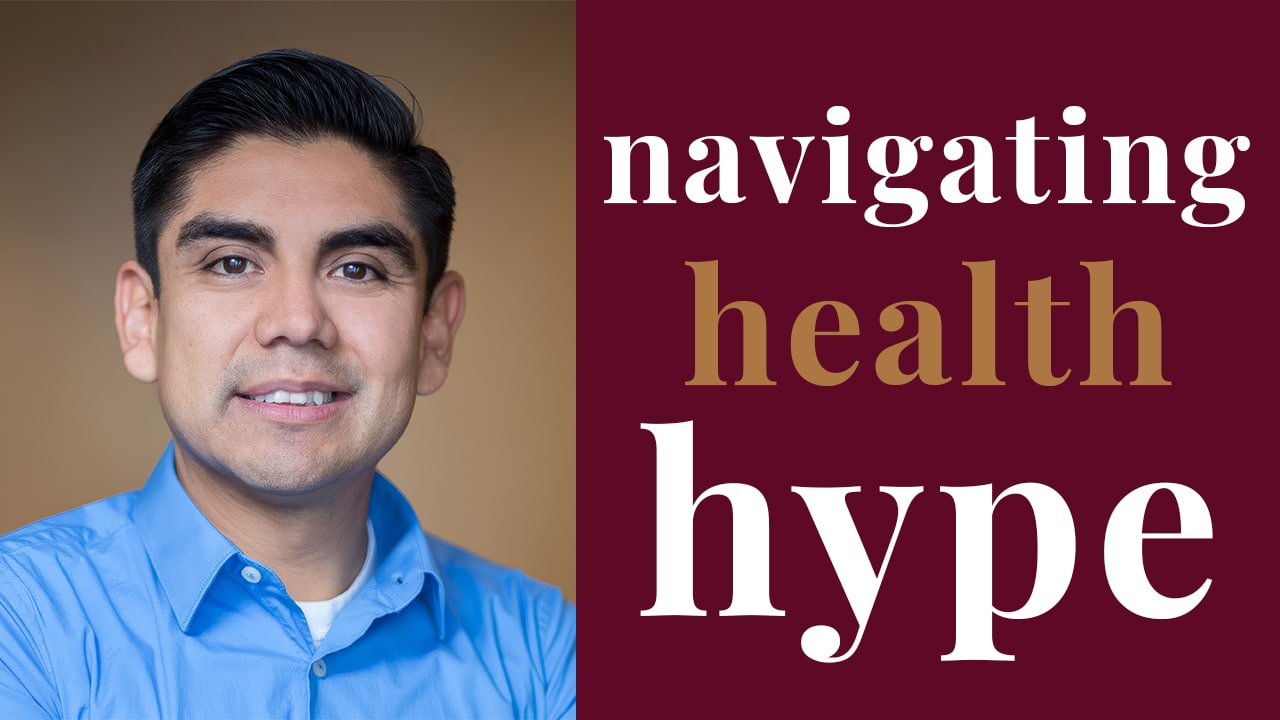
Health information has never been easier to access—but figuring out what to trust can feel harder than ever. Every day we’re exposed to new studies, expert opinions, personal stories, supplement claims, and wellness trends promising to change our health.
For those of us living with autoimmune disease or chronic health conditions, these decisions can feel especially high-stakes. Being open to emerging ideas can sometimes lead us toward something genuinely helpful, but that doesn’t mean every compelling claim is supported by good evidence—or worth the risk.
In this episode of the Autoimmune Wellness Podcast, I’m joined by Dr. Guillermo Ruiz to talk about how we can navigate that middle ground: staying curious and open-minded while maintaining a healthy level of skepticism and learning to distinguish between what’s plausible, what’s promising, and what’s actually been demonstrated.
.
Watch the Episode
.
Why Health Information Is So Hard to Navigate
One of the biggest challenges with health information is that we naturally want clear answers: the right diet, the right supplement, the right treatment, or the right amount of something.
But human biology is rarely that simple.
Dr. Ruiz and I talk about why individual context matters and how advice that works incredibly well for one person may be completely inappropriate for another. We also discuss how social media can strip away that nuance, turning strategies like intermittent fasting, fermented foods, or restrictive diets into universal recommendations.
For people with autoimmune disease, this can become especially problematic when multiple recommendations are layered together in an attempt to get better faster.
.
Evidence, Anecdotes & the Latest Health Trend
How does a small study turn into a viral supplement claim? And what should you do when thousands of people online seem convinced that a new therapy is the answer?
We walk through examples of how research findings can become exaggerated as they make their way into headlines, marketing, and social media. We also discuss emerging therapies and supplements, including peptides, and why the amount and quality of evidence matters—but isn’t the only question worth asking.
Risk matters too.
Personal stories can also be valuable. In fact, patient experiences can sometimes point researchers and practitioners toward ideas worth investigating. But an anecdote isn’t the same thing as evidence, and something being labeled “natural” doesn’t automatically make it safe.
.
How to Experiment Without Chasing Every Health Trend
Toward the end of our conversation, we get practical about how to approach personal experimentation.
Dr. Ruiz suggests starting with the foundations—food, movement, sleep, and other lifestyle factors—and then considering additional interventions based on your individual needs.
We also talk about red flags to watch for in online health content, including absolute claims, cure language, oversimplified before-and-after stories, conspiracy framing, and marketing that leaves out important nuance.
Most importantly, before trying something new, consider both sides of the equation: What might I gain, and what am I risking?
The goal isn’t to become skeptical of everything. It’s to stay curious, ask better questions, understand the limitations of what we know, and make informed decisions about your health.
.
Resources
- Follow Dr. Guillermo Ruiz: @3030strong
- Contact Dr. Ruiz: [email protected]
- Dr. Ruiz Clinic: Go Health
.
Prefer to Listen Instead?
.
Episode Timeline
00:00 – How do we know what health information to trust?
02:20 – Introducing Dr. Guillermo Ruiz
04:32 – Why navigating health information online is so challenging
17:56 – Evaluating health headlines, studies, and products
29:29 – How to navigate personal stories and anecdotes
34:12 – The hidden risks of supplements and herbal medicine
40:31 – Red flags in online health content
44:32 – How to approach personal experimentation with caution
50:39 – Wrap-up and where to follow Dr. Ruiz
.
Transcript
Below is the full transcript of Episode 101 of the Autoimmune Wellness Podcast. This transcript is provided for accessibility and reference.
Title: Navigating Health Information Online with Dr. Guillermo Ruiz (Ep 101)
Mickey: Health information has never been easier to access, and somehow it’s never felt harder to know what to trust. Every day, we’re exposed to new research, expert opinions, personal stories, podcasts like this one, social media posts, supplement claims, and headlines telling us that something is either the next big breakthrough or is something that we need to just avoid at all costs.
And when you’re living with autoimmune disease or any other chronic health condition, the stakes feel so high. You’re not just casually scrolling along. You might be actually looking for answers. You might be trying to understand why you don’t feel well, decide whether a new treatment is worth exploring, or figure out if something that you’ve heard about online could actually help you.
And there’s another side to this conversation I think is really important, especially for this community that we have here. The Autoimmune Protocol itself started out as a completely theoretical framework. There were people experimenting with it and sharing their experiences, and of course, I was one of these people who decided the potential benefit was worth exploring before there was any research to back it up. And in my case, I’m really glad that I did. Sometimes it pays to be an early adopter. If I had waited for the evidence to try anything, especially in some of these areas where research is limited or slow, we can actually miss opportunities that might genuinely help us.
So being open to emerging ideas doesn’t mean that we should accept every compelling claim that comes our way. It makes it even more important to understand the difference between what is plausible, what’s promising, and what’s actually been demonstrated, and to think critically about the information we’re consuming and the risks, oh, I want to highlight that, the risks that we’re taking on when we decide to act on it.
So how do we navigate this middle ground? How do we stay curious and open-minded while also maintaining a healthy level of skepticism? And what does evidence-based actually mean? That’s what we’re going to get into today.
Mickey: Welcome back to the Autoimmune Wellness Podcast. I’m your host, Mickey Trescott, and before we get started, a quick reminder that this podcast is for informational and educational purposes only, and is not intended as medical advice.
[00:02:20] Introducing Dr. Guillermo Ruiz, ND
Mickey: My guest today is Dr. Guillermo Ruiz, medical director of naturopathic medicine at Go Health. Guillermo is a graduate of Southwest College of Naturopathic Medicine, and practices naturopathic endocrinology with a focus on metabolic health. His work has long centered on bringing an evidence-based approach to naturopathic and integrative medicine, while also exploring the connections between modern medicine, traditional healthcare systems, nutrition, and lifestyle.
And I actually met Guillermo way back in the day at the Ancestral Health Symposium, when a lot of us were having some of the earliest conversations about ancestral nutrition, evolutionary health, and how these ideas fit or maybe didn’t fit with emerging science. And over the years, he’s become one of my go-to people when I encounter a new health claim or an emerging area of research and want to ask, “Okay, like, what’s going on here?”
Right? He’s somebody that I trust to be curious and willing to change his mind when the evidence changes, and also a really exceptional practitioner. And full disclosure, Guillermo’s also a very close friend of mine, so this is one of these conversations I’ve been looking forward to, because it’s very similar to the conversations we’ve been having behind the scenes for years.
So Guillermo, welcome to the Autoimmune Wellness Podcast. I’m really excited to finally have you here.
Dr. Ruiz: I finally made it. How are you doing?
Mickey: I’m doing great. I’m doing great, and I’m really excited to have this conversation with you and record it so that all of my podcast friends can actually benefit from the info that you have to provide.
Dr. Ruiz: It’s really funny. I’ve been traveling a lot, and last week was one of those travel days, we were scheduled to do this interview a week ago. And I texted you that I had been up for 20 hours and I was like, “I don’t know what kind of product I’m, we’re going to be able to put out there if I’m like half, sleep deprived and tired, but I still want to talk to you.” So we actually jumped on a FaceTime conversation and, it was so cool to just riff for an hour. So hopefully this is going to be a little bit more structured.
[00:04:32] Why is Navigating Health Information Online So Challenging?
Mickey: We’ve got some really exciting things to share with you guys, and really hopefully will help people just clarify how to make sense of all this information. We just are exposed to so much. And really, Guillermo, that’s where I want to start.
Why is health information so hard to navigate? We have access to more than ever before, and now with LLMs, we can search it and organize it and validate things, but it can really feel harder than ever to know what to trust. Talk to me about why you think this is just so difficult.
Dr. Ruiz: As humans, we have this tendency to want a black or white answer to things. And because we’re constantly searching for that precise answer, for that precise treatment, for that precise diet, we end up fumbling, and it becomes even more difficult for us to understand.
Very early in my career, we had this idea of making a thyroid calculator, Okay? This is before you could vibe code something and just tell it what to do, and then it’ll spit it out. But the idea was, okay, so you weigh 150 pounds and your lean body mass is X and thus, you should be taking this amount of thyroid. 150 micrograms or 100 micrograms or whatever.
And then you would just go to my website or whatever, you input your information, you press Enter, and then it would say, you taking more or less than this?” And if you’re taking more, that means that something is not optimized, or you could be taking less or whatever.
And it sounds so cool to have a solution like that. know? Imagine you go into a website and you put your information, you press Enter, and then it will tell you supplements to take or are you taking too much testosterone, estrogen, progesterone, thyroid, blah.
The problem is that we are not robots. I don’t know if you remember in high school when whenever you would do a physics problem, it would say, “Oh, and let’s pretend we’re in a vacuum with no air resistance or whatever.” Because, if you start inputting all of those things, then things change. Same thing with something as easy as taking your thyroid medication in the morning. If you weigh 150 pounds, and you might need 25 micrograms of T4 to get your thyroid levels to where they need to be, or you can weigh 95 pounds soaking wet and need 250 micrograms of T4 with 10 micrograms of T3 to get those numbers where they need to be. and one of those persons might be like, “Well, why do I need so much?” Or, “Why do I need so little?” But we’re not taking into consideration so many other things like, for example, how is your HPA axis? Is that preventing your thyroid from working properly? What about your digestion? Are you not absorbing the thyroid that you’re getting?
Would you be better off absorbing a different type of thyroid? And when you start putting all of this together, you can see how this idea of having a calculator makes no sense. We use whatever tool we have at our disposal make you feel better for yourself, for your community, and for your family, and that should be the goal. But that is so nebulous, it’s not precise, it’s really hard for us to just accept it.
Mickey: Yeah, Guillermo, one thing that I’m thinking about as you’re saying this is, so much about health, both from the person, as a person with a body, but also as a practitioner working with other people with bodies that are just biologically so unique, there’s a part of it that is an art.
And what is art if not nuance and gray area and kind of breaking rules in a way that, if you could just replicate it for everyone, it wouldn’t be art, right? It is just this, this kind of beautiful creative process that people who, relate to that, I think they can find a cozy little home and they’re like, “Huh, what am I going to discover?”
And other people want that answer, right? And they want it to be consistent and, bodies are just not like that. I love how you describe that, and that’s what I took from it, is really just having all this information doesn’t take out the idea that maybe there is an art and an unknown to this.
And by existing in that gray area, in the nuance, in not needing to know why a really small person needs a ton of thyroid hormone, and just accepting that if you deliver that and that person feels truly well, then can we be happy with that?
Dr. Ruiz: It gets even deeper because maybe someone has a lot of intestinal permeability and their absorption, or years and years and years of reversing celiac disease or malabsorption, stuff like that.
And so that person’s going to need a lot more thyroid than another one. But it then it gets kinda sad when you start, know, opening the layers. And social media, know, am just posting what’s cool, what’s good, my, my success, you know? and what works for me is not what’s going to work for patients.
Let, let me ask you a question. What’d you have for breakfast?
Mickey: I had my protein oats.
Dr. Ruiz: Aha
Mickey: A little pea protein, quick oats, walnuts, flax, hemp, some fruit, 40 grams of protein, 12 grams of fiber. Everybody knows how I roll. Yeah, I, I eat that for breakfast almost every day.
Dr. Ruiz: Uh, I intermittent fast, and I think intermittent fasting for women is one of the worst life hacks that you can do. If someone is listening to this and I didn’t add that, maybe they are like, “Well, maybe I need to start intermittent fasting, or maybe I need to eat more oats, or maybe I need to,” but within social media, we are taking all of these health tips and all these health things, and we are trying to incorporate them, and we start doing more and more and more and more and more. And what people forget is that a lot of these algorithms, a lot of these discussions, a lot of this is done by guys who happen to be really healthy, who, have maybe disposable income, or they have framed their life in a way where they have less stress.
If I was in a different situation and I was my own patient, I wouldn’t recommend to intermittent fast. And when we start searching because that’s how we started. Like I started listening to podcasts. Was working in an emergency department. I was completely in the conventional model, and I read the book Good Calories Bad Calories, and then that was very interesting, and it expanded, and now I’m here.
But what if I had read a different book, – this, this, this wall of books right here, they’re all like health books. Yeah. And I have your book right there. Half of them I’ve bought just to continue learning, but the other half were the diets that “failed” or that didn’t work for me. I just so happened to land in the diet in, within the paleo context that worked for me. and not all of the things that I’ve learned over the years, and I’ve changed my mind and the supplements and, all that have changed as my health has changed. And we keep just curating and curating and curating and curating.
I’ll give you an example. If I have a patient has SIBO okay? I am going to ask them to stop eating fermented foods. And a lot of people are like, “Why? I thought fermented foods are good for me.”
Mickey: This is such a good example.
Dr. Ruiz: Yeah. Yeah. I think fermented foods are really important. They taste really good too. but why would I ask a patient with SIBO stop taking fermented foods? And the reason is because fermented foods are not precise. There has been studies that different kimchis taste different, and it’s because of the flora of the person making them. Their hand flora of just making the kimchi will change the taste of the kimchi.
So now imagine you have someone with a very fragile flora. We’re probably going to use either herbs or we’re going to use antibiotics to kind of reset the environment, and now you’re going to introduce something that could have weird flora. So for the time until we get a recovery, no kombucha, no kimchi, no sauerkraut, no natto, no… And then eventually once we are at a place you feel healthy and you feel daring and you feel you want to try new things, I think that tolerating kimchi or sauerkraut, like tolerating lettuce or oxalates, represent a healthier, sturdier individual.
Once we’re there, we try the kimchi and we see how it works. And then if it works, then we continue trying things, and then eventually that can be part of your diet. But if it doesn’t and you regress, not your fault. We haven’t gotten deep enough to fixing the flora for you to be able to tolerate this alien individual. Yeah.
Mickey: Yeah. That’s a really good example of how much content are we exposed to that is like, “We all need to be eating fermented foods for our microbiome. It’s healthy.” I know I’m the source of this information for a lot of my audience because fermented foods are really good and healthy, but there are individuals for at that time or for another reason, it’s not going to work for them, and they don’t feel represented in the information that they’re being exposed to because it’s actually the opposite of maybe what they need.
Dr. Ruiz: And then we go, “Okay, I can’t, I have read all this information about sauerkraut being so good for me, and every time I eat sauerkraut, I feel like crap.” So now I have to go into social media and see what hacks people are using in order for them to accept the sauerkraut. So then you keep getting closed in and closed in into this echo chambers of self-curated individuals that benefited from adding sauerkraut or whatever fermented food to their diet, and now you are on the corner just listening it in, feeling sorry for yourself because you are not like them. You are, you’re not getting the benefits.
And that’s just fermented foods. Now think about intermittent fasting, fasting, carnivore, AIP, paleo, veganism, you name it. And maybe you’re not ready for that place. Let’s extract what’s beneficial from those media places, social media places or health ideas, adapt them to what happens in our life, and then see if they make sense. Try it out, see if it works. And if it doesn’t work, maybe it’s not not doing it hard enough. Maybe you’re just not ready to, for that intervention.
Mickey: Yeah, and something I see a lot, Guillermo, is people, especially people who are really active in these really niche communities where a lot of things are being layered, they’re just doing everything. They think that if they remove, like I can’t tell you how many people I’ve heard of with AIP, which AIP, we specifically say don’t add all these other things.
Don’t do fasting. Don’t do caloric restriction. Don’t do low FODMAP, you know? But people do. , They add, “Just in case, I’m not going to eat FODMAPs. I’m not going to eat oxalates. I’m going to do it in a carnivore way,” and they layer on so many things thinking that if they pick the most extreme version of everything that’s out there, maybe they’ll get to the final answer faster but, I’ve seen that road lead to suffering for a lot of people just because it’s not healthy to take on all of these things.
[00:17:56] Evaluating Headlines and Products Online
Mickey: And, the next thing I really want to talk about is really just evaluating information whether it’s a diet or a headline or a supplement. I actually have a story that I told you last week when we were first brainstorming this. My husband is a firefighter and gym guy, and he’s, likes to work out and interested in getting stronger.
And he comes to me and he’s like, “Hey, what’s with bromelain? I keep getting all these social media ads for bromelain increasing testosterone,” and, like, “Is that a thing? I didn’t even know.” And I’m like, “That’s new. That’s a new one for me,” you know? So I go on and try to find the source of this information, and it was one study done in Tour de France style stage cyclists, which are, like, elite athletes who, when you do a stage race, you’re doing an extreme amount of activity many days in a row, which is shown to decrease testosterone in athletes.
So, like, on day 10 the athletes that took the bromelain had, this statistically significant, which can be very small to be reported as a positive finding. But they had statistically significant a little bit higher levels of testosterone than the other athletes, and I think the pool was, like, 20 people.
And so I shared this with Guillermo to be like this then filters down onto social media. All the bromelain companies are like, “This is our big moment.” They get all their affiliates to put out all these testimonials and ads, and all of a sudden people are buying this supplement that can be effective for certain things. It’s not against bromelain, but it is a great example, I think, of how things can reach this critical mass, and then it’s everywhere. And then, people think, like, “I gotta get on this hype bandwagon,” when it actually could harm you.
So tell me, Guillermo, like, how do we evaluate studies or health headlines and make sense of what’s out there?
Dr. Ruiz: I’m going to take my practitioner hat off, you know? How would I evaluate something like that. Personally, like with the bromelain story, it would be like, is it dangerous? With my knowledge, what is bromelain? It’s an enzyme, breaks down muscle. It’s found in papaya. I don’t have to Google any of that. We’ve been around the block enough that I already have bromelain sitting on my dinner table because I have digestive enzymes, know? it would be like, “Huh, interesting.” And then, I would see when I’m, when am I due for my next labs, and then I would take it and see if there was a difference in my labs.
What about something way, way, way bigger and more dangerous? Something like, peptides, which
Mickey: Oh boy.
Dr. Ruiz: All the rage, you know?
Mickey: Let’s get into it.
Dr. Ruiz: Yeah. It’s such a big cookie, you know? It’s such a big question because it sounds so cool. It sounds so cool that this little chain of amino acids can have such a impact on your health, okay?
And if we back it up even more, we’ve known about these things for so long. For example, insulin is a hormone, and it’s a polypeptide. What if we can change or we can increase certain peptides and what would they do? Probably the most used would be a GLP at this moment. We’re going to have to do a second podcast because that’s a whole different topic in how using GLPs have dramatically shift how I practice. But, when it comes to other peptides, like the “safe” ones, like BP-157 or the
Mickey: And for those listening, there were air quotes.
Dr. Ruiz: Yeah, air quotes, you know?
Mickey: ’cause we, we are an audio podcast, but,
Dr. Ruiz: ears.
Yeah.
Mickey: “safe.”
Dr. Ruiz: And then the really, really scary ones that are like sermorelin, the ones that are growth hormone incredents or analogs. I’d been hearing about BPC-157, for a long time. I think the first time I heard was an influencer that was injecting it on himself.
We’re talking about 10 years ago. More people start using it, and then it has reached a critical mass. And I thought to myself, “Well, it’s body protective compound BP-157,” if you want to use it, blah, blah. And then I finally downloaded around 250 papers. There are no human trials. Rodent trials. And something really funny happens, around paper 80 or 90, where they start discussing how it helps, venules and capillaries grow, so it increases circulation.
That’s when my ears perked up, because of the characteristics or one of the needs for cancer to grow is increased circulation. So now if we’re injecting this thing that makes venules and capillaries grow, are we putting ourself at risk for cancer? It is just so silly to think that something that cannot be securely acquired from a pharmacy, that it’s in the gray market, that has the possibility on increasing circulation in a place that could be cancer prone, is safe.
It is natural, yes. The body does produce it, but what happens when we increase its bioavailability into our body and we exogenously increase its presence? So then, even more interesting, they started changing the wording around the study, they stopped calling it increased circulation. They start saying modulated circulation and that’s code talk for us people that have written papers and scientists or whatever, that, “Oh, if you need more circulation, it will give you more circulation, but if you don’t, it’s going to release it,” and I just don’t believe that.
So even the quote unquote “safe” BPC-157 could be very dangerous. Could be. So there’s, there’s the gray. So Guillermo, do you use BPC-157 on, on your patients? Maybe. I do have some patients that maybe I would suggest maybe an oral form that is available legally in the United States, if in the future we have a compounded, maybe. Maybe I will use it. So I’m sitting here telling you, “Oh, this compound is so dangerous,” and at the same time, “But I’m willing to use it.” We just short circuit, and we just do not like that.
Mickey: Mm-hmm. But in medicine, that’s a really common situation. ‘Cause, I mean, to your HRT example, I mean, hormone replacement therapy has been around a very, very long time, and because of that and because of the research, like we don’t know everything there is to know, especially right now with the amount, the volume of people who are getting on the bandwagon and using it,
but that history, is a lot longer than you know,
Dr. Ruiz: Yeah, that
Mickey: these, some of these peptides, getting it from, from some guy on the street. And
Dr. Ruiz: you know?
Mickey: yeah, it’s like who knows because the studies stopped at animals, so your point about risk is really important for everyone listening, understanding the risk.
Because even if we don’t know and it is something that you might try, it’s like somebody who has a very rare and very serious autoimmune condition or any health condition where possibly they’re going to die in a few years if they don’t find something that works, and they enroll in a trial for a drug that, there’s a lot of risks and they don’t know what’s going to happen.
It’s because for them, they’ve done the math with their healthcare provider, and they’ve decided, “I’m going to try this thing.” And sometimes those work out really well for people because they’re on the forefront of something that isn’t known yet. But do you really want to be that person with something that, has some concerns and there’s a reason why it’s not on the market?
Everybody should know what their risk is, right?
Dr. Ruiz: And then the funniest thing is that I’ve heard this story so many times. “What do you think about peptides?” Sometimes like I’m just human, so I might roll my eyes. I was like, “Oh my God, here we go again.” And then they might think that, “Oh, he just doesn’t know.” This is cutting edge technology. You know? He just doesn’t know. He, he’s just not educated in peptides, and that’s why he’s just poo-pooing it, you know? and if you read and if you go and search, e-everyone is doing the BPC-157, the copper. They’re doing the Wolverine stack. “Oh, have you heard about the Wolverine?” Yes, everyone has heard of this. This is not something new, okay? It’s such a sexy name, right?
Mickey: Yeah, there’s a lot of marketing. There’s a lot of marketing in this.
Dr. Ruiz: The best scenario, you might find some benefit. In the worst case scenario, you’re putting yourself at risk for activating an autoimmune disease, increasing your chances of cancer, increasing your chances of cardiomegaly. It doesn’t matter if it’s micro-dosed or if it’s at a full dose.
Everyone is pushing this peptide story. And they are using a couple of banners to affect its spread. So the anti-big pharma flag is a big one. The be an advocate for yourself, which is very empowering actually. Of being able to order something without having to explain to your doctor why you want it, and then your doctor rolling their eyes because we’ve heard this over and over and over, and we are very cautious with your health. It’s what the cool kids are doing.
But in the end, if you don’t have the basis of things, if you haven’t figured out what works for you? Is it intermittent fasting or is it eating oats? What things you react to? If you don’t have that basis, you shouldn’t be messing around peptides.
We also have a problem with loving the new thing. I want a shirt that says, “This morning I discovered recency bias, and it’s my favorite thing.” So recency bias is it’s like this new thing has popped into the market, and then it’s showing a little bit of promise, we just want it, and now we want the new thing, the new, phone, the new treatment, the new diet, the new fad, the new… something like retatrutide that, it’s not approved by the FDA yet.
Mickey: That’s what happens with so much of this stuff that we see, right? To you and I, we’ve been around for a while doing this in this community, and you see something that everyone is jumping on the bandwagon, and it’s like, “Hey, guys, we’ve known about this for a very long time.”
[00:29:29] How to Navigate Personal Stories and Anecdotes
Mickey: And also, the population of people who that is shown to be beneficial for is very, very small. But the general public is eating it up. Which, brings me to a question that I have is just about personal stories. I think a lot of us get really sucked into the trap of seeing a person that they really relate to, and especially in the chronic illness world and saying, “This worked for me.”
And for sure, I don’t want to dismiss that. Patient experiences can really point us towards things that are worth paying attention to. It’s how I got here with the AIP community. But anecdotes are just not the same thing as that evidence, and it can be really easy for people to over-hype things that, there isn’t a lot of foundation for. So how do people navigate that?
Dr. Ruiz: It goes back to, again, I’m not talking as a doctor here because the answer should be you find your doctor and they are going to be the ones that guide you and help you. And I hopefully I am that someone for a lot of people, right? But not a lot of people have access to me. It’s difficult to find someone you jive with.
I learn so much from my patients, okay? I’d like to think that I’m open-minded and I’m willing to work with my patients towards something, as long as it’s not dangerous for them. LDN was a big topic in the paleo community very early on. I actually know the person that put it on the map, Dr. Dan Rubin, he’s a naturopath, and what he was using it for was to help with pancreatic cancer, and it was a combination of alpha-lipoic acid and low-dose naltrexone. Then more and more studies started coming out about LDN, okay? And reality, I was looking at those studies and it wasn’t that phenomenal. So I stopped using it.
So I stopped using LDN, and I remember being in in a consult one of my patients said, “Well, I want to try LDN.” Actually, and I start pulling all my research about how LDN is not that great. And, and she’s like, “Cool story, bro. I want to try LDN.” And I was like, “You know what? Why not? Why not try it? As long as it’s not putting you in danger.” Like for example, if I had a patient that had polyps or pre-cancer lesions in their colon, and they said, “I want to try HRT.” I’m going to be absolutely not. You’re not going on testosterone. know,
Mickey: Yeah, the, the risk profile is so important, right? Yeah, ’cause LDN has a very good risk profile.
Dr. Ruiz: Correct.
Mickey: And, and for anything like that if you’re going to try something and it’s known, why not, right? I totally agree with you, Guillermo. Some things have that super low risk profile, and other things are actually quite high.
Dr. Ruiz: And then she stabilized. This very reactive person that I was like banging my head against the wall trying to lower all these problems, of a sudden stabilizes, and she can reverse the funnel and start adding more things and living a better life and whatever. And after that day, LDN became another one of the tools that I was going to use. So yes, some things can be very, very dangerous and very powerful and very useful. Some things can be very safe and, no- low risk and helpful, but that doesn’t mean that everyone should use them.
And we are back again in the gray. How do we figure out what to use? So to give some tools for the people that, are listening, because I don’t want to leave you in the grey. I would try to start with the lifestyle using the tools that you have learned in trial and error. And then I would be mindful and first and foremost a skeptic about what the claims are. Not because it’s a pharmaceutical, it, that means that it’s bad for you because, big pharma’s trying to, it’s sick care, and not because it’s a supplement, that it’s safe and everyone, and it’s the answer to everything.
[00:34:12] The Hidden Dangers of Supplementation
Mickey: I have a story about that actually. So I have a friend who tried to treat a UTI with uva ursi, which, Guillermo is an expert in herbs. And actually, this story is why I’m very, very cautious recommending a lot of herbs because these herbal supplements, because you can buy them over the counter, does not mean that they are safe or even weak or… they can be incredibly powerful.
But my friend ended up at UCLA on a liver transplant list after just one week of using a self-prescribed tincture, as directed on the bottle, because she was trying to self-treat a UTI. And so these compounds can be incredibly powerful. I think a lot of the natural holistic healing community, people like to say, “This comes from nature, therefore it cannot be as strong as what medicine, big pharma, whatever, has for us,” and that is actually false.
A lot of these things can really harm people. They can really help if they’re the exact thing you need, which is why I recommend consulting an expert herbalist before integrating any herbs into your routine. But I just wanted to put that out there because there is this misconception that because something is a prescription medication that it doesn’t have a safety background.
Some things that are prescriptions are, like, incredibly harmless because they have decades and decades, and millions of people have taken them and we understand exactly how it works and who it’s for. A lot of things that you could just walk into a health food store and buy off the counter are actually incredibly dangerous if used by the wrong person, in the wrong quantity or whatever.
So I just want to throw that out there and challenge people’s assumptions about some of that stuff, because a lot of this really needs to be used carefully, you know?
Dr. Ruiz: It is so frustrating when I have a female patient, it happens very often, that says, “Oh, my doctor has me on Macrobid prophylactically for my UTIs.” So this person has chronic UTIs has been given an antibiotic that she is meant to take for the rest of her life to keep the UTI at bay. That is insanity. Okay? But at the same time, I’m not going to tell that person, “Oh, don’t take Macrobid. You should take uva-ursi.” Uva-ur-ursi is very close to my heart because it is one of the plants that I actually published a paper on. We were trying to do in vitro experiments to figure out what the mechanism of action of these, plants are.
What is the mechanism of action? Uva-ursi is a beta-lactam like amoxicillin. That’s the same mechanism of action, that amoxicillin has The difference between amoxicillin and uva-ursi is that when you get that pink liquid, know exactly what the concentration, you know exactly the effectiveness, you know exactly how long to take it for. The way that we discovered uva-ursi was a beta-lactam was uva-ursi on a 50/50 extraction of ethanol to water, okay, with dried uva-ursi.
If you’re taking a capsule, I cannot tell you that’s a beta-lactam. It is so specific on the mechanism of action. One of my favorite stories in my research was, the, another plant that we worked with was sage. And we were doing our experiment, and all of a sudden sage tincture stops working. And we’re like, “What the heck?” “Why is it not working anymore?”
Our herbalist that was preparing the tinctures for us had a really good crop of really beautiful sage and decided that instead of drying it out, he was going to use fresh sage because obviously it has more vital power or whatever, more energy. And it was going to work better. But the reality of things that something, and we learned this, something happens in the drying process of the oxidation of the leaf that actually activates the antimicrobial activity of sage.
Which evolutionarily speaking is so awesome because, imagine if you were eating sausage, and every time you eat sausage with sage, you’re getting antibiotics. That would be bad for your flora. So basically, our grandmas that were using sage to treat infections and stuff like that had to have purpose creating the medicine because sage is a culinary spice. And so putting sage on your turkey is not going to make it antimicrobial. Putting dried sage on a jar with a 50/50% ethanol and water and letting it sit for 30 days, and that is going to actually unlock the antimicrobial possibilities of sage, and it’s going to become antimicrobial.
Mickey: Wow.
Dr. Ruiz: Beautiful, you know? So there has to be a level of intent in converting something from a plant to culinary to an actual medicine. And now I’m going to be aware that maybe people that are using over-the-counter things could end up in liver failure or something completely unrelated.
Mickey: Well, and also, for any ladies that get chronic UTIs, topical estrogen cream can be life-saving. So just throwing that out there. I’ve worked with many clients. This is becoming way more of a known fact. You don’t need to be perimenopause or menopausal for that to really be effective.
I’ve had some clients that I’ve worked with but as a root cause, and it’s because it nourishes the microbiome in a way that is really helpful. So just throwing that out there for any ladies that are suffering from that.
[00:40:31] Red Flags in Online Health Content
Mickey: What are some of the biggest red flags you notice in health content online?
Dr. Ruiz: When everything is sunshine, rainbows, and unicorns. If I see a guy that is super fit telling you, “This is how I got here,” that is an instant red flag. This idea that, if you take this one thing, in especially in a guy that we have very different hormonal patterns that make it easier for us to be leaner, that make it easier for us to be able to do intermittent fasting, know.
And specifically being marketed towards women, that is an absolutely red flag.
Mickey: How about absolute claims or cure language?
Dr. Ruiz: Oh, absolutely. Yeah. Yeah, 100%.
Mickey: What about conspiracy framing?
Dr. Ruiz: Ah, that’s a good one. We love being victims. We love being the little guy, you know? It motivates us. The problem is that there are a lot of problems with big pharma. The problem is that there are a lot of problems with the government.
Mickey: Yeah, there’s a kernel of truth in there, right?
Dr. Ruiz: Yeah. And, it’s more amusing to me to kinda like go backwards and be like, “Where did this start?”
Mickey: Mm-hmm
Dr. Ruiz: And you will usually find something. But yeah, but conspiracy theories are, oh my goodness, yeah.
Mickey: What about proprietary formulas or testing?
Dr. Ruiz: I use, I recommend products that have a proprietary formula, because they work. So it’s not an automatic no. But it’s more like, why is it a proprietary formula?
Is it because you’re trying to corner a market? Is it for financial reasons? Is it something that you claim?
Mickey: How about a lack of nuance in the marketing?
Dr. Ruiz: Ooh.
Mickey: I mean, I’m thinking of the bromelain. When these guys are like, “This is going to help raise your testosterone.” Like, what?
Dr. Ruiz: I think that goes back into claims, huge claims. How fast can we consume information you know? I love reading, and that gives me a little bit more depth of what people are talking about. Because what we get is this short-form content is like, “Boost your testosterone with bromelain.” Next, next. And there is no nuance. And this is where like, ” BPC-157 is good for you.” Next.
And then no one stops and asks why. It is so sad because you are sick, if you have fibromyalgia, if you have POTS, if you have something that is super debilitating, and the only energy that you can muster is, looking at health social media, you’re being bombarded by these beautiful people telling you that this is the one thing that they did to make, And you might think to yourself, “What is there to lose?” So then it’s very easy to click on the link and get a bottle of something on your kitchen counter and trying it. The problem is that we don’t know what the harm could be. The harm could be as low as, just bromelain, or it could be as high as tainted supplements from China. And when you are desperate, when you’re hurting, when you don’t have your health, unfortunately that’s when we’re the most vulnerable to fall into something like this.
[00:44:32] How to Approach Personal Experimentation with Caution
Mickey: Yeah, I agree. The last question that I have for you is really about personal experimentation, ’cause I think that’s where a lot of us land. When is a personal experiment reasonable, and what guardrails should people put around it? What does a threshold look like depending on whether we’re talking about something that’s like very low risk and reversible, like taking vitamin B12 and then stopping it, right?
Or like changing the timing of your meals versus taking something that’s off-market or, stopping like a medication. Tell me in short just how you would do that risk assessment, ’cause I know, we are all running these personal experiments with things that could at some point hurt us.
Dr. Ruiz: Us as practitioners, we’re very dangerous because we think we know the risks. A quick example would be, I am not a climber and I’m not a BASE jumper, so the chances that I die from a wingsuit accident are zero because I don’t do those things. Someone that has experience and someone that knows the risks and someone that actually practices BASE jumping are going to have a really high risk of dying from that. So same thing with us. Because we know all of the risks, I might be more willing to try things that someone that is completely, oblivious to it.
But how do I do the risk? The number one thing is it a lifestyle? If it’s a lifestyle I think we can try different things. And then, the second would be being able to stop, look at what happened course correct. So for example, I’ve been doing intermittent fasting since twenty ten. I’ve gone all the way to OMAD, know, 24-hour fasts. And what works for me is around a 16-hour fast. Okay? My day is not ruined if I have breakfast. It’s just convenience. It’s a little bit better, more efficient for me to not have breakfast, not stop. Okay?
One of the biggest problems that I had in the beginning is that I wasn’t getting all of the quotations, again, ” benefits of fasting”, so I kept pushing my fast and pushing my fast and making it, I’m not doing it enough. But I never stopped and analyzed, okay, what am I trying to accomplish? And once you start, okay, let’s try this for 30 days. Let’s see if it works. Let’s see what happens after I try it. And then decide, you know what? I do feel better. Yeah, my day is more efficient. Yeah, you know, blah, blah, blah. I’m going to include this in my daily habit. But if it doesn’t work, there is nothing wrong with you.
Maybe that strategy is just not for you. And being able to identify that second is way harder than what it seems.
Mickey: Yeah. I, I like that. I think that’s really good advice, and I think doing a risk assessment, if anybody’s learned anything today, I think we want you to be a little more skeptical and be a little more interested in the risks because you’re going to learn about all the potential benefits. If anything, you’re going to be oversold, probably, all of the potential benefits, and it’s going to seem very attractive and exciting, especially if it’s something that involves, like, taking a supplement and not actually doing work, which is hard.
But doing a risk analysis is something that everyone should know how to do, and that can include your healthcare provider. If you don’t have somebody who’s up on supplements and stuff, you can do some research online, although that can be dicey. That’s a, probably another whole podcast episode.
But I do think people should be aware of some of those risks and really thoughtfully think about adding things. And, my personal take on this is that I’m a minimalist when it comes to adding things because even, think about a supplement. We are ingesting this thing every single day, and we’re trusting that even whatever it is that we think we’re taking has been manufactured in a safe way, in a facility that is free from, for me, I have celiac, so it’s going to be gluten-free.
Those machine lines are clean. It is going to be what it says it is. That’s a very tall order. Even if the company has the best intentions, they have lots of testing, things can go wrong.
Dr. Ruiz: First and foremost, supplement a healthy lifestyle. If you want omega-3s, eat more fish. If you want, more magnesium, try eating more green vegetables. If you want folic acid, try eating fresh green vegetables because folic acid gets destroyed in the freezer. “Oh, but he said folic acid. Doesn’t he know that it’s folinic acid that you need?” chill. Yes, I’ve read Ben Lynch’s book. I’m just talking. let’s start with food.
And then once you start with food, like for your testosterone, let’s start with, exercising. Let’s start with having more sex. That increases your testosterone. Let’s quit the chronic cardio. Let’s be very, level-headed and start with food, start with lifestyle, clean water, and then supplement as needed in the most minimal way.
Mickey: Yeah. I completely agree with you, and I think a lot of the benefits that people are after, like 90% of them are going to come from changing your diet, changing the way that you eat, changing the way that you move, however that’s best for you. It’s going to be different for everyone.
It’s an open secret, all these health books on the shelf, most of them give you the same baseline foundational health approach with then, 10% of, whatever that person’s little secret sauce is, special sauce. So but really, the, the benefits are the foundations which take work unlike taking a supplement.
[00:50:39] Wrap-Up and Closing
Mickey: So I think that’s probably a good place to wrap up here, Guillermo. Thank you so much. It’s been a really fun conversation. Can you tell everybody where people can find you and follow your work online in case they want to keep up with you?
Dr. Ruiz: I’ve ben a hermit and I need to come back to social media. I have not p- I
Mickey: don’t have to. You can also live your, your off social media bliss, which I’m, I’m really
Dr. Ruiz: It’s,
Mickey: of, honestly.
Dr. Ruiz: been, it has been so amazing. You can follow me on social media at 3030strong. That’s, three-zero-three-zero strong. That’s my handle on all of the social medias. I, you know, I need to start posting more and maybe, do a little bit more public speaking in forums like this safe spaces where we can be a little bit more mainstream at the same time of being more French and, not be
Mickey: kind of what’s out there in a nuanced way,
you
Dr. Ruiz: not be accused of being FDA shills or, or the opposite. Just follow me on social media, 3030 Strong, [email protected] if you want to drop a note.
Mickey: I love it. I love it.
Dr. Ruiz: Yeah
Mickey: you, Guillermo, for being in the gray area with me. You don’t know how happy it is to find other humans that are neither here nor there. I think it’s just delightful to talk to you about this. And, for everybody listening, I hope that this episode gave you some practical tools and just some ideas for how you navigate all of this information that we navigate every single day, and maybe a little more confidence to just stay curious, ask better questions, make some informed decisions about your health.
If you have enjoyed this conversation, make sure that you are subscribed to the Autoimmune Wellness Podcast wherever you listen, and I would love it if you’d share this episode with somebody who could use it.
Thanks so much for listening, and I’ll see you next time.
.



0 comments