
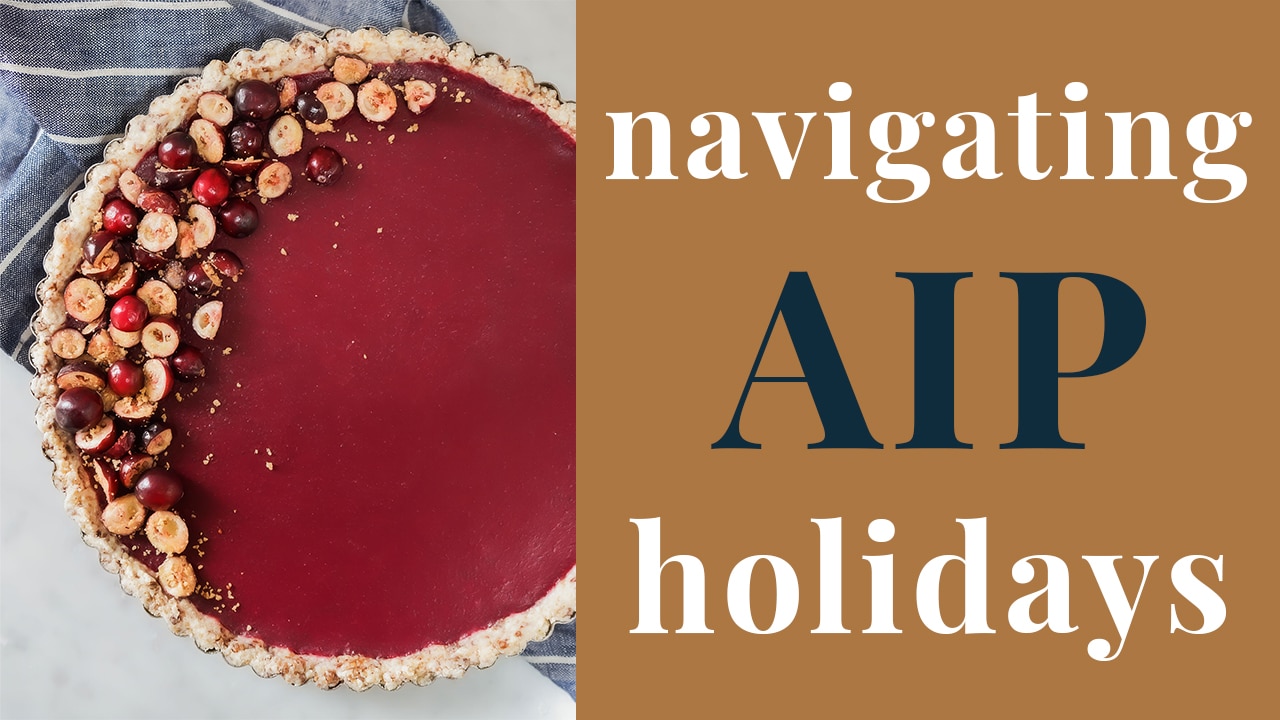
The holidays are supposed to be a time for celebration, connection, and enjoying traditions with the people we love. But when you’re following the Autoimmune Protocol, they can also bring challenges around food restrictions, family expectations, and social gatherings.
Whether you’re currently in elimination or have completed reintroduction, navigating holiday meals requires some planning and flexibility. And beyond the food itself, there’s the emotional side of feeling different, missing favorite traditions, or worrying about how others will respond to your dietary needs.
In this episode of the Autoimmune Wellness Podcast, I’m sharing practical strategies for enjoying the holidays while supporting your health, wherever you are in your AIP journey.
.
Watch the Episode
.
Navigating Holiday Meals During Elimination
If you’re following Core or Modified AIP elimination, a little preparation can make holiday gatherings much easier.
I share strategies for communicating with your host, bringing dishes you genuinely enjoy, checking unfamiliar ingredients, and making sure you have a satisfying meal without asking everyone else to accommodate your entire food list.
We also discuss why the holidays may not be the ideal time to begin elimination or experiment with reintroducing multiple foods. The goal is to follow the process in a way that supports your health without missing out on meaningful celebrations.
.
Finding Flexibility After Reintroduction
Once you’ve completed reintroduction, navigating the holidays can look very different.
I explain why it’s important to distinguish between medically necessary restrictions, foods that consistently cause symptoms, and the gray-area foods you may tolerate in certain amounts or circumstances.
Rather than continuing to follow elimination rules indefinitely, the goal is to use what you’ve learned about your body to make informed choices, enjoy a more varied diet, and create holiday traditions that work for you.
.
Setting Boundaries and Supporting Your Health
Holiday food restrictions aren’t just a practical challenge. They can also bring up difficult emotions, especially when family members question your choices or you feel left out of familiar traditions.
I share ways to communicate your needs without overexplaining, respond to unsolicited advice, and set boundaries while maintaining meaningful connections.
We also look beyond food to discuss holiday stress, sleep, movement, and energy management. Supporting your health means considering the whole experience—not just what’s on your plate.
.
Resources
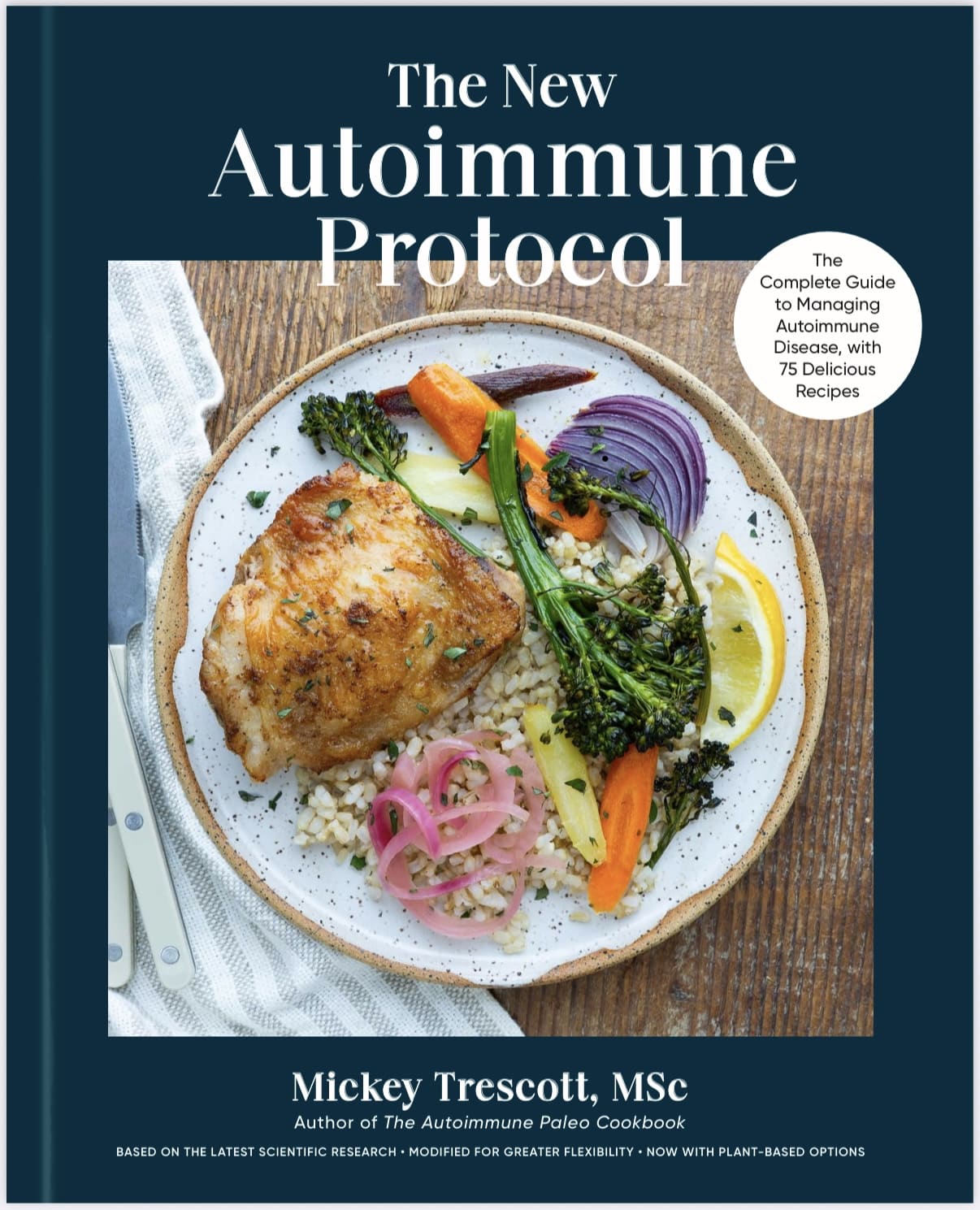
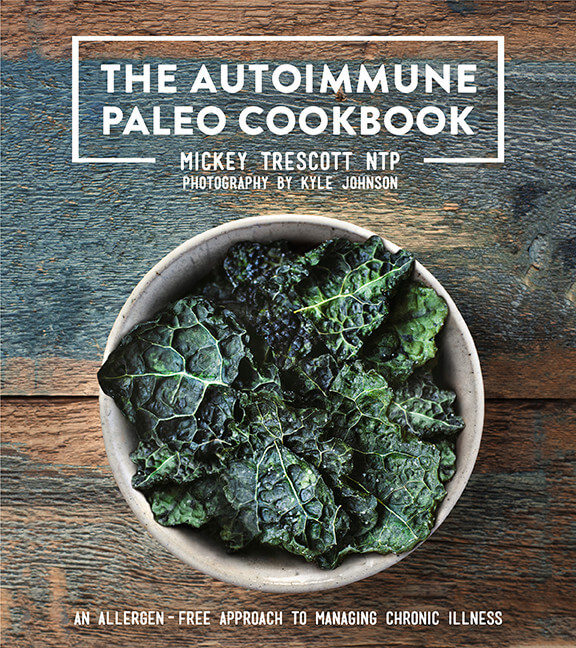
- The New Autoimmune Protocol by Mickey Trescott
- Free AIP Foundation Series
- The Autoimmune Protocol Community
- AIP Cranberry Curd Tart Recipe — Autoimmune Wellness
- Pecan Sweet Potato Pie — Simone Miller
.
Prefer to Listen Instead?
.
Episode Timeline
00:00 – Navigating the holidays with food restrictions
03:35 – Holiday meals during AIP elimination
04:17 – Planning ahead and communicating with your host
07:40 – Bringing dishes you genuinely enjoy
09:09 – Checking ingredients and avoiding assumptions
10:31 – Should you take a break from elimination?
14:06 – Navigating the holidays after reintroduction
15:16 – Understanding different types of food restrictions
16:55 – Making informed choices about gray-area foods
19:13 – Planning around your personalized diet
21:12 – Why holiday symptoms aren’t always caused by food
22:47 – Communicating restrictions and setting boundaries
30:57 – The emotional side of holiday food restrictions
34:47 – Supporting your health beyond food
40:40 – Wrap-up and closing
.
Transcript
Below is the full transcript of Episode 106 of the Autoimmune Wellness Podcast. This transcript is provided for accessibility and reference.
Title: Navigating the Holidays on AIP (Ep 106)
Mickey Trescott: The holidays are supposed to be a time for celebration, connection, and enjoying traditions with the people we love. But when you’re following the Autoimmune Protocol, they can also bring up a lot of stress. Maybe you’re wondering what you’re going to be able to eat at a Thanksgiving dinner, how to explain your restrictions to family members, or whether it’s worth making an entirely separate meal for yourself.
Maybe you’ve already completed reintroduction, but you’re still figuring out how to balance your personalized food restrictions with the foods and traditions that you look forward to all year. And beyond the food itself, there can be some complicated emotions, maybe feeling left out, worrying about being a burden, or simply wishing you could enjoy a holiday gathering without having to think so much about what you’re eating.
The good news is that with a little planning, flexibility, and perspective, it is possible to enjoy the holidays while supporting your health. And the approach that works best for you might look very different depending on where you are in your AIP journey. Today, we’re going to talk about how to make that happen.
Mickey Trescott: Welcome back to the Autoimmune Wellness Podcast. I’m your host, Mickey Trescott, and with Thanksgiving just a few days away here in the United States, I thought this would be the perfect time to talk about navigating holidays while following the Autoimmune Protocol. Before we get started, as always, a quick reminder that this podcast is for educational purposes only and isn’t a substitute for personalized medical advice.
Now, way back in November of 2012, I wrote an article about navigating holidays and social situations on AIP. At the time, I was going through elimination myself, and I was learning firsthand how challenging it would be to share meals with my family and friends when I had so many food restrictions. It’s really hard to believe that that was 14 years ago.
And while a lot has changed since then, including our understanding of AIP and the options available to people who might be following it, many of the same challenges still come up in our community today. One of the things that I’ve learned over the years is that navigating the holidays during elimination is a really different experience from navigating them after you’ve completed reintroduction and established your personalized diet.
Now, that might be obvious, but it doesn’t mean that the problems go away. During elimination, you’re working within this defined set of restrictions for a relatively short period of time, and then after reintroduction, you’ve got more information about which foods work for your body and often some more flexibility to make decisions based on your individual needs.
Today, I want to address both of those situations because I know that we have listeners at every stage of AIP. But I also want to go beyond the practical question of just what’s on your plate. We’re going to talk about communicating your needs to family and friends, handling that dreaded social pressure, managing expectations, and dealing with some of the emotional challenges that come with navigating food restrictions during a season that is so centered around eating.
We’ll also touch on the bigger picture of autoimmune wellness during the holidays, including tips for managing stress, sleep, travel, and making space for rest and connection.
[00:03:35] Navigating the Holidays During Elimination
Mickey Trescott: Let’s start with those of you who are currently in the elimination phase, because this is probably the stage where navigating holiday meals requires the most planning. Whether you’re following Core AIP or a Modified AIP, you are temporarily removing certain foods from your diet so that you can establish that baseline, and eventually begin the process of systematically reintroducing them.
And while the holidays can make this process a little more complicated, I want to emphasize something right from the beginning. You don’t have to put your life on hold just because you’re in elimination. You can still attend Thanksgiving dinner, celebrate with family and friends, and enjoy delicious food. It just might require a little more preparation than you’re used to.
[00:04:17] Decide on your approach ahead of time
Mickey Trescott: So let’s talk strategies. The first thing I recommend is making a plan before the holiday arrives, and this seems really obvious, but some people are just not planners, so I just want to acknowledge that planning makes things work.
If you are hosting Thanksgiving yourself, you have the advantage of being able to control the menu. And honestly, a traditional Thanksgiving meal is one of the easier holiday meals to adapt for AIP because so many of the central ingredients are actually very compatible.
Once, I was actually on a plane eating a pre-cooked AIP meal that I brought from home. It was roasted chicken and Brussels sprouts and sweet potatoes, and the woman sitting next to me on the plane was, like, when I opened it up, she was like, “Oh, my gosh, it’s like Thanksgiving.” And it was actually just a regular meal for me. So AIP food can actually very easily be adapted for Thanksgiving.
We’re thinking things like turkey, sweet potatoes, winter squash, roasted vegetables, cranberry sauce, lots of fresh herbs. With a few modifications to your seasonings or recipes, maybe the cooking fats and some of the other ingredients, you can put together a beautiful holiday meal that everyone can enjoy.
And if you subscribe to the Autoimmune Wellness newsletter, you already have received my Thanksgiving AIP menu. I’ve been giving this out for many, many years, which is compatible with Core AIP recipes and provides a full menu and timeline for you to create a holiday meal. And a reminder, you don’t necessarily have to make every dish AIP compliant.
This is just one strategy. If you’re cooking for or collaborating with a group, you can make sure there are plenty of options that work for you while allowing your other family members or friends to bring or prepare their favorite traditional dishes. Now, if you’re attending a gathering at somebody else’s home, that’s where a little communication becomes really important.
I recommend reaching out to your host well in advance rather than waiting until after you arrive and trying to figure out everything at the dinner table. You definitely do not need to send them your entire AIP food list and ask them to prepare a special meal just for you. In fact, I recommend not doing that, and instead, keeping your request as simple as possible.
So for Thanksgiving, I might drill down on asking whether the turkey can be prepared with ingredients that work for you. In most cases, this is going to be a pretty low lift. Or whether a portion can be set aside before adding any seasoning blend, butter, or gravy. Something that I have done is get, like, a turkey part, maybe a turkey breast or a turkey leg, and then preparing that separate from the other turkey that maybe doesn’t have something that I eat.
Then you can offer to bring one or two side dishes that you’ll know you’ll be able to eat. This is actually advice that I shared in that original article back in 2012. It’s something that I still recommend today. Rather than asking your host to make the entire meal fit your specific restrictions, find a way to collaborate so that you have a satisfying plate of food without creating unnecessary work for anyone.
[00:07:40] Bring something you genuinely enjoy eating
Mickey Trescott: My next tip is to bring a dish that you are excited about. Don’t just bring something that you can technically eat. One of the hardest parts of following an elimination diet during the holidays is feeling like everybody else gets to enjoy this special meal while you’re stuck with a plain piece of meat and some steamed vegetables.
It does not need to be that way. There are so many wonderful holiday recipes that can be made with AIP-compatible ingredients. You can make flavorful roasted vegetables, mashed sweet potatoes, savory dishes with herbs and mushrooms, even festive desserts. And you might even make a dessert for yourself and bring a portion.
You might bring a whole dessert to share with everyone else. And if you’re following the new Modified protocol, you might actually have some additional options available to you, including rice, legumes, seeds, and other foods that are included in that version of the elimination protocol. I love and often bring something that everybody can enjoy. That way I get to participate in the meal and share something delicious rather than feeling I’m off in a corner eating, like, my own food separately.
And here’s another practical tip. Bring enough food that you know you’ll have a satisfying meal, even if some of the other dishes turn out to be not compatible. You don’t want to spend the entire gathering hungry because you brought something, got a little portion, everyone else dug in, and then there’s really nothing else left for you to eat.
[00:09:09] Don’t make assumptions about ingredients
Mickey Trescott: This brings me to something that is especially important during elimination. Don’t assume that a dish is compatible just because it looks like it could be. Holiday recipes often contain ingredients that aren’t immediately obvious. So roasted vegetables might be cooked in butter or seasoned with a spice blend containing nightshades.
Your mashed sweet potatoes might contain dairy. The turkey might be prepared with a commercial seasoning mix or stuffing that has gluten in it, and gravy almost always contains flour. Even a simple salad can have ingredients in the dressing that you wouldn’t expect. And so if you are unsure about something, it is reasonable to ask.
And if you can’t get a clear answer or somebody doesn’t know, my recommendation is just to choose something else. I know it can feel awkward, especially when somebody has spent a lot of time preparing a meal. But remember that you’re not criticizing their cooking. You’re not rejecting their hospitality. You’re following a plan that you are doing for a specific purpose.
And for those of you with celiac disease or food allergies, there’s an additional consideration here, cross-contamination. If a food needs to be strictly avoided for medical reasons, it is important to consider not just the ingredients, but where and how the food was prepared and served.
[00:10:31] What if you want to take a break from Elimination?
Mickey Trescott: Now, I want to address a question that comes up every holiday season. What if you’re in elimination, but you just want to enjoy some of your traditional holiday foods and take a little break, a little time off? So remember, elimination is meant to be temporary. It’s not this lifelong commitment to avoiding everything on the elimination list, but at the same time, there is a reason why you need to be fully compliant and follow a structured process.
Again, the goal with AIP is to establish that stable baseline so that when you begin reintroduction, you can better identify how individual foods affect your symptoms. So if you go to Thanksgiving dinner, and you introduce several eliminated foods all at once, it might be really difficult to tell which food contributed to your symptom change if you experience one.
It also might give you exposure to one of your regular triggers, and ramp up your inflammation, and set you back. So if you’re already in elimination and making progress towards that baseline, my recommendation is generally stick with your plan, enjoy a holiday meal built around foods that work for you, and don’t go off-plan if you can avoid it.
But if you haven’t yet started AIP, and you’re wondering whether to begin the week of Thanksgiving or a different holiday, it’s also perfectly reasonable to consider your timing. There’s no special benefit to starting during one of the busiest and most food-centered weeks of the year. In fact, in my coaching practice, I often suggest to my clients who may be extremely motivated to avoid this season to start.
Now, there are people who often end up still doing reintroductions and still having food restrictions through the season, and we’ll talk about that later. But if you’re right about to start, this might not be the time. You might actually want to wait until it is easier to begin when you have more time to prepare, shop, establish your routine, and not have all these celebrations. And if you’ve already been in elimination, again, the people who are considering reintroductions, remember that that reintroduction process has structure for a reason.
Thanksgiving dinner is not the ideal setting for testing even one or multiple new foods simultaneously, so if you haven’t been working towards this already, I don’t recommend this week to start. So none of this is about being perfect. It’s about understanding what you’re trying to accomplish and making decisions that support your ultimate goal.
[00:13:06] Keep the experience in perspective
Mickey Trescott: Finally, I want to encourage you to think about what would make the holiday enjoyable beyond the food. Maybe it’s spending time with relatives or friends that you don’t see very often. Maybe it’s cooking with somebody that you love, taking a walk after dinner, playing games, or simply having a day off from your usual responsibilities.
When you’re following a restrictive diet, it’s easy for the food to become the main event, not because you want it to, but because you’re just spending so much energy thinking about what you can and you can’t eat. And a little planning can actually help you shift that focus. So if you know ahead of time what you’re going to be eating, you’ve communicated with your host, and you’ve brought a dish or two that you enjoy, you can spend less time worrying about the meal and more time being present.
And that’s really the goal, to follow the process in a way that supports your health without allowing it to take over every single aspect of your life.
[00:14:06] Navigating the Holidays After Reintroduction
Mickey Trescott: Now let’s talk about what happens when you’ve moved beyond elimination and reintroduction, and you’re following your personalized version of AIP. So this is kind of maintenance. What happens after you’ve gone through AIP, and you have a list of foods that you might avoid, and what works for you?
So this is a different situation, and I like to make the distinction because sometimes the advice that I give people during elimination then gets carried over into the long-term approach, even when it doesn’t need to apply.
I know that I say this so much on the podcast, but it is really that important. The goal of AIP is not to stay in elimination forever. It’s to use that temporary period of restriction, followed by systematic reintroduction, to learn more about your individual food tolerances, and ultimately build the most varied, nutrient-dense, and sustainable diet possible.
So ideally, by the time you have completed the reintroduction phase, you have this huge understanding of which foods you tolerate well, which foods consistently cause symptoms, and which foods fall somewhere in between. And that information can make navigating the holidays so much easier.
[00:15:16] Not all food restrictions are created equal
Mickey Trescott: One of the most important things I’ve learned over the years is that not every food restriction needs to be approached in the same way. So for example, I have celiac disease, so gluten is non-negotiable. It doesn’t matter whether it’s Thanksgiving or my birthday.
Gluten is not something I can decide to eat occasionally because the occasion is special. The same principle applies to any diagnosed food allergy. You guys know this already. These are situations where strict avoidance is necessary for medical reasons. But there are other foods that don’t work super well for me, and those can require a different kind of decision-making.
Maybe a food consistently causes some digestive symptoms, some joint pain, or another noticeable reaction. And if you’ve identified a clear pattern through the reintroduction phase, you might actually decide that avoiding that food is worthwhile, especially if the symptoms are significant.
You guys have heard me call these gray area foods. They’re foods that don’t necessarily cause a clear, consistent, or serious reaction every time you eat them. Maybe you tolerate a small serving but notice symptoms when you eat a larger amount. Maybe you can eat a food occasionally without any noticeable problem, but then if you eat it a few days in a row, it doesn’t work as well.
Or perhaps the reaction is mild enough that you’re comfortable including that food from time to time. These are situations where your individual experience and preferences can help guide your choices. And the holidays are a really good time to talk about this because they’re often when we’re faced with foods that have a lot of personal or cultural meaning.
[00:16:55] Making informed choices about gray-area foods
Mickey Trescott: So let’s say you’ve completed reintroduction, you’ve discovered that you tolerate eggs reasonably well, but eating a large amount of them sometimes causes mild digestive symptoms. And I am raising my hand right now because that is exactly what happens to me. Maybe your family’s traditional holiday breakfast includes a dish made with eggs, and it’s something you really look forward to.
Or maybe you’re like me and you’re obsessed with The New York Times cranberry curd tart recipe, which contains eggs. You might decide to have a small portion and see how you feel, or you might decide that you’re not interested in the potential symptoms and would rather prepare something different. Either choice is reasonable.
The important thing is that you’re making a decision based on information you’ve gathered about your own body rather than following a blanket rule that says a particular food is always off-limits. Now, I want to be careful here because I’m not suggesting that everybody experiment with foods that make them feel unwell during the holidays.
That’s absolutely not a fun approach, right? If a food causes you significant symptoms or if you haven’t completed a structured reintroduction and don’t know how you respond to it, again, the holiday gathering probably isn’t the best time to test it. But if you’ve already done that work and understand your response to a particular food, you might have some more flexibility than you did during elimination, and that flexibility is one of the benefits of completing reintroduction.
I also think it’s worth remembering that food tolerance isn’t always all or nothing. Portion size, frequency, the combination of foods you’re eating may all influence your experience. And I also want to put in a little note here that alcohol has a tendency to amplify food reactions. So personally, even though I tolerate very small amounts of alcohol on a very occasional basis, I actually choose during the holidays not to drink so that I can have more leeway with some of these other ingredients that I really want to eat certain things.
So it doesn’t mean that we can predict every reaction. It certainly doesn’t mean we should ignore symptoms. It just means that our relationship with food can be more nuanced as we learn what works for us. So in this situation, planning still matters, but it can look different.
[00:19:13] Planning still matters, but it can look different
Mickey Trescott: Just because you’ve been through reintroductions doesn’t mean that all the practical challenges of holiday eating disappear. You might still have serious food allergies or sensitivities, medically necessary restrictions, or foods that you’ve learned are best avoided. But instead of planning around the elimination list, you’re planning around your own personalized diet. So for some people, that might mean that you can eat most of what’s served at a holiday gathering with just a few exceptions.
For others, it might mean checking on a couple ingredients, bringing a favorite dish, or preparing an alternative to a traditional food that doesn’t really work for you. And I think this is where that experience really helps. Over time, you learn which questions are worth asking, which situations require more prep, and which foods you can enjoy without giving them much thought.
And you might even develop a few holiday traditions of your own. For example, maybe you’ve found a version of a family favorite recipe that works with your restrictions, and now everybody looks forward to it. Or maybe you’ve discovered that you don’t actually miss certain foods as much as you thought you would because you found other things that you enjoy just as much.
The goal is to build a holiday experience that feels satisfying and meaningful to you. And in my family, I’ve been making two desserts every Thanksgiving for many, many years now. The first is a pecan sweet potato pie by Simone Miller, which is a honey and maple-sweetened pie using a pecan crust.
My family decided that they loved the sweet potato over a traditional pumpkin pie, and then also over the years, we shifted from my AIP adaptation of a cranberry curd tart, which is totally egg-free, to a version of the famous New York Times cooking one using shortening instead of butter.
And I’m actually really excited to give that one a try this year using actual butter since I’ve been tolerating that lately. And so if you’re looking for the pecan pie and the AIP cranberry tart recipes, I will include all of those links in the show notes.
[00:21:12] Consider the whole experience, not just the individual food
Mickey Trescott: There’s one more thing I want to bring up here, and that’s the importance of looking at the bigger picture. Sometimes we attribute every symptom change to something we ate, especially when we’ve spent a lot of time paying close attention to food reactions.
But think about all the other stuff that happens during the holidays. You might be traveling, you might be sleeping in an unfamiliar bed, you might be staying up later than usual, eating at different times, managing the stress of seeing your family, or spending long days cooking and entertaining. All of these things can influence how you feel, especially when you live with autoimmune disease.
So if you wake up the day after Thanksgiving feeling more fatigued or experiencing a symptom flare, it doesn’t necessarily prove that something that you ate caused it. Maybe food played a role, but maybe your sleep was disrupted, you overextended yourself, or several factors contributed. And this is why I encourage people to look for consistent patterns rather than drawing conclusions from just one experience, and it’s also why I think it’s so important not to let fear of potential food reactions overshadow the entire holiday season.
You absolutely can take your dietary needs seriously while also recognizing that your health is influenced by so much more than just what you eat. The goal in maintenance is to use what you’ve learned to make choices with greater confidence and less stress. So you know which restrictions are essential, which foods work well, and where you might have some flexibility, and that knowledge can help you participate in holiday traditions in a way that supports both your health and your quality of life.
[00:22:47] Communicating Food Restrictions and Setting Boundaries
Mickey Trescott: Okay, so now let’s talk about something that can be just as challenging as figuring out what to eat during the holidays, and that is explaining your food restrictions to other people. And if you’ve been following AIP for any length of time, you have undoubtedly encountered this situation. You’re at a gathering, somebody offers you some food, and when you politely decline, they want to know why.
Maybe they are genuinely curious, maybe they’re concerned that you’re not eating enough food, or maybe they just don’t understand why you’ve made the changes to your diet and feel the need to offer their opinion. And sometimes, even when people have the best intentions, these conversations can become uncomfortable.
I remember this being a huge challenge for me when I first started AIP. In fact, one of the main points I made in that article that I wrote back in 2012 was that you do not need to explain the Autoimmune Protocol to everyone. And nearly 14 years later, I still think that that’s excellent advice.
[00:23:50] You don’t owe everyone an explanation
Mickey Trescott: When you’re following a dietary approach that people are just not familiar with, it can be tempting to explain all the reasoning behind it. You might start talking about autoimmune disease, inflammation, food sensitivities, intestinal permeability, or the exact elimination and reintroduction process, and before you know it, you have turned this casual conversation at Thanksgiving dinner into a nutrition lecture that nobody was expecting. I am super guilty of this myself.
Now as someone who has spent much of my career educating people about AIP I can tell you that I love talking about these topics. But I have also learned that there is a time and a place for those conversations, and a holiday meal isn’t always it.
You do not need to convince everyone at the table that your dietary choices are valid. You don’t need to explain the research behind AIP. You don’t need to defend your decisions or share details about your medical history that you would rather keep private. Sometimes a really simple explanation is all that’s needed.
So you might say, “I am following a specific diet right now to help manage my health, so I’m being careful about certain ingredients.” Or, “I’ve learned that certain foods don’t agree with me, so I’m going to stick with what I know is working right now.” And if someone offers you something you can’t eat, it’s perfectly fine to say, “Thank you so much, but I’m going to pass on that.” You can be warm, you can be appreciative without offering a lengthy justification.
And of course, if somebody is genuinely interested and you’d like to share more, that’s completely fine, too. The point is that you get to decide how much information you want to share and with whom.
[00:25:33] Communicate with your host before the gathering
Mickey Trescott: One of the easiest ways to prevent uncomfortable conversations is to address your food needs before the event. We’ve already talked about this, but it bears repeating. If you’re attending a holiday meal at somebody else’s home, reach out to them ahead of time. Let them know what you need. And I think the way that you approach this conversation can make a big difference. Rather than giving somebody a long list of everything that you can’t eat and asking them to figure out how to accommodate you, try to offer a simple solution.
For example, you might say, “I’m following an elimination diet right now, so I have quite a few food restrictions. I’d love to bring a couple dishes to share so you don’t have to worry about making anything special for me.” Or if there’s one dish you’d like to coordinate with the host, you might ask whether they could set aside a portion before adding some other ingredients that you need to avoid.
Most hosts want their guests to feel welcome and enjoy a meal, but they might not know everything about AIP, and asking them to navigate that unfamiliar food list can feel overwhelming. So by communicating early, offering to help, you are making the situation easier for everyone. And remember, your host does not need to understand every detail of your dietary approach to respect your needs.
[00:26:46] Handling unsolicited advice and difficult comments
Mickey Trescott: Now, sometimes the challenge isn’t the host. It’s another family member or guest who has opinions about what you’re eating. Maybe somebody tells you that just a little bit of a particular food couldn’t possibly hurt you. I wish I did not have experience here, but I have personally been left in tears due to some early interactions with some extended family members over the way I was eating at the time, so I know how awful that feels.
Maybe they say that you’re being too restrictive, that you should just enjoy yourself because it’s a holiday, or that they read something online suggesting that your specific approach doesn’t work. I also received some of that back in the day. These comments can be especially frustrating when you’ve put a lot of thought and effort into making dietary changes to support your health.
So my advice is to remember, you don’t have to engage in every conversation you’re invited to. You can acknowledge someone’s comment without debating it. This is a hard one for me. Something like, “I appreciate your concern, but this is what I’ve decided works best for me right now,” or, “I’ve spent a lot of time figuring out what works for my health, and I am comfortable with my choices.”
And then you can change the subject. You might ask about their holiday plans, compliment what they’re wearing, or turn the conversation to something different. I also think it’s helpful to remember that people’s comments are not always coming from a place of criticism. Sometimes they’re uncomfortable because they just don’t understand, or they’re worried that you’re not enjoying yourself.
It doesn’t mean you have to accommodate that discomfort by eating something you don’t want to eat. But recognizing their intentions can sometimes help you respond with a little more patience. And if somebody repeatedly ignores your boundaries, it’s okay to be direct. You can say, “I would rather not discuss my diet today. I’m here to enjoy spending time together.” That is an absolutely reasonable boundary.
[00:28:43] When someone has cooked something especially for you
Mickey Trescott: Here’s another situation that can be particularly tricky. Let’s say a family member knows you’re following AIP. They go out of their way to prepare a special dish for you, but they didn’t let you know their plans ahead of time. They have made the effort, they’re excited for you to try it, and then you discover it contains something you’re avoiding. I actually have a lot of experience with this one as well. This can feel incredibly awkward because you don’t want to hurt their feelings. You don’t want to seem ungrateful.
But I think it’s important to separate appreciation for somebody’s effort from whether or not you can eat it. You can genuinely appreciate the gesture without eating something that is not going to work for you. You might say, “That was so thoughtful of you to make something special for me. I really appreciate it. I feel so loved. Unfortunately, there’s still an ingredient that I’m avoiding right now, so I’m going to pass, but thank you for thinking of me. Thank you for understanding.” And then move on.
[00:29:36] Find people who can support you
Mickey Trescott: One final thing I want to mention is the value of having someone in your corner. If you’re attending a large family gathering, and you’re worried about how your restrictions will be received, it can be incredibly helpful to have a partner, family member, or a friend who understands what you’re doing.
Maybe they can help communicate with the host, make sure that there’s something that you can eat, or that those serving utensils are protected during the line. Maybe they can help you redirect the conversation if somebody starts asking uncomfortable questions. Sometimes just knowing that one person understands your situation can make the whole experience feel easier.
And if you don’t have that kind of support within your family or your social circle, this is where connecting with others in the autoimmune community can be really valuable. There are people who understand what it’s like to navigate holiday meals with food restrictions, and sometimes hearing how somebody else handled a similar situation can give you the confidence to approach your own gathering differently.
So ultimately, I want you to remember, you can be considerate of other people’s feelings without compromising your needs. You can express gratitude, participate, enjoy time with your family and friends, and still maintain whatever food boundaries are appropriate for you. And the more you practice having these conversations, the easier they often become.
[00:30:57] The Emotional Side of Navigating the Holidays with Food Restrictions
Mickey Trescott: Now, I want to spend some time talking about the emotional side of navigating the holidays with food restrictions. We’ve covered a lot of practical strategies; planning ahead, bringing your own food, communicating, boundary setting. But even when you’ve done all those things, the holidays can still be really hard. Food is about so much more than nutrition. It’s connected to our memories, our families, our cultures, our traditions, and during the holidays, those connections can feel especially strong.
Maybe there’s a dish that your grandmother made every Thanksgiving, or dessert that you’ve looked forward to since childhood. Maybe cooking together is one of the ways that your family connects, or maybe sharing a meal is the centerpiece of your holiday celebration. And when you suddenly feel like you can’t participate in those traditions in the same way, it brings up complicated feelings, and I think it’s important to acknowledge that that is real.
[00:31:52] It’s okay to miss the foods you used to eat
Mickey Trescott: First off, it’s okay to miss the foods that you used to eat. During the holidays, you might find yourself missing foods that you haven’t thought about in months, simply because they’re part of a holiday tradition, and it is completely normal to feel disappointed about that. You can believe that the dietary changes you’re making are worthwhile and still feel sad about missing a favorite food. Those two things aren’t mutually exclusive.
[00:32:13] Feeling different or left out
Mickey Trescott: Another common experience is feeling different from everybody else at the table. Maybe everybody is passing around dishes that you can’t eat, and you’re sitting there with food that you brought from home. Or maybe somebody asks why you’re not eating the stuffing or the pie, and suddenly all of the attention shifts to you, and even if nobody is being intentionally unkind, that is a really isolating feeling.
And I think this can be especially difficult for people who are maybe newly diagnosed with autoimmune disease or just beginning AIP. Your life might have changed a lot in a short period of time. You might be dealing with symptoms, fatigue, or some uncertainty about your health, and the challenge of learning a completely new way of eating.
And then the holidays show up, and you’re faced with another reminder that your life looks a little different than it used to. And if that’s where you are right now, I want to encourage you to give yourself some grace. You do not have to love every part of this experience, and you don’t have to force yourself to feel positive about something that is difficult.
But I would encourage you to look for ways to participate that feel meaningful. Maybe you can bring a dish that becomes a part of your family’s holiday tradition. Maybe you can help prepare a favorite recipe with some modifications or take on another part of the celebration that has nothing to do with food.
[00:33:33] Letting go of the idea of a perfect holiday
Mickey Trescott: Finally, I want to encourage you to think about how much importance you’re placing on the holiday meal itself. I know it’s easier said than done, especially when a day like Thanksgiving is so centered around food. But when you think back on your favorite holiday memories, chances are that at least some of them have very little to do with exactly what was on your plate.
Maybe you remember laughing with your siblings or spending time with your grandparents, watching kids play, or having a meaningful conversation with someone that you just don’t get to see all the time. Those experiences are still available to you even if your food choices have changed. We can learn to separate the enjoyment of a celebration from the expectation that we need to eat every traditional food in order to participate.
Food is delicious, it’s comforting, it’s so meaningful, but it does not have to carry the entire weight of the holiday. You can enjoy what you’re able to eat, appreciate the traditions that still work for you, and create new ones where necessary. And if this holiday season feels harder than you expected, that’s okay, too. You don’t have to figure everything out at once. The longer you navigate these situations, the more you’ll learn about what works for you, not just in terms of your food tolerance, but in terms of your relationships, your energy, and your overall wellbeing
[00:34:47] Looking Beyond Food — Supporting Your Health During the Holidays
Mickey Trescott: Now, for this last section, I want to zoom out a little bit because we’ve spent most of this episode talking about food. And while food is obviously an important part of the Autoimmune Protocol, it’s not just the whole picture. And I think the holidays are a good time to remember that because even if you navigate every meal well, you might still find yourself feeling exhausted, overwhelmed, or experience an increase in your symptoms, and that doesn’t necessarily mean you’ve eaten something wrong.
[00:35:16] Holiday stress and the pressure to do everything
Mickey Trescott: So let’s talk first about holiday stress and the pressure to do everything. The holidays are wonderful, but they come with so much pressure, right? There’s shopping, cooking, decorating, traveling, coordinating schedules, attending gatherings, managing family expectations. And for a lot of people, all that’s happening on top of the usual work and family responsibility, it’s a lot, right?
If you’re living with autoimmune disease, and especially if you’re dealing with fatigue or pain, brain fog, any active symptoms, the extra demand on your time and energy can feel significant. And I think one of the most helpful things you can do is take a realistic look at what you have the capacity for this holiday season.
Maybe in previous years, you hosted this huge Thanksgiving dinner, cooked everything from scratch, and spent the whole week entertaining. But this year, maybe you are dealing with a flare, you’re still recovering from a difficult period with your health. It’s totally okay if your holiday looks different.
Maybe you host a smaller gathering. Maybe you, for the first time, ask everybody to bring something. Maybe you purchase some prepared foods that work well with your dietary needs, or you simplify the menu so that you’re not spending two full days cooking. And maybe you decide that this isn’t the year to host at all.
I know that can be difficult, especially if you’re somebody who loves cooking or takes pride in creating holiday experiences for other people. I’m kind of this person. But I think it’s important to recognize that taking care of yourself is part of making the holiday successful. So you do not need to push yourself to the point of exhaustion to create a meaningful celebration.
[00:36:55] Protecting your sleep and energy
Mickey Trescott: So next, let’s talk about protecting your sleep and your energy. Another area that can get easily disrupted is sleep. Maybe you’re traveling across time zones, staying with relatives, attending late night gatherings, or simply just staying up later than usual because there’s so much going on.
So one of my recommendations is to identify a few routines that you can reasonably maintain even when your schedule is different. Maybe that means keeping your bedtime relatively consistent, getting some natural light in the morning, or making sure you have a quiet place to sleep if you’re staying with family.
And if you know that a particular gathering is going to run late, perhaps you can plan for a slower morning the next day.
[00:37:35] Movement without adding more pressure
Mickey Trescott: Let’s also talk about movement without adding more pressure. During the holidays, it’s common for our normal routines around movement to change. Maybe you’re away from your gym, spending more time in the car, or simply have less time for your usual activity. Movement is an important part of supporting overall health, but it doesn’t have to look exactly the same every week of the year.
A walk after Thanksgiving dinner, some gentle stretching in the morning, or getting outside with family members can all be wonderful ways to incorporate movement into your holiday. In fact, I actually think one of the nicest things about holiday gatherings is the opportunity to make movement a shared activity. Maybe your family takes a walk together after a big meal. Maybe you go hiking, play outside with the kids, or find another activity that everybody enjoys.
And of course, the type and amount of movement that’s appropriate will depend on your individual health and symptoms. If you’re experiencing a flare or dealing with significant fatigue, rest or gentle movement might be more appropriate than trying to maintain your exercise routine. The goal is to support your body, not add another thing to your holiday to-do list.
[00:38:43] Give yourself permission to adjust your expectations
Mickey Trescott: Lastly, I want to give you permission to adjust your expectations. If you’re living with autoimmune disease, you probably already know that your energy and symptoms are not always predictable. You might make plans weeks in advance and then find that you’re not feeling well when the day arrives, or you might discover that a holiday gathering is more tiring than you anticipated.
This is all okay. You can change your plans. You can leave early. You can ask for help. You can simplify a meal. You can skip an activity. You can also have a wonderful holiday that doesn’t look anything like the version you originally imagined.
I think sometimes we put so much pressure on ourselves to maintain traditions, meet other people’s expectations, and do everything the way that we have always done it, that we forget to ask what would actually make the experience enjoyable for us, and that question is so important when you’re managing a chronic health condition.
What would make this holiday season feel meaningful, manageable, and supportive of your health? Maybe the answer is more quality time with your family or your friends. Maybe it’s having a quiet celebration at home. Maybe it’s preparing a favorite meal, or maybe it’s taking a break from cooking altogether and ordering some Urban AIP meals. Whatever that looks like for you, I want you to know that it’s okay to make those choices.
Supporting your health during the holidays isn’t just about avoiding certain foods or following a particular diet. It’s about taking care of yourself as a whole person, and that means considering your nutrition, your sleep, your stress, your energy, and your relationships and finding a balance that works for your individual circumstances.
The holidays do not have to be this test of how perfectly you can follow AIP. They can be an opportunity to put everything you’ve learned about supporting your health into practice while still making room for celebration, connection, and enjoyment.
[00:40:40] Wrap-Up and Closing
Mickey Trescott: As we wrap up today, I want to leave you with one final thought. There isn’t one right way to navigate the holidays when you’re living with autoimmune disease. Don’t lose sight of the bigger picture. The holidays are about so much more than what’s on the table. They are an opportunity to connect with the people we love, participate in meaningful traditions, and hopefully take a little time away from our usual routines.
When I think back to writing that article back in 2012, I remember just how much effort it took to manage my food restrictions in social situations. And while today I still have dietary restrictions, I’ve gained so much confidence and perspective over the years. My hope is that you will find the same sense of confidence as you move through your own AIP journey. It might take some trial and error, and not every holiday will go exactly as you planned, but it does get easier to find an approach that works for you.
And if you’re celebrating Thanksgiving this week, I hope you’re having a wonderful holiday, whatever that looks like for you. Whether you’re cooking an elaborate AIP feast, bringing a few dishes to share, or keeping things simple this year, I hope you find some time to rest, connect, and enjoy yourself.
Thank you so much for spending part of your week with me here on the Autoimmune Wellness Podcast. If you found this episode helpful, I would love for you to share it with someone who might be navigating food restrictions this holiday season.
Until next time, take care of yourself, and I will see you.
.




0 comments