
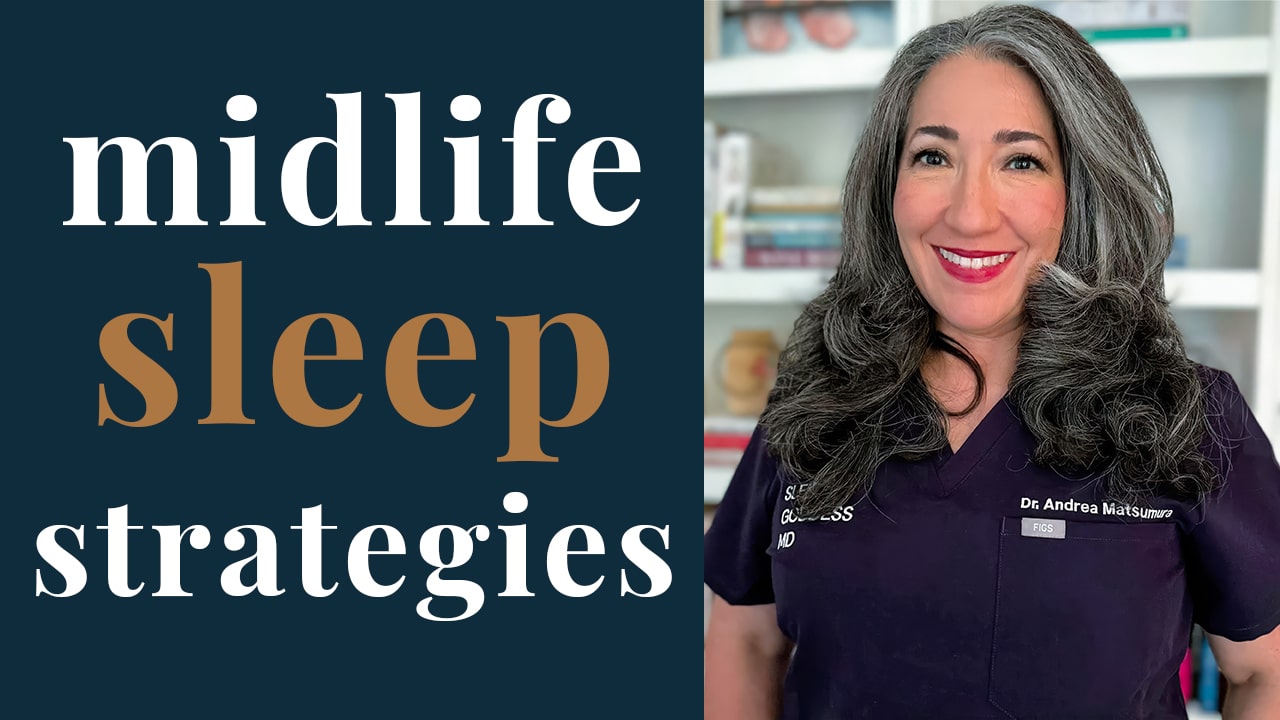
If you’re a woman in your 40s or 50s and your sleep suddenly isn’t what it used to be, you’re definitely not alone. Sleep problems are incredibly common during the menopause transition, and for those of us living with autoimmune disease, figuring out what’s behind them can be especially challenging.
Is it fluctuating hormones? Inflammation, pain, or stress? Or could there be an underlying sleep disorder that hasn’t been recognized?
In Episode 105 of the Autoimmune Wellness Podcast, I’m joined by Dr. Andrea Matsumura, a double board-certified physician in internal medicine and sleep medicine and a certified menopause practitioner, to explore why sleep changes during perimenopause and menopause, how sleep disorders can present differently in women, and what we can do about it.
We also discuss the relationship between autoimmune disease and sleep, the importance of recognizing overlooked sleep disorders, and why poor sleep shouldn’t automatically be dismissed as a normal part of getting older.
.
Watch the Episode
.
How Hormonal Changes Affect Sleep During Perimenopause
Dr. Matsumura explains how fluctuations in estrogen and progesterone can affect our ability to fall asleep, stay asleep, and wake feeling rested. She describes what she calls the “sleep syndrome of menopause,” which includes difficulty falling asleep, middle-of-the-night awakenings, waking earlier than usual, and feeling unrefreshed despite getting enough sleep.
We also explore why waking at 2 or 3 AM is so common during perimenopause, the roles of melatonin and cortisol, and how cognitive behavioral therapy for insomnia (CBT-I) and acceptance-based approaches can help reduce the stress surrounding disrupted sleep.
.
Why Sleep Disorders Are Often Missed in Women
One of the most important parts of our conversation is how sleep apnea can present differently in women. Instead of the loud snoring and obvious daytime sleepiness we typically associate with sleep apnea, women may experience fatigue, fragmented sleep, headaches, or mood changes.
Dr. Matsumura explains why at-home sleep studies can miss milder breathing abnormalities, including upper airway resistance syndrome (UARS), and when an in-lab sleep study may be appropriate.
We also discuss restless leg syndrome and the importance of evaluating iron and ferritin status, particularly for women who experience low iron stores.
.
Untangling Autoimmune Disease, Hormones, and Sleep
For those of us living with autoimmune disease, poor sleep can have multiple contributing factors. Pain, inflammation, fatigue, medications, hormonal changes, and underlying sleep disorders can all overlap, making it difficult to identify what’s actually going on.
Dr. Matsumura shares her D.R.E.A.M. Sleep Method, a framework that considers daily habits, the sleep environment, emotions, circadian rhythms, and medical conditions when evaluating sleep problems.
My biggest takeaway from this conversation is that while sleep changes are common during perimenopause and menopause, we don’t have to accept poor sleep as inevitable. Understanding the possible causes and advocating for appropriate evaluation can help us find a path toward better rest.
.
Prefer to Listen?
.
Resources
- Dr. Andrea Matsumura: Instagram
- D.R.E.A.M. Sleep Method: Dr. Matsumura’s framework for evaluating women’s sleep
- Dream Circles: Upcoming small-group sleep education sessions
- When Women Stop Sleeping: Dr. Matsumura’s forthcoming book (2027)
.
Episode Timeline
00:00 – Sleep, perimenopause, and autoimmune disease
02:09 – Introducing Dr. Andrea Matsumura
03:40 – The “sleep syndrome of menopause”
06:17 – How estrogen and progesterone influence sleep
10:15 – Why women wake at 2 or 3 AM
14:06 – How sleep apnea presents differently in women
19:27 – At-home versus in-lab sleep testing and UARS
22:19 – Restless leg syndrome, iron, and ferritin status
27:01 – Autoimmune disease, perimenopause, and sleep
30:07 – The D.R.E.A.M. Sleep Method and upcoming resources
33:00 – Wrap-up and closing
.
Episode Transcript
Below is the full transcript of Episode 105 of the Autoimmune Wellness Podcast. This transcript is provided for accessibility and reference.
Title: Sleep, Perimenopause & Autoimmune Disease with Dr. Andrea Matsumura (Ep 105)
Mickey Trescott: If you’re a woman in midlife and your sleep suddenly isn’t what it used to be, you’re definitely not alone. Research suggests that somewhere around 40 to 60% of women experience sleep problems during the menopause transition. And when we look at autoimmune disease, we see similarly high rates of poor sleep across conditions like inflammatory bowel disease, lupus, RA, and multiple sclerosis.
So what happens when these two things overlap? If you are living with autoimmune disease and entering perimenopause or menopause like me, waking up at 2:00 or 3:00 in the morning, struggling to fall asleep or feeling exhausted despite spending enough time in bed, it can be so difficult to untangle.
Is it your hormones? Is it some of that autoimmune inflammation, pain, stress, or is there an underlying sleep disorder that you have not recognized yet? And today, we’re going to talk about how to figure that out.
Mickey Trescott: Welcome back to the Autoimmune Wellness Podcast. I’m your host, Mickey Trescott, and before we get started, a quick reminder that this podcast is for educational purposes only, and is definitely not intended to diagnose, treat, or replace individualized medical advice from your healthcare provider.
Autoimmune disease and perimenopause have both been incredibly hot topics in this community lately, and today we’re adding another important piece to that conversation: sleep. We already know that sleep is foundational for those of us living with autoimmune disease, but sleep can change significantly during the menopause transition, and not every sleep problem should automatically be blamed on hormones or autoimmune disease.
There are conditions like insomnia, sleep apnea, and restless leg syndrome that show up differently in women, might be overlooked, especially during this stage of life. So today I wanted to bring in somebody who specializes this intersection of sleep medicine, women’s health, and menopause to help us understand what is actually happening, and most importantly, what we can do about it.
[00:02:09] Introducing Dr. Andrea Matsumura, MD
Mickey Trescott: My guest today is Andrea Matsumura, double board-certified physician in internal medicine and sleep medicine, and a certified menopause practitioner through The Menopause Society. Andrea began her career in primary care, where she practiced for 13 years before pursuing specialized training in sleep medicine at Oregon Health & Science University. She later joined The Oregon Clinic, where she became a partner and built one of the region’s largest consultative sleep services, with a particular focus on women’s health and sleep.
Today, she serves as chief of sleep services for Monarch MD. She’s also the creator of the D.R.E.A.M. Sleep Method and Sleep Goddess archetype frameworks, designed to help women understand the biological, behavioral, and medical factors influencing their sleep.
And beyond her extensive clinical work, Andrea has served on the executive board of the Oregon Medical Association and has been involved in public health and healthcare policy efforts throughout her career. Her expertise in women’s sleep and menopause has been featured in outlets including The New York Times, CNN, and SHAPE.
And I’m especially excited to have her on today because she brings together two areas we’ve been talking about a lot on this podcast: women’s health and midlife, and the importance of sleep, while helping us add that autoimmune lens to the conversation.
So Andrea, welcome to the Autoimmune Wellness Podcast. I’m so excited to have you here.
Andrea Matsumura MD: Oh, thank you for having me.
[00:03:40] The “Sleep Syndrome of Menopause”
Mickey Trescott: Awesome. So, Dr. Matsumura, let’s just jump right in. Why does sleep so often change during perimenopause and menopause? And talk to us about what you call the “sleep syndrome of menopause”.
Andrea Matsumura MD: Yeah. You know, we’ve got these hormones in our body, right? We’ve got estrogen, progesterone, we have testosterone. I include cortisol and melatonin. They all balance each other out. And when we hit perimenopause, the two main players, which are progesterone and estrogen, they start to fluctuate. And when they fluctuate, so too do the other hormones.
And one of the important pieces here is that melatonin is not a supplement. It is labeled as such due to a law that was passed in 1994, but it in fact is a hormone, and that hormone relies on estrogen to some extent. So there’s a significant change, not just in the general population with melatonin production, but especially in women as we hit midlife.
And then you mentioned, the sleep syndrome of menopause. I coined that term because what I was seeing was these four things that commonly were presenting in every single woman who was hitting midlife, and that’s either you suddenly cannot fall asleep. You used to be a great sleeper, and then all of a sudden you have trouble falling asleep.
Or you’re having that dreaded in the middle of the night awakening at 3:00 a.m., and you feel like you’re wide awake and you don’t know what’s going on. Or you are suddenly waking up one to two hours before your alarm or one to two hours before you typically used to wake up, and you don’t know why.
Why all of a sudden am I waking up a little bit earlier than I should? Lastly, you may be sleeping through the night. You may be sleeping the same amount of hours you always have, but you suddenly feel extremely fatigued. You do not feel refreshed. So those are the four areas that I was seeing and still do see consistently, and I named them the sleep syndrome of menopause.
Mickey Trescott: Those four buckets that you talked about highlight, for me personally, the different areas that I started experiencing when I went into perimenopause. So I think you’re definitely onto something with organizing that and conceptualizing for us just kind of the commonalities and the different ways that we can see our sleep change.
[00:06:17] How Estrogen and Progresterone Influence Sleep
Mickey Trescott: So specifically, let’s talk a little bit about the hormones. Will you tell us about estrogen and progesterone, how they influence sleep, and what changes as these two different hormones fluctuate and decline?
Andrea Matsumura MD: Yeah. Estrogen is really the hormone that helps us stay asleep. So it really works intimately in certain structures of the brain that help us stay asleep. It also helps us with oxygenation. It works at the back of the throat and helps with the lung tissue for oxygenation.
Progesterone is really GABAergic. It has a lot of GABAergic properties, which means that it really helps to set the stage for sleep. It allows us to get relaxed, and it also helps us with ventilation. So progesterone helps us understand when we need to do the exchange of oxygen and carbon dioxide. That’s its main component.
When these two start to fluctuate, that’s when you start having that trouble getting to sleep, the trouble staying asleep, and sometimes waking up a little too early. In addition, estrogen plays a role in the modulation of melatonin. Melatonin and cortisol really work in concert with each other.
Melatonin rises as we are getting ready for bed. It is a chronobiotic, meaning that it is setting the stage for sleep. It’s not a sleep inducer, like it is sold over the counter. That is not truly how it works, which is why it doesn’t work for a lot of people. So you’ll have melatonin rising over a four-hour period, three to four-hour period before you actually fall asleep, and that stays elevated, and as it is washing out, your cortisol will start to rise.
Now, because estrogen modulates the production of melatonin, we have some reduced signaling in our production and quality of melatonin as we age. That’s for the general population, though. But for women, because estrogen also plays a role in that production, I feel like we get a double hit. So it’s not only just the natural process of aging, it is also in part because we have this reduction of estrogen, which aids in the production of melatonin.
And we have this really significant dip, and I’m hypothesizing we don’t have any published data around this because, well, that’s a whole ‘nother story around
Mickey Trescott: women.
Andrea Matsumura MD: Around women, right?
Mickey Trescott: Yeah.
Andrea Matsumura MD: But we see that with the reduction in melatonin signaling and cortisol typically starting to rise, if it doesn’t have that kind of canceling out, you know, you’ll have earlier rise in cortisol.
And that’s why I think that we have a lot of these middle of the night awakenings. And then in turn, people just start to feel unrefreshed, even if they’re sleeping through the night, and that is because of how I said previously that estrogen and progesterone really play a role in oxygenation and ventilation and supporting the back of the throat structures.
And we know that in midlife, up to 50, anywhere between 40, the data shows 40, some articles will say 46, mid-40s, to as high as 60% in some articles that are published that women will have obstructive sleep apnea, and 9 out of 10 women do not know that they have it.
Mickey Trescott: Wow. is stunning. And I mean, the risks of having that go untreated, I’m sure we’ll talk about that more but, that is a big problem. Thank you for educating us on that. I really wasn’t aware of the oxygenation and the ventilation effects. On social media everything is really reduced to estrogen does this, progesterone does that. But that is a new one for me, so thank you.
[00:10:15] What is Going On with the 2 and 3 AM Waking in Perimenopause?
Mickey Trescott: Talking a little bit more about that middle of the night waking, I can tell you, all of my friends that are my age, we are all waking up at 2:00 or 3:00 in the morning. And so just kind of that rising and falling. Do you have any other insight about why that is such a common thing happening in perimenopause?
Andrea Matsumura MD: Yeah. So again, it goes back to estrogen. Even if you’re on menopause hormone therapy, and you don’t have to start it… You don’t have to be in menopause to start menopause hormone therapy. I hope everybody does know that. The minute you start having perimenopausal symptoms, you can in fact start hormone therapy, which is typically estrogen and progesterone.
For some people, they only need to be on estrogen, but that’s, that’s also probably another topic. However, you’re not replacing what you’re losing. These are minimal doses to help reduce most symptoms, and knowing how much estrogen to help support someone sleeping through the night, that’s never been quantified.
We don’t know if we could ever get there. We don’t know if we can truly replace what we are losing to help with sustaining sleep. So there’s that piece, that it’s the lack of estrogen that is typically causing that middle of the night awakening. In addition, it’s that early morning cortisol spike, and then it could be that reduction of melatonin signaling, and that really helps to maintain what we call sleep architecture and circadian timing.
It is not a sleep inducer. Melatonin does not cure insomnia. It is all about circadian regulation with melatonin, and all of these items are, are fragile during your perimenopause state.
Mickey Trescott: Okay. Yeah, that makes a lot of sense, and I’m sure, like, when that wake-up happens, I know there’s not a lot of behavioral interventions you could probably do to make it not happen. But I can imagine the wrong thing to do is do anything stimulating, like look at your phone, because of that circadian rhythm, right?
Andrea Matsumura MD: Yes. You want to do something relaxing. The theory is, you know, if we really stick to the cognitive behavioral therapy for insomnia protocol and recommendations, it typically says to get out of bed if you cannot fall back to sleep. I actually combine therapies.
I combine cognitive behavioral therapy for insomnia with what we call A-ACT, which is acceptance and commitment therapy. It helps to decatastrophize the unrest and the really uncomfortable feeling of waking up in the middle of the night, and you are wide awake, and you feel like, “Oh my goodness. I’ve got all this work to do tomorrow, and I am not going to feel refreshed or rested. How long am I going to be awake?”
This is a way to identify that discomfort and meet yourself where you’re at, give yourself some grace, and help to get back to relaxing. So that’s my long-winded way of saying, CBTI is the only one that’s been studied. It is the gold standard. What I find is that for midlife women, using this combination of therapy actually is more successful.
Mickey Trescott: Mm-hmm. I think you’re onto something there too, because there is just so much stress and anxiety that comes up, and I think, getting to the root of that and trying to teach yourself that that’s okay, I’m sure is a really meaningful intervention. When, you know, we’re in the peak of our lives where most of us, like, we’ve got, like, our careers and kids and there’s a lot happening, and it just seems like the, the worst time.
Andrea Matsumura MD: Yeah.
Mickey Trescott: Through something like that.
[00:14:06] Sleep Apnea Presents Differently in Women
Mickey Trescott: So let’s talk a little bit about sleep apnea. You mentioned changes in ventilation, in oxygenation, and the risks are really extreme for untreated sleep apnea. Talk to us about how sleep apnea presents differently in women, why it’s often missed, and how people listening might distinguish it from other sleep issues.
Andrea Matsumura MD: Yes. So sleep apnea, if you were to look it up online, you’re going to see all of the symptoms that are truly for men. So the loud snoring, the witnessed apneas, waking up sleepy. We know that women do not typically wake up sleepy, meaning you just can’t keep your eyes open. You wake up feeling fatigued.
You still get through all the things you need to get through during the day, but you just feel like you’re dragging. Women– I love it, women never say that they snore loudly. If a woman snores loudly, that is high pretest probability that you may have sleep apnea. Most women say that they purr. I love that.
They love to say that they purr in their sleep. They do not have loud snoring. Women present, and I love, love to say this for clarification, we’re not presenting atypically. We are presenting typically for a mid-life woman. We just haven’t been studied enough to have published data saying, “This is women-specific symptomatology for obstructive sleep apnea.”
And that’s fragmented sleep. That can be some snoring, but not always. It can be waking up with headaches. It can be feeling more depressed. And I often will have women tell me, “I don’t know if I’m depressed because I’m sleepy, or I’m sleepy because I’m depressed. I don’t know which one is causing the issues.”
And then you, of course, will have a lot of daytime fatigue. Those are the main symptoms for obstructive sleep apnea. By definition, what is obstructive sleep apnea? Obstructive sleep apnea is a breathing abnormality in your sleep. That means that you’re not maintaining your oxygen levels, or you’re having a lot of the middle of the night awakenings.
And I say this because there is a condition that’s somewhere kind of in between not having sleep apnea and having sleep apnea, which is you have a reduction in oxygen saturations, and that’s called upper airway resistance syndrome. And that is when you have a small dip in your oxygen level, or maybe no dip, but we see a change in your oxygen curve a little bit, and you have an arousal. And we know that everybody has arousals every hour of every sleep, but too many fragment your sleep and leave you feeling really fatigued.
And what we don’t have data on is does fragmented sleep, does this unrefreshing sleep pose a significant risk for heart attacks, for strokes, for memory loss, and dementia? What we don’t have is enough data that says, without a doubt, we should be treating women who have upper airway resistance syndrome, or even data that says, without a doubt, women have different endotypes of sleep apnea, meaning they have different physiological mechanisms that may pose the same risk.
Maybe men who have severe sleep apnea have this high risk of heart attack and stroke, but maybe a woman who has mild sleep apnea has the same risk, but the number doesn’t really mean anything. We don’t know.
Mickey Trescott: Hmm. Mm-hmm.
Andrea Matsumura MD: What, what I think we need to focus on are the symptoms, that are being presented. I feel really tired. I feel extremely fatigued, and we really need to be treating symptoms and reducing those symptoms rather than hanging our hats on a number, especially for women. Because it’s also just one night. Like, we’re doing a one to three n-night testing, and we really need to be looking at patterns, which is where wearables actually play a role because they help you identify patterns. They are not diagnostic tools, not yet, but they do help identify a pattern.
Mickey Trescott: Mm-hmm. Mm-hmm. Yeah, actually to that point, so I have been wearing an Oura Ring since 2017 when I was 33, and I actually went back and I looked at all my data through my 30s. My sleep efficiency, which for everybody listening, is the time you spend in bed relative to the amount of time that you’re actually asleep, every single year it just predictibly declined, declined, declined, declined, declined until last year when I started seeing a menopause society-trained doctor.
I started some progesterone, and now my sleep efficiency is back when I was 33 years old, and I would never have known that if it had not been for the Oura Ring. Now, of course, that was hormones. That wasn’t sleep apnea.
[00:19:27] In-Home Testing vs. Lab Testing for Sleep Apnea and UARS
Mickey Trescott: My next question is for anybody who is listening and thinking, “Maybe I should get tested,” can you walk us through… you know, there’s an at-home test. There’s like a lab sleep study. How
Andrea Matsumura MD: Mm-hmm.
Mickey Trescott: start to explore that? And is even, like, an at-home test good enough to untangle, like, that upper airway resistance syndrome, which sounds a little more subtle?
Andrea Matsumura MD: Yeah. So, most insurance companies, if you’re going to work through your insurance company, are only going to approve a home sleep study as the first pass unless you have specific medical conditions that warrant an in the sleep center sleep study, and there’s specific criteria. So you’re going to get a home sleep study.
Now, if you have enough symptoms and your sleep study, home sleep study is negative, my recommendation is that you really need to do an in the sleep center sleep study because that’s going to be much more sensitive and specific around subtle breathing abnormalities. A home sleep study does not capture upper airway resistance syndrome.
If you actually look at the definition of a, what we call a type three home sleep study, it is truly recommended for someone who has a high to moderate pretest probability of having moderate to severe sleep apnea. Now, most women don’t have moderate or severe obstructive sleep apnea.
They have mild to moderate obstructive sleep apnea. So many women who will have a home sleep apnea test performed will then have a negative home sleep apnea test but still have significant symptoms and may in fact have mild obstructive sleep apnea that did not get captured on a home sleep apnea test.
Mickey Trescott: Mm, so that self-advocacy is really important, yeah.
Andrea Matsumura MD: Absolutely, because remember, all of these protocols are male-focused. They are not women-focused medical protocols, we need to change that because that is, in my mind, a whole set of criteria. I feel like sleep medicine is where cardiology was 20 years ago in understanding and identifying the specific needs for women and understanding that there are different disease processes for women in midlife, especially in midlife around cardiac health.
Mickey Trescott: Mm-hmm. Well, we’re so grateful to you for leading the way in this, and hopefully everyone listening, if some light bulbs are going off for you, get tested, keep advocating for yourself.
And, you know, everybody listening here is no stranger to that because autoimmune disease takes an average of five years and six doctors to get diagnosed. So if there’s one thing we’re good at, it’s demanding the best care that we can get from our providers because we have to. We’ve been through this before.
[00:22:19] Restless Leg Syndrome, Iron, and Ferritin Status and How They Impact Sleep
Mickey Trescott: So pivoting a little bit, let’s talk a little bit about restless leg syndrome. This is connected with iron status. This is a key issue in our community. I’m a low ferritin girlie. You know, I’ve got two autoimmune conditions that come with that symptom. And I know this really can affect sleep. What do we need to know about iron status and restless leg syndrome?
Andrea Matsumura MD: Yeah. TIBC, and your transferrin and your ferritin levels. So these are the markers that most clinicians need to be looking at. Ferritin is an acute phase reactant, so if you’re feeling like you have restless leg syndrome, and by definition, restless leg syndrome is a conscious phenomenon.
That means that you are awake when you’re having this symptom, and it’s this feeling of uncomfortableness or unrest. It’s not pain necessarily, but it feels like the classic descriptor is creepy crawlies in any limb, really. And you feel like it’s building. You move that limb, it dissipates, and then it builds right back up, and it is preventing you from getting to sleep. This can happen for people when they’re watching a movie, on a long car ride, in an airplane, or when they’re relaxing in the evening and trying to get to sleep.
Now, the data that has just come out that I’m really excited about are these new levels for ferritin, right? And for a person who has restless leg syndrome, that ferritin level should be at least above 75, if not 100. And in the past, you know, we were telling women who had a ferritin level of, like, 17, 15, “Well, you know, it’s on the lower end of normal, but it’s normal.”
And in fact, now we know that that is probably really too low and there’s a depletion of iron stores that is significantly affecting your ability to potentially get to sleep, and also your fatigue. We also underutilize iron infusion. That’s a whole ‘nother story because if you have really low iron stores, if your ferritin is, like, 20, we should be thinking about iron infusion. Unfortunately, it’s cost-prohibitive, so insurance companies charge a lot. Infusion centers, because of the cost of the infusion itself, it can be cost-prohibitive, so then you’re forced to have to figure out, okay, how can I regain my iron load status using an oral therapy, and how often should I take it?
I recommend that people take it every other day, not every single day. And then you have to be careful about, am I somebody who can absorb iron? What should I do to help improve my iron absorption? There’s so many factors involved, and we underdiagnose it. I can’t tell you how many parties I’ve been to, and this comes up in conversation, and nearly every single, every single social event I’ve been to, there will be one woman who says, “I think I have that, and I didn’t even realize I have it, but I have restless leg syndrome.”
Mickey Trescott: Yeah. And, and the reference ranges, thank you for sharing that 70 is kind of the new guideline because, in the autoimmune community we’re pretty up to speed on, like, 20 and 30 is, like, not going to cut it. And I mean, I suffer from hair loss too, and I found that as long as I get my level over 50, I’m not suffering hair loss.
But it is really hard to be dismissed when a woman goes in and they have their ferritin checked, and it comes back in that 20, 30 range, and they’re told that they’re fine, they’re okay. And the amount of work that it takes both from nutritional supplementation or diet to get your ferritin, I mean, for me, getting from 30 to, like, 80 took, like, nine months of dedicated work because without an infusion, it’s just hard to do. So,
Andrea Matsumura MD: It, it is
Mickey Trescott: thank you for sharing that ’cause I think, it’ll inspire a lot of women who have these symptoms to work on your ferritin, and your iron levels because, that, that creepy crawling gotta move feeling, I had that most of my life until I figured out that that’s what it was.
Andrea Matsumura MD: My goodness. And then in midlife, you also have a blip in the prevalence of restless leg syndrome because estrogen does play a role in the hydroxylation of iron. And so then it’s even harder to
Mickey Trescott: Hmm.
Andrea Matsumura MD: have higher iron stores in midlife.
Mickey Trescott: Hmm. Okay. Okay. Gotta get it checked and stay on top of it, ladies.
[00:27:01] Autoimmune Disease, Perimenopause, and Sleep
Mickey Trescott: So let’s talk about the autoimmune side of this. You know, I know that there’s probably not a lot of research specifically on midlife women with autoimmune disease and sleep because we just don’t study women specifically for anything.
Andrea Matsumura MD: Yeah.
Mickey Trescott: But is there any advice that you have for anybody who is navigating kind of this journey and untangling the hormonal part, the pain, maybe medications, and other potential causes of poor sleep?
Kind of where would you start in an evaluation?
Andrea Matsumura MD: I use a method that I also developed called the D.R.E.A.M. sleep method. And that really focuses on the D, which is daily habits, so all of the things that you’re doing during the day that could be contributing to lack of sleep. Resting environment, what does your resting environment look like? Is it optimized?
You mentioned pain. Is your mattress okay? Do you need a different pillow? Too much noise, too much light, not cool enough. Then E is emotions. We know that women are more susceptible to mood disorders for a variety of reasons and we tend to lose some of that protectiveness with estrogen and progesterone during midlife, and we have a rise in our depression and anxiety.
A is archetype, which is your circadian rhythm. Are you an early bird? Are you a night owl? Are you somewhere in between? Are you able to follow your circadian rhythm, or are you somebody who has to wake up earlier than when you want to because of work or home/life responsibilities?
Or do you have a job that is swing shift and you have to work late nights, and you are somebody who would rather go to bed earlier, right? And then the last piece is M or medical conditions. We’ve touched on obstructive sleep apnea, restless leg syndrome, very briefly have touched on insomnia, those middle-of-the-night awakenings and not being able to get to sleep or stay asleep.
But also, there’s a whole host of other medical conditions. We know that heart disease can play a role in insomnia or unrefreshing sleep and increased risk of obstructive sleep apnea. We also know that when people have autoimmune disorders, they’re much more at risk for chronic fatigue and also may need a different type of intervention.
We also know that pain can be involved, and you want to make sure that you’re doing all that you can to control the pain level in sleep so that you can actually stay asleep and not wake up from pain.
Mickey Trescott: Mm-hmm. Yeah, that’s a, a big piece for our community. I have psoriatic arthritis also, and when I’m having a flare, that pain really can inhibit your ability to get a good, nice, deep night of sleep. So, that sounds like a really comprehensive approach. Do you have a, a book coming out or anything,
Andrea Matsumura MD: Yeah .
Mickey Trescott: a resource where people can find this?
[00:30:07] Upcoming Sleep Resources for Patients and Practitioners
Mickey Trescott: ‘Cause I think what you just described sounds, like, so helpful, and I know people are going to be like, “How do I find out more about this method?”
Andrea Matsumura MD: Yeah. I have a website that, really describes the entire method. It also has a number of blog posts on there just like one-page information sheets about all the different types of things that can affect a woman’s sleep. I am going to be launching a small group educational offering called Dream Circles, and it is really, a two-hour session for anywhere between six to eight women.
We will do a presentation and then a Q&A, and that’s going to be two hours. That’ll be an offering on my website. In addition, I have a book coming out called “When Women Stop Sleeping.” That’s going to be through Macmillan Publishing. Their imprint is Flatiron Books, and it’s really going to take women from menstruation to menopause and all of the different conditions that can affect a a woman’s sleep and life changes that can affect a woman’s sleep.
Lastly, I have a course for practitioners that will be released in March, April of 2027, and that is really a nod to all the practitioners out there who probably, once this book is in women’s hands, which is not going to be released until the end of 2027 or January 2028, but I just can hear all my colleagues saying, “Who is this, medical person that told my patient to download this resource and read this book and come to me with, like, this list of sleep issues?”
So as a nod to that, I am developing and in the midst of writing this entire course for, practitioners. So it’s really anybody who is a healthcare practitioner that is serving women in midlife, or women in general because I am going to be talking about conditions that affect women and sleep when they’re menstruating as well as when they’re not menstruating.
That’s going to have 19 continuing education credits with it, so that way practitioners can actually use their educational dollars.
Mickey Trescott: Yeah, yeah. Well, we have a lot to look forward to, and I feel honored to have had you on the podcast and sharing with us kind of in the midst of planning and building out all of that because I know that this area is something that women need so desperately. We need really quality, precise advice in this area because if we’re not sleeping, we’re not getting anything done, right? So thank you.
Andrea Matsumura MD: Yeah.
Mickey Trescott: for us
Andrea Matsumura MD: Yeah
Mickey Trescott: And for chatting with us about that today.
[00:33:00] Wrap-Up and Closing
Mickey Trescott: I think this has been a really helpful conversation and one of my big takeaways is that while these changes are so common during perimenopause and menopause, it just doesn’t mean that we need to accept poor sleep as a normal part of getting older or having an autoimmune disease.
So if you’re somebody that’s listening and you’ve been having some of the issues that we talked about today, and maybe you also have some fatigue, some hormonal changes, I think it’s really important for you to dig in, try to understand these changes. Be curious, as I always say, instead of being alarmed.
This is kind of a new phase of your changing body, and you get to figure out the inputs and different things that help you feel your best. And so Dr. Andrea, really appreciate you. Will you let everybody know, I know you mentioned kind of your upcoming programs, but like where can we follow you online?
Andrea Matsumura MD: Oh, yeah.
Mickey Trescott: you know, I know you’re wonderful on Instagram, so
Andrea Matsumura MD: Yeah,
Mickey Trescott: But
Andrea Matsumura MD: Yeah, so it’s Dr. Andrea Matsumura, that’s my Instagram handle. And, you said something really important. I would love everybody to follow me because I try to give daily tips, focus on articles, just in the news, women and sleep.
But really, what you said, which is, we don’t have to live with this, and that’s really my mission in, in all of this work, is I want us to stop the normalization of the suffering of women because we are told all of the time that this is just the norm.
We’re supposed to live this way, and we don’t have to live this way, and I have never had a case that I couldn’t solve with a woman and her sleep. We can always get you to a better place.
Mickey Trescott: I love that encouragement and hope because when you’re in the middle of it, you think nothing is going to help. I love that perspective, and I know as a clinician you have so much experience, so it really means a lot.
So we’re going to link to everything in the show notes, and Andrea, thank you so much for joining me today and sharing your experience with this community. To everybody listening, I hope this conversation has given you a better understanding, about some ideas of where to start.
Let’s get our sleep and live our most vibrant lives so we can get on to doing the things we love and living our life in the way that we want. Thank you so much for listening, and we’ll see you next time on the Autoimmune Wellness Podcast.
.












0 comments